Frida Kahlo
Frida Kahlo converted catastrophic physical suffering into one of the most psychologically legible bodies of work in art history, not because pain is romantic, but because she had no other material available and was too honest to pretend otherwise.
Pain as creative currency
Childhood polio, then the bus accident at 18 that shattered her spine and her planned medical career, the body became her subject because it was the only subject she could not escape
Converting suffering into visual language; using the self-portrait as psychological cartography before the vocabulary existed
Intense, destructive attachment to Diego Rivera, love that required drama to feel real; she needed the wound as much as the man
Identity construction through costuming and appearance, the Tehuana dress, the unibrow kept, the flowers in the hair, as deliberate political and psychological armor
The Accident That Made Her
On September 17, 1925, an eighteen-year-old Frida Kahlo boarded a bus in Mexico City. A streetcar hit it. A steel handrail sheared through her pelvis and exited her body. She fractured her spinal column in three places, her collarbone, her right leg in eleven places, her right foot. Her left shoulder was dislocated. She was impaled.
She survived. She then spent the next twenty-nine years surviving the survival.
Before the accident, Kahlo had been enrolled at the National Preparatory School, one of thirty-five girls among two thousand students, and had planned to study medicine. The accident ended that trajectory, not immediately, but definitively. The thirty-five operations, the months in plaster, the years of recurring pain and medical intervention that followed consumed the medical career before it could begin. What replaced it was not a plan. It was a response to constraint. Her mother had a mirror mounted above her bed during recovery so she could see herself. She began to paint.
This is not metaphor. It is the literal origin. She painted herself because she was alone and she was looking at herself and there was nothing else to look at. From that condition emerged one of the most significant bodies of self-portraiture in the history of Western art.
The Body as Canvas
Kahlo painted herself fifty-five times in a career that produced roughly two hundred works. This number is often cited as evidence of narcissism by people who have not thought carefully about what narcissism requires, namely, a self-concept stable enough to be admired. Kahlo's relationship to her own image was not stable. It was investigative.
What Kahlo was doing in those self-portraits was not admiring herself. She was trying to find out what had happened to her, and to determine whether what remained was still a self at all.
The body in her paintings is not idealized. It is a site of event: broken columns for spines, medical nails driven into a nude torso, hearts extracted and displayed, roots growing through flesh, a deer with arrows in its back wearing Kahlo's face. These are not symbols chosen from a library. They are reports from an interior. She was painting the phenomenology of chronic pain and medical violence before medicine had developed a language adequate to that experience.
The self-portrait, in her hands, became what therapy would later call somatic processing, the attempt to take an overwhelming physical and psychological reality and render it into something that could be looked at, held at a slight distance, understood. The paintings are not about suffering. They are a technique for surviving it.
Diego: Love as Destruction
Diego Rivera was twenty-one years older than Kahlo, twice divorced, unfaithful in all his relationships as a matter of course, and one of the most celebrated muralists in the world when they married in 1929. They divorced in 1939. They remarried in 1940. He continued affairs throughout; she conducted her own, with men and women. He had an affair with her younger sister Cristina. She called the bus accident and Diego the two great accidents of her life.
The psychology of this attachment is not a mystery, though it is often described as one. Kahlo was a woman whose body had betrayed her catastrophically at eighteen, who had been rendered dependent and immobile, who had survived through a combination of extraordinary will and the experience of profound helplessness. Rivera was chaotic, unreliable, alternately adoring and negligent, in other words, he reproduced the precise emotional conditions her nervous system had been trained to navigate.
Love that arrives reliably and gently does not feel like love to a person whose nervous system was formed under conditions of intermittent reinforcement. Rivera's inconstancy was not the price she paid for the relationship. It was, at some level she could not fully articulate, the texture she required. The wound sustained from him was legible. It was familiar. It could be painted.
She painted him with great tenderness and great rage. The 1940 self-portrait with cropped hair, made immediately after their divorce, shows her in a man's suit, his suit, scissors in hand, hair cut and scattered. It is one of the most psychologically precise images of the post-rupture state ever made, the performance of severance that is also, in the wearing of his clothes, a form of keeping him.
Identity as Construction
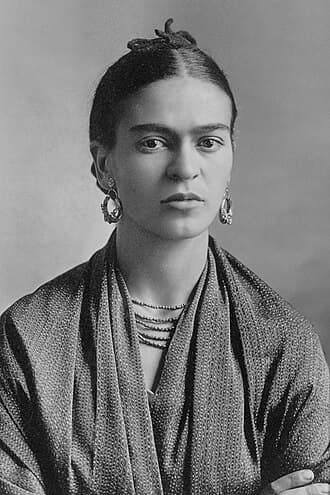
Kahlo's visual identity, the elaborate Tehuana dress, the Indigenous Oaxacan jewelry, the flowers braided into her hair, the unibrow she kept and sometimes extended, is often discussed as self-expression. It was that, but it was also a more deliberate project.
The Tehuana costume was the traditional dress of the women of the Tehuantepec Isthmus, a matriarchal culture in the south of Mexico. Kahlo adopted it for reasons that were simultaneously political, romantic, and strategic. Politically, it was an assertion of Mexican Indigenous identity against European aesthetic hegemony, she wore it to exhibitions in New York and Paris as a provocation. Romantically, Rivera loved it. Strategically, it functioned as armor: the elaborate headpieces and heavy skirts concealed her damaged leg, the polio-withered limb she had hidden since childhood.
“I tried to drown my sorrows, but the bastards learned how to swim.”
Frida Kahlo
The unibrow, the faint mustache she did not remove, the flowers in the architecture of hair, these too were a statement. In a culture that pressured women toward a European standard of beauty, she refused the standard. But refusal is also a position, a place to stand. The construction of the Kahlo persona was psychologically protective: it gave a woman whose body was under constant assault a surface she could control, a self she could design, an image she could author when so much else was being authored by pain and surgery and Diego.
What She Was Actually Painting
Kahlo is often received as a painter of suffering, which is accurate but incomplete in a way that matters. The suffering in the paintings is not the subject. It is the medium through which the subject, survival, continuity of self, the persistence of identity under assault, is explored.
The distinction is not academic. A painter of suffering would produce work that wallows, that offers the viewer pathos, that positions the subject as victim. Kahlo's paintings do not position her as a victim. They position her as an investigator. The body is examined. The wound is catalogued. The grief is made precise. But the gaze, her gaze, consistent across fifty-five self-portraits, is steady. Not defiant, not anguished. Looking.
She died in 1954, at forty-seven, the cause officially listed as pulmonary embolism. Her last diary entry read: I hope the exit is joyful, and I hope never to return. It is the statement of someone who had been exhausted by the work of staying, not of someone who had given up. There is a difference. She had been doing the work of staying for three decades. She had made it visible in a way no one had quite managed before or has quite replicated since.
The paintings are not a record of what happened to her body. They are evidence that a self persisted through what happened to it, which is, ultimately, the only thing a self-portrait can be evidence of.
References
- Herrera, Hayden. Frida: A Biography of Frida Kahlo. Harper & Row, 1983. - Kahlo, Frida. The Diary of Frida Kahlo: An Intimate Self-Portrait. Abrams, 1995. - Kettenmann, Andrea. Frida Kahlo: Pain and Passion. Taschen, 1992. - Tibol, Raquel. Frida Kahlo: An Open Life. University of New Mexico Press, 1993. - Grimberg, Salomon. Frida Kahlo: Song of Herself. Merrell, 2008.
---
Interpretive opinion based on the public record. Not a clinical assessment or diagnosis of any individual.