Vladimir Putin
A man trained by an institution that pathologizes trust came to govern a nation of 144 million by the same principles, and the resulting foreign policy looks a great deal less like geopolitics and a great deal more like a personality made exterior.
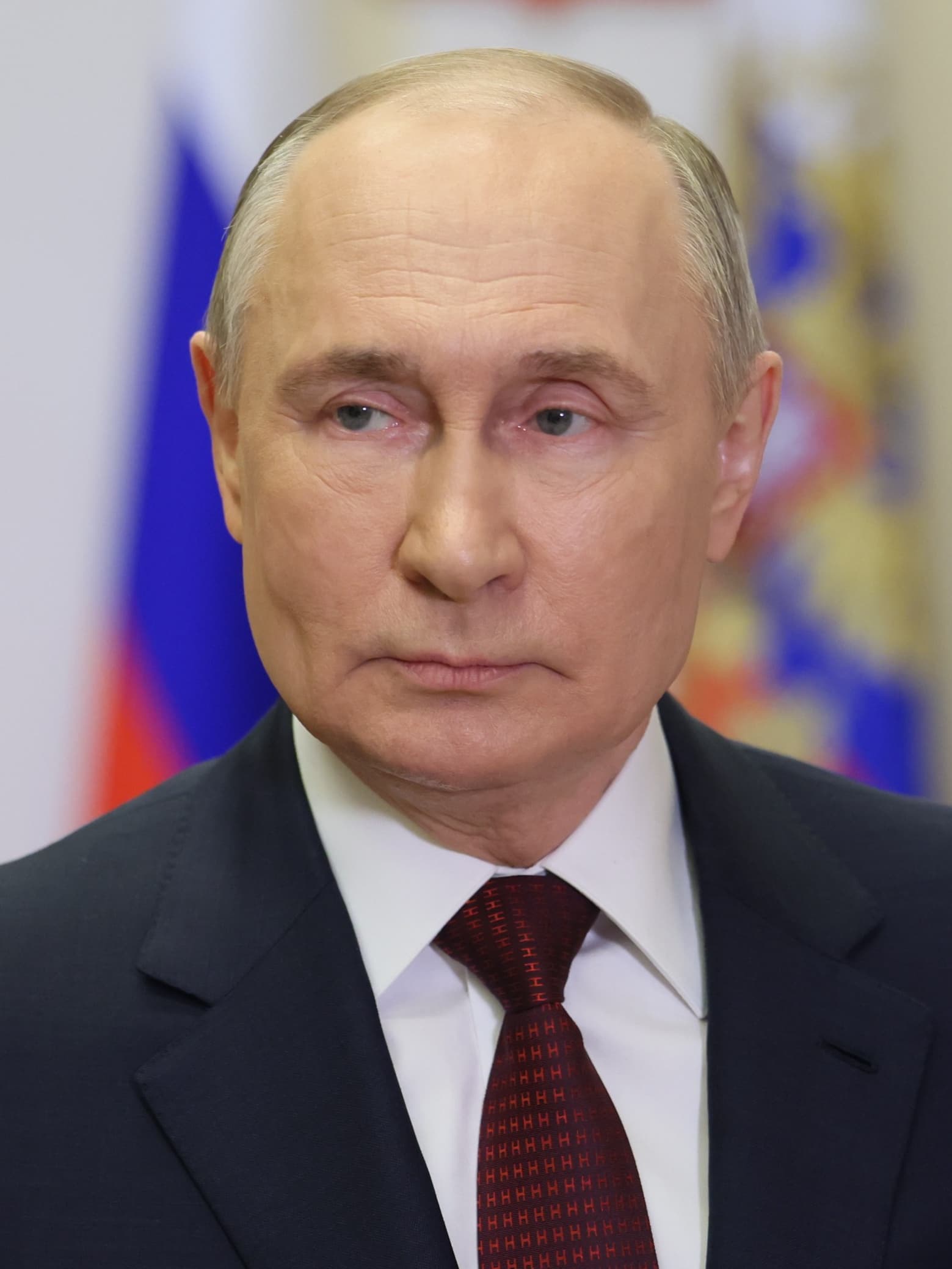
Control as the only viable response to chaos
Soviet-era Leningrad childhood in poverty; KGB training that systematically replaced trust with surveillance; the collapse of the USSR as a civilizational humiliation he experienced personally
Hypervigilance as leadership style, the long tables, the delayed meetings, the information asymmetry maintained as a matter of psychological control
Transactional; loyalty demanded but never reciprocated; connection experienced as vulnerability to be managed rather than sought
The mask worn so long it became the face, the opacity that reads as strength in Russian political culture and as pathology in Western psychoanalytic terms
What the KGB Does to a Person
Intelligence agencies are, at their core, institutions organized around the premise that no one can be trusted. The entire architecture of tradecraft, the dead drops, the cover stories, the compartmentalization of information, the systematic cultivation of informants within every social circle, is built on the operational assumption that trust is a vector for compromise. You do not trust your colleagues. You do not trust your assets. You do not trust your superiors. You verify. You surveil. You maintain information asymmetry as a matter of professional survival.
Vladimir Putin entered the KGB in 1975 at twenty-two. He spent sixteen years in that institution, culminating in work in East Germany, where he was stationed in Dresden during the final dissolution of the Eastern Bloc. The psychology required to function in that environment is not a professional mode that can be switched off at the end of a workday. It is a restructuring of the nervous system's baseline assumptions about other people. After enough years, the question is not "can I trust this person?" The question is "what do they want from me, and how do I maintain the upper hand?"
This is the psychological substrate on which the Putin government was built. It is not metaphor. It is the literal experiential formation of the man who would run Russia for more than two decades.
The Leningrad Foundation
Putin was born in 1952 in Leningrad, the city that had survived the Nazi siege a decade earlier at the cost of roughly a million lives. The siege was living memory in his neighborhood, in his building, in the vocabulary his parents used. His father had fought. Two of his uncles had died. The family lived in a communal apartment, a kommunalka, with rats in the stairwells.
The formative environment was not one of abundance or safety. It was one in which survival was recent, precarious, and had required extraordinary collective violence to achieve. The lesson available in that context is not that the world is generous. It is that the world is dangerous and that only the strong, individually, nationally, survive it.
Putin has described his childhood neighborhood as one in which he learned to fight, because the alternative to fighting was being beaten. He studied judo and sambo. He was not large; he compensated through precision and relentlessness. This is a psychological template he carried into every subsequent arena: the response to structural disadvantage is not accommodation but the application of whatever leverage is available, without hesitation.
The Soviet promise, that the collective project of communism would produce security, dignity, superpower status, was the ideological container that made the deprivation legible. It meant something. The suffering had a framework.
The Humiliation of 1991
In December 1991, the Soviet Union ceased to exist. Putin, then working for the St. Petersburg city administration after his KGB career, has described watching the red flag lowered over the Kremlin as one of the most devastating experiences of his life. He called the collapse of the USSR "the greatest geopolitical catastrophe of the twentieth century."
This assessment is widely mocked in Western commentary. It should not be. To mock it is to miss its diagnostic value.
For Putin, the dissolution of the Soviet Union was not a political event happening to a country. It was a personal humiliation happening to an identity. He had joined the KGB because he wanted to serve the Soviet state. He had organized his self-concept around the institution and the nation it embodied. When that structure collapsed, it was not simply that the government changed. The meaning system that made his choices intelligible collapsed with it.
The subsequent decades of his political career read most coherently not as geopolitical strategy but as a project of restoration, the attempt to reconstitute, by will and force, the conditions that would make that humiliation retroactively bearable. The annexation of Crimea, the invasion of Ukraine, the rhetorical insistence on Russia's great-power status: these are not separable from the man who watched the red flag come down in 1991 and concluded that what followed required undoing.
“The demise of the Soviet Union was the greatest geopolitical catastrophe of the century.”
Vladimir Putin, annual address to the Federal Assembly, 2005
Power as Psychology
The long tables are not an accident.
When Putin meets foreign leaders, the tables at which they sit are famously, comically long, twenty feet, forty feet of polished wood between the heads of state. This is described in the Western press as a COVID precaution, as eccentricity, as theater. It is theater, but it is purposeful theater. Imposing physical distance on an interlocutor is a dominance display, a way of making the other person experience, bodily, that they are on Putin's terrain and by Putin's terms.
The same logic governs the choreographed delays: foreign dignitaries who waited hours for scheduled meetings; the information withheld from his own generals; the systematic isolation of advisors who might offer unwelcome assessments. These are not management failures. They are applications of a specific psychological principle: the person who controls information controls the interaction, and the person who controls the interaction controls the relationship.
The KGB trained him to manage human assets through a combination of leverage and information asymmetry. He has been applying that training to the governance of a nuclear state for more than twenty years. The foreign policy is not separable from the psychology. It is the psychology, scaled.
What He Cannot Do
The liability of hypervigilance as a governing principle is structural. It functions as a closed system.
A leader who cannot trust advisors does not receive accurate intelligence. He receives what he has trained his apparatus to produce: information filtered through the question of what he wants to hear, what is safe to say, what will not be punished. Putin's reported misjudgment of Ukrainian resistance in 2022 is consistent with this dynamic. A man who has spent decades in an information environment he has systematically distorted cannot accurately read external reality. He has optimized his system for control, and control requires eliminating the feedback that would allow correction.
There is also the exit problem. The KGB training produced a man who experiences trust as vulnerability. A man who cannot trust cannot cede power, because ceding power requires trusting successors. A man who cannot cede power cannot retire. The system that keeps him in control also traps him in it. The inability to be surprised, to receive bad news, to adapt, these are not quirks of style. They are the predictable consequences of a psychology organized around the permanent management of threat.
The result is a leader who is very difficult to deter and very difficult to negotiate with in good faith, not because he is uniquely evil, but because his psychology does not contain the architecture that negotiation and deterrence require. He does not believe in the reliability of agreements. He believes in leverage. He was trained to believe this. The institution did its work.
References
- Rahr, Alexander. Vladimir Putin: The "German" in the Kremlin. Universum Verlag, 2000. - Gessen, Masha. The Man Without a Face: The Unlikely Rise of Vladimir Putin. Riverhead Books, 2012. - Myers, Steven Lee. The New Tsar: The Rise and Reign of Vladimir Putin. Alfred A. Knopf, 2015. - Hill, Fiona and Clifford G. Gaddy. Mr. Putin: Operative in the Kremlin. Brookings Institution Press, 2013. - Soldatov, Andrei and Irina Borogan. The New Nobility: The Restoration of Russia's Security State and the Enduring Legacy of the KGB. PublicAffairs, 2010.
---
Interpretive opinion based on the public record. Not a clinical assessment or diagnosis of any individual.