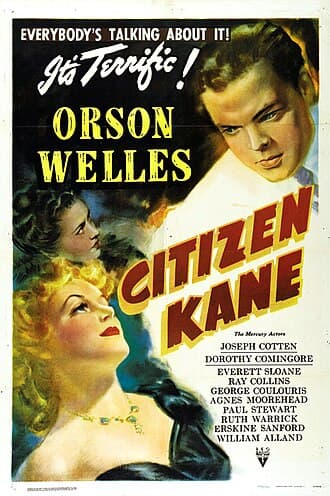
Citizen Kane
Rosebud is not a sentimental detail. It is the film's central argument: that the entire architecture of Charles Foster Kane's life, every acquisition, every betrayal, every newspaper and opera house and castle, was organized around the recovery of something lost in childhood. The external accumulation is real. The internal recovery it was meant to produce never arrived. That gap is what the film is about.
Acquisition as the misidentified cure , the wound requires presence and love, and the response to the wound is power and accumulation, which cannot deliver what the wound requires
Premature severance from maternal connection and the ordinary warmth of childhood , Kane is removed from his mother at the point of his formation and never recovers the interior conditions that removal ended
Love through possession , Kane cannot receive love in its actual form, so he attempts to manufacture its conditions through control, acquisition, and the construction of environments that mirror his wishes rather than those of the people in them
Relationships as projects , Kane enters every significant relationship as a person who intends to shape the other person toward his own image of what they should be, which produces relationships that are controlled rather than mutual
The reporter as structural absence , the film's investigative frame produces a portrait assembled from other people's perceptions, none of which find the thing the investigation is actually looking for
The Film's Opening Move
Citizen Kane opens with a death and a word. Charles Foster Kane, alone in his castle Xanadu, drops a snow globe and whispers "Rosebud" as he dies. The film then runs backward from that ending, through the testimony of the people who knew him, trying to understand what the word meant and what the man behind it was.
The structural genius of Orson Welles and co-writer Herman J. Mankiewicz is that the investigative frame of the film is designed to fail. The reporter Thompson never finds what Rosebud means. The audience finds out, in the film's final shot, because they have access to information Thompson does not. But even the audience's discovery does not resolve the film's central problem, because the resolution the film offers is specifically the resolution that Kane himself never reached. He died not knowing where Rosebud was. He died not having recovered what it represented. Xanadu, for all its scale, was not a home. It was a monument to the impossibility of returning.
The Wound at the Beginning
The scene that explains everything in Citizen Kane is not the election loss or the singing career of Susan Alexander or the final revelation of the sled. It is the scene in Colorado, in which Mary Kane signs the papers giving custody of her son to the banker Thatcher, and young Charles is playing outside in the snow, unaware. He does not know what is happening inside the house. He is small and warm in his coat, alone in the white field, pushing a sled.
What happens next is the film's first and most important event: a child who is happy in the ordinary way of children, who has no reason to feel unsafe, is removed from his mother and from the life he knows and given to a cold and formal guardian who will provide money and education and nothing of the warmth that the snow outside represents. The child does not understand why this is happening. The mother does it because she believes it will be better for him, which may be true in material terms and is catastrophically false in terms of what the child actually needed.
The sled is Rosebud. The sled is the object that was in his hands in the moment before everything changed. It is not a sentimental artifact of happy childhood in the generic sense. It is the specific object from the specific moment of rupture: what he was touching when the world that contained him was taken away.
What Kane Was Trying to Recover
Every subsequent action of Kane's life can be understood as an attempt to recreate the interior conditions of that Colorado childhood, or to compensate for its loss, or to punish the world for having taken it. The attempts are not conscious. Kane does not know he is trying to recover Rosebud. He experiences himself as a man who wants things, and he acts on what he wants with the enormous resources at his disposal.
The newspapers are the first form: Kane takes a flagging paper and turns it into a powerful one, and he does it by making the paper a vehicle for his own voice. The paper is large and noisy and reaches millions of people. It mirrors what Kane wants the world to know and feel. It is the opposite of the boy in the snow, who was small and unheard and removed. What Kane is building is a mechanism for being heard at scale, because the original experience of having his voice matter, in the home with his mother, was taken from him before it could become stable.
The first marriage to Emily Norton is a union between Kane's appetite and a woman who has her own interior life and her own requirements. The film compresses their deterioration into one of cinema's most precise sequences: the breakfast table at successive points in their marriage, the physical and emotional distance increasing with each cut, until they are reading different newspapers in silence across a table that has become the full width of the marriage's failure. Emily is not the wound. She is the person who could not be made into the solution to the wound, because no person can be made into that solution.
Susan Alexander and the Specific Shape of Control
Susan Alexander is the film's most painful study in what love becomes when it is organized around the lover's needs rather than the beloved's. Kane meets Susan when she has a toothache and a modest singing voice and no interest in being a public figure. He falls in love with her, or with what she represents to him: someone who doesn't know who he is, someone who sees him without the scaffolding of his power, someone in front of whom he can be, briefly, the man before Thatcher and the newspapers.
But Kane cannot stay in that simplicity. He builds Susan a career she does not want. He constructs an opera house so that her voice, which is not an opera singer's voice, can be presented to audiences who do not want to hear it. He is not doing this for Susan. He is doing it for a version of Susan that reflects back the image of what he needs to have provided. The project is for him. The object of the project, Susan, is being treated as a property of the project rather than a person in her own right.
When she eventually leaves him, after years of being made miserable by the career and by Xanadu and by the accumulation of everything except what she actually wanted, Kane's response is to destroy her room. He moves through it in a rage until he finds the snow globe, and he holds it and says "Rosebud" for the only time except the last. The snow globe is a portable version of Colorado. It is weather he can hold in his hand. In the moment of losing Susan, the original loss reasserts itself, and the film briefly allows Kane's interior to be visible.
The Structure of the Film as Argument
Welles made a formal choice that perfectly matches the film's psychological content: he told Kane's story through the testimony of people who knew him, assembled after his death, none of whom knew the whole person. Bernstein remembers loyalty. Leland remembers idealism and its betrayal. Susan remembers cruelty and, finally, a form of helplessness that almost approaches the real man. Thatcher's memoirs remember a problem to be managed.
None of them know about Rosebud. The investigation ends without finding it. Thompson shrugs and says it probably doesn't matter, that it probably wouldn't explain anything even if they found it. This is the film's most quietly devastating beat: the investigator is wrong. It would explain everything. But the explanation is inaccessible from the outside, because the wound is interior, and the people who surrounded Kane's exterior never had access to the interior where the wound was operating.
The final shot, in which the camera finds the sled in the furnace and we watch ROSEBUD burn as the chimney exhales into the night sky, is not a resolution. It is the statement that the thing which organized an empire is now smoke. It was always going to be smoke. No amount of accumulation was going to reach it. It was a sled. It was a moment. It was the last ordinary thing he had, and it has been at the bottom of Xanadu's contents, in a warehouse the size of grief, since the day he arrived at the castle with everything except what the sled represented.
The Minimum Viable Truth
Citizen Kane's minimum viable truth is this: the wound that is not understood at the time it is inflicted will organize everything that comes after it, and the size of what it organizes is no indication of whether the organizing wound was ever addressed.
References
- Citizen Kane. Directed by Orson Welles. Written by Herman J. Mankiewicz and Orson Welles. RKO Radio Pictures, 1941. - Kael, Pauline. "Raising Kane." The New Yorker, February 20 and 27, 1971. Reprinted in The Citizen Kane Book. Atlantic-Little, Brown, 1971. - Thomson, David. Rosebud: The Story of Orson Welles. Knopf, 1996. - Welles, Orson, and Peter Bogdanovich. This Is Orson Welles. HarperCollins, 1992. - Carringer, Robert L. The Making of Citizen Kane. University of California Press, 1985. - Mulvey, Laura. Citizen Kane. British Film Institute Film Classics. BFI Publishing, 1992. - Brady, Frank. Citizen Welles: A Biography of Orson Welles. Scribner, 1989. - Naremore, James. The Magic World of Orson Welles. Revised ed. Southern Methodist University Press, 1989.
---
Interpretive opinion based on the public record. Not a clinical assessment or diagnosis of any individual.