Requiem for a Dream
The film does not show you what addiction looks like from the outside. It reproduces the neurological structure of craving inside the viewer, and forces you to feel it rather than observe it.
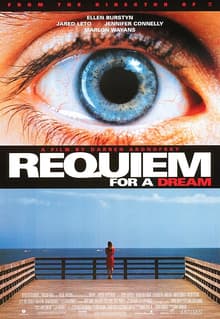
The dream as wound in disguise
The self that cannot be tolerated without chemical mediation
Escalating doses to maintain a baseline that keeps retreating
Attachment redirected from people to substances that cannot disappoint
Television addiction and heroin addiction as the same architecture
What the Film Actually Does
Most films about addiction adopt the perspective of the observer. They show consequences: deterioration, family rupture, the bottom. Darren Aronofsky's Requiem for a Dream, adapted from Hubert Selby Jr.'s 1978 novel, does something structurally different. Through rapid editing, split screen, accelerating tempo, and a score by Clint Mansell that functions like a pharmacological pressure increase, the film makes the viewer experience the neurological rhythm of craving.
You are not watching people want things. You are, briefly and artificially, made to want things. The discomfort of watching the film is not moral horror at what the characters do. It is the discomfort of having your own reward circuitry manipulated by a filmmaker who understands exactly what he is doing.
The Same Architecture
The film's most precise insight is its insistence on treating Sara Goldfarb's television diet-pill addiction as the same structure as her son Harry's heroin addiction. This is not a metaphor. It is an accurate clinical observation.
Sara (Ellen Burstyn) wants to fit into her red dress to appear on a television game show. She starts taking amphetamine-based diet pills from a doctor who barely examines her. The stimulants produce a subjective sense of energy, purpose, and momentum. They also produce tolerance, requiring escalation. They produce psychosis. Her story ends in electroconvulsive therapy.
"The distinction between 'legitimate' and 'illegitimate' addiction is a social category, not a neurological one. Sara's pills are prescribed. Harry's heroin is purchased on a corner. The tolerance curves, the craving structures, and the ends of their stories rhyme precisely."
This is not a coincidence of plotting. It is the film's central argument.
The Dream as the Wound
Each character's dream reveals their wound if you read it carefully.
Sara wants to appear on television because she wants to be seen and recognized by the world that has, since her husband's death, reduced her to an apartment in Brighton Beach and a television set. To be seen on television, in her psychological landscape, is to be real. The diet is not about vanity. It is about the intolerable experience of invisibility.
Harry wants to provide for Marion, to open a store with her, to be the kind of man who builds something. His wound is inadequacy. The heroin gives him the feeling of competence and warmth without requiring him to actually develop it.
Marion wants to create, to be an artist, to have a self she can respect. Her dream is perhaps the most painful because it is the most coherent. The film's ending, in which she trades sex for drugs in a transaction that degrades everything she wanted to be, is the logical destination of a person who could not sustain the gap between the self she was and the self she wanted.
The Editing as Pharmacology
Aronofsky's formal technique is inseparable from the film's psychological argument. The quick-cut sequences showing drug preparation and consumption are edited with the same rhythm as the sequences showing Sara's television watching and diet pill taking. The visual language refuses to distinguish between them.
The film accelerates as tolerance accelerates. Early sequences have room. Late sequences are compressed, frantic, overwhelming. This is not stylistic excess. It is the subjective experience of a nervous system that has reorganized itself around a substance and now cannot find the baseline it started from.
The Logical Destination
The ending, which is among the most formally audacious in American cinema, shows each character at the end of the trajectory the film has been tracking. The destinations are not arbitrary. They are where these specific people, with these specific wounds, using these specific substances, were always going.
Addiction, as the film understands it, is not a detour from a life. It is a life organized around the intolerable experience of the self without the substance. Requiem for a Dream is a film about people who cannot tolerate who they currently are, and about the precise mechanisms by which that intolerance destroys them.
References
- Selby, Hubert, Jr. Requiem for a Dream. Playboy Press, 1978. - Aronofsky, Darren, dir. Requiem for a Dream. Artisan Entertainment, 2000. - Koob, George F., and Michel Le Moal. Neurobiology of Addiction. Academic Press, 2006. - Alexander, Bruce K. The Globalization of Addiction: A Study in Poverty of the Spirit. Oxford University Press, 2008. - Hari, Johann. Chasing the Scream: The First and Last Days of the War on Drugs. Bloomsbury, 2015. - Dodes, Lance M. The Heart of Addiction. HarperCollins, 2002.
---
Interpretive opinion based on the public record. Not a clinical assessment or diagnosis of any individual.