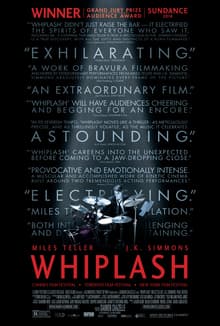
Whiplash (Damien Chazelle, 2014)
Fletcher is not the villain. He is a wound-delivery system. The film's real question is whether the wound produces greatness or destroys the person who might have been great - and the final scene refuses to answer it. That refusal is the most psychologically honest thing in the film.
Achievement as identity replacement - the self that exists only inside the performance of excellence
Conditional value conditioning: the child whose worth was entirely contingent on output
The teacher as stand-in for the original wounding relationship - re-enacting the conditions of the wound in search of mastery
Instrumentalizing everything that is not the goal; connection experienced as distraction from the real task
The ambiguous finale - transcendence and self-erasure as the same event
The System
Terence Fletcher runs a jazz program at a fictional conservatory modeled on the kind of excellence-at-all-costs pedagogy that has produced both genuine virtuosos and psychological wreckage in roughly equal proportions throughout the history of elite performance training. The film is not interested in the question of whether Fletcher is a good teacher. It is interested in what kind of person responds to what Fletcher offers, and what that response costs.
The answer the film constructs is Andrew Neiman: nineteen years old, driven by a hunger for greatness that he could not fully articulate if asked. His father is a failed writer who is kind, encouraging, and ordinary. Andrew cannot stand ordinary. The film is precise about this: Andrew's relationship to his father is warm and functional and ultimately insufficient. He needs something his father cannot provide. The question is what that thing is.
The wound the film traces is not Fletcher's abuse. It is Andrew's pre-existing relationship to his own value - the sense, already established before Fletcher enters the picture, that his worth is entirely contingent on the achievement of something extraordinary. Fletcher does not create this. He finds it and uses it.
Fletcher's Function
Fletcher is a brilliant character study in the specific psychology of conditional approval operating at maximum intensity. His method is not sadism for its own sake - the film makes this case explicitly in a late scene where he explains his philosophy. His method is the removal of a floor of acceptance. He creates an environment in which there is no baseline validation, no safety, no good enough. The only available response to that environment is either collapse or escalation.
Andrew escalates. This is presented as heroic determination. The terrain reading is more complicated. Andrew escalates because he cannot afford to collapse, because collapsing would mean confronting a self whose value is already, before Fletcher, entirely conditional on the achievement of extraordinary performance. Fletcher does not introduce the conditionality. He amplifies a condition that was already structuring Andrew's interior.
The Charlie Parker myth that Fletcher uses - Bird became Bird because Jo Jones threw a cymbal at his head, because the humiliation produced the drive - is a story Fletcher tells himself about the wound. It is not accurate as music history. It is psychologically revealing as the narrative a person uses to justify a relational pattern that causes damage. The people who were not Charlie Parker, who also had cymbals thrown at them, are not in the story Fletcher tells.
"Fletcher is not a teacher who has gone too far. He is a mirror of the psychology he selects for. He does not break students who have selves outside the performance. He breaks students who are only the performance - because they are the ones willing to stay in the room."
Andrew and Tiger
The terrain overlap between Andrew Neiman and the psychological architecture traced in the Tiger Woods map is precise enough to be worth naming directly. Both cases involve a child - or in Andrew's case, a young adult - whose value was entirely conditional on performance output. Both involve the complete absence of a self that exists independently of the achievement. Both involve a relational pattern in which the primary attachment figure is also the source of the conditioning.
The difference is the scale of the infrastructure. Tiger Woods had Earl. Earl had thirty years. Andrew Neiman has a single academic year with Fletcher. But the architecture produced is recognizable: a person who is exquisitely capable of extraordinary performance and who has no practiced relationship with a self that exists outside the performance.
Andrew ends a relationship explicitly because it will be a distraction. He delivers the breakup in language that is clinical and final, describing the relationship as an obstacle to his goal with the precision of someone who has correctly identified a threat to their only functioning identity structure. The film presents this as cold. The terrain reading identifies it as the logical behavior of someone who genuinely cannot afford the distraction, because there is nothing left if the performance fails.
The Question the Film Asks
Damien Chazelle has said in interviews that he based the film on his own experience in a demanding high school jazz program and that the question he was trying to ask was about the price of ambition. The more precise question the film actually asks is: at what point does the pursuit of greatness become indistinguishable from the destruction of the person who is pursuing it?
The film offers two possible interpretations of Andrew's journey. In the first, Fletcher was right: the suffering produced the artist, the pain produced the performance, and the extraordinary final scene represents genuine transcendence and the arrival of a real musician. In the second, the final scene represents Andrew's complete disappearance into the performance - the last remaining part of himself surrendered to the approval of the man who has been withholding it for a year.
The film is honest enough not to resolve this question, which is what makes it a serious psychological document rather than a sports movie with drums. Both interpretations are true simultaneously. The performance is transcendent. The person achieving it has been systematically dismantled to make it possible.
The Final Scene
Fletcher introduces Andrew in a way designed to humiliate him. Andrew begins to play. Fletcher tries to stop him. Andrew keeps playing. The dynamics build. Fletcher, eventually, begins to conduct. The performance reaches something genuinely extraordinary.
What the ending gives us is a moment of apparent triumph read by most audiences as vindication - Andrew wins, he proved himself, Fletcher's method worked. The terrain reading of the same scene: Andrew has done the one thing Fletcher could not take from him. He has performed so completely that the relationship finally produces the nod of approval that has organized the entire preceding narrative.
“The movie is really about how much you're willing to give up for your passion.”
Damien Chazelle, interview with The Guardian, 2015
The nod lands. Fletcher gives Andrew the look. And Andrew plays on, alone at the kit, past the end of the performance, into something that transcends the room. It is also the moment when the last negotiable version of Andrew Neiman - the one who might have chosen differently - is no longer present to make a different choice.
The Good Job Problem
The scene most often cited in discussions of Fletcher's psychology is the scene in which he describes a student he once pushed until the student broke. Fletcher's account of the incident, delivered as explanation of his method, reveals the psychology of conditional approval at its most structurally explicit: approval that is withheld is the only approval that retains power. The teacher who says "good job" too easily produces students who believe the "good job." Fletcher is after something else. He is after the "good job" that comes after the student has abandoned every other source of self-validation.
This is recognizable as the psychology of relationships organized around emotional withholding - in families, in mentorship relationships, in romantic attachments. The person who dispenses approval on a variable reinforcement schedule produces more powerful attachment than the person who is consistently generous. Fletcher is not doing this cynically. The film suggests he genuinely believes in the method. That belief is the most chilling detail. The damage is produced by someone who thinks he is doing his students a service.
References
- Whiplash. Damien Chazelle, dir. Sony Pictures Classics, 2014. - Chazelle, Damien. Interview with The Guardian, October 2014. - Chazelle, Damien. Interview with Collider, October 2014. - Teachout, Terry. "The Myth of the Ruthless Teacher." The Wall Street Journal, October 2014. - Bjork, Robert A. "Memory and Metamemory Considerations in the Training of Human Beings." In Metcalfe, J. and Shimamura, A. (eds.), Metacognition: Knowing About Knowing. MIT Press, 1994. - Duckworth, Angela. Grit: The Power of Passion and Perseverance. Scribner, 2016. (For the limits of the grit framework when drive is compulsive rather than chosen.) - Benedict, Jeff and Armen Keteyian. Tiger Woods. Simon & Schuster, 2018. (For structural comparison with real-world conditional value conditioning.)
---
Interpretive opinion based on the public record. Not a clinical assessment or diagnosis of any individual.