Cobain - MTV Unplugged
A performance that reads, in retrospect, as a farewell. The man who hid behind distortion and volume forced into acoustic honesty - and the set list he chose, and the way he sang, and what the room received without knowing what it was receiving.
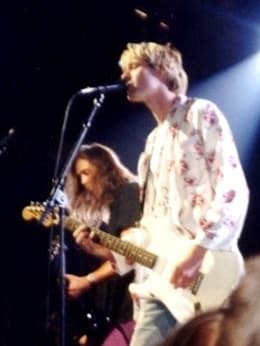
Disclosure through form - the acoustic format as confession mechanism
Chronic pain, unwanted fame, and the inability to accept being loved for a version of yourself you did not recognize
The cover song as autobiography - other people's words used to say the unsayable
Connection through art, disconnection through persona - the audience had the music but not the person
The performance as goodbye - legible only after the fact
The Format as the Statement
Kurt Cobain did not want to do MTV Unplugged. He resisted the format, pushed for candles instead of stage lighting, insisted on lilies and black candles - a funeral aesthetic he explicitly requested. The production team thought it was an artistic choice. It was also a psychological one.
When you remove distortion and volume from a performer who has used those elements as armor, what remains is the person. The Unplugged format strips the performance to its minimum viable layer. Cobain knew this. He chose it anyway, or was maneuvered into it, and then made something inside the constraint that told the truth he could not tell directly.
The acoustic format was the confession booth. What he put inside it was the confession.
The Set List as Map
Most bands doing Unplugged play their hits. Nirvana played five cover songs - more than a third of the set. The choices were not random: David Bowie's "The Man Who Sold the World," three Meat Puppets songs performed with the Meat Puppets brothers, Lead Belly's "Where Did You Sleep Last Night."
A man who cannot say something directly will often find another person's words to say it. The cover song is the most common autobiographical form in popular music, precisely because it allows the performer to deliver a message with deniability. The message is still delivered.
"Where Did You Sleep Last Night" closed the show. It is a murder ballad - a man asking his partner where she has been, the answer being that she is already dead. Cobain sang it with his eyes closed, his voice breaking at the end into something that was not performance. The room went quiet in the way rooms go quiet when they have witnessed something that is not quite contained by the format.
"He was five months away from his death. The audience at the taping did not know that. What they knew was that something was happening onstage that was different from a rock performance. They could not name it. They clapped very hard at the end, which is what people do when they have received something they cannot process."
The Fame Problem
Nirvana's ascent from 1991 to 1993 was one of the fastest and most disorienting in rock history. Cobain had spent years wanting to be heard and had built, in his Olympia and Aberdeen years, an identity organized around outsider status - the kid who was too weird for the town, who found the other weird kids, who made noise with them in basements.
Fame at that scale does not just reward that identity. It obliterates it. You cannot be the outsider when you are the center. The wound that produced the music was, in part, the wound of not belonging. Fame removed the conditions that made the wound legible to the person carrying it - and did not replace them with anything workable.
What the Room Received
The Unplugged recording was released posthumously in November 1994, seven months after Cobain's death. It won the Grammy for Best Alternative Album. The people who received it after his death heard it differently than the people in the room on November 18th, 1993.
Both experiences are valid terrain maps. The live audience received a great performance. The posthumous audience received a document. The document had always been there. The context changed what was visible.
This is the cartographic pattern: some disclosures are only legible after the window closes. The information was always present. The frame was not.
References
- Nirvana. MTV Unplugged in New York. DGC Records, 1994. (Recorded November 18, 1993.) - Cross, Charles R. Heavier Than Heaven: A Biography of Kurt Cobain. Hyperion, 2001. - Azerrad, Michael. Come as You Are: The Story of Nirvana. Doubleday, 1993. - Kurt Cobain: Montage of Heck. Directed by Brett Morgen. HBO Documentary Films, 2015. - Cobain, Kurt. Journals. Riverhead Books, 2002. - Arnold, Gina. "Nirvana MTV Unplugged." Option, January 1994.
---
Interpretive opinion based on the public record. Not a clinical assessment or diagnosis of any individual.