The Enron Collapse
Enron did not fail because of a few bad actors. It failed because it built an institutional culture in which performance was systematically rewarded over substance, until the performance became the only thing anyone knew how to produce. The accounting was not a fraud layered onto a real company: it was the company's actual operating system.
Performance rewarded over substance until performance became the substance
Not applicable as individual wound. The institution's wound was its founding logic: that sufficiently impressive presentation would eventually become sufficiently impressive reality.
Mark-to-market accounting and SPE architecture as institutional defense against having to produce what was being claimed
Rank-and-yank internal culture: loyalty to the performance of confidence over honest assessment
Institutional enablers: Arthur Andersen, investment banks, Wall Street analysts, board members who had financial reasons to believe
The Company That Was an Idea
Enron Corporation was formed in 1985 through the merger of Houston Natural Gas and InterNorth, two relatively conventional natural gas pipeline companies. Under CEO Ken Lay, and then under the aggressive operational leadership of Jeff Skilling, who joined in 1990, Enron reinvented itself repeatedly over the following decade: from pipeline company to energy trader, from energy trader to broadband provider, from broadband provider to market maker in everything from electricity to weather derivatives. Each reinvention was announced with considerable fanfare, executed with minimal operational infrastructure, and measured not by what the business actually produced but by what the market believed it would eventually produce.
Skilling's single most consequential decision was his successful push, beginning in the early 1990s, for the Securities and Exchange Commission to allow Enron to use mark-to-market accounting. Under this method, a contract or asset is recorded not at its actual cash value but at its estimated future value, calculated according to models Enron built and operated itself. When Enron signed a twenty-year energy contract, it could immediately book as current income the total estimated profit from that contract over its full life, as determined by its own internal projections. The cash did not exist. The revenue was a model's output. But on the income statement it appeared as earned income.
This was not technically illegal, and it was approved by regulators. What it did to the institution's interior was irreversible. It decoupled, at the foundational level of the company's accounting, the relationship between what Enron claimed and what Enron actually had. From that decoupling, everything else followed.
The Culture That Accounting Built
Skilling's human resources innovations reinforced the accounting logic at the personnel level. The Performance Review Committee, which employees nicknamed rank and yank, evaluated all Enron employees on a curve every six months and required that fifteen to twenty percent of employees receive the lowest rating and be subject to termination. The explicit criteria were intelligence, initiative, and the demonstration of confidence. What the system actually measured, as the journalist Bethany McLean and the documentarians Alex Gibney and others have documented extensively, was the performance of those qualities: the ability to project certainty, to present ideas compellingly, to appear not to be failing even when the underlying work was not producing what was claimed.
The institutional effect was a company in which honest assessment of a failing project was more dangerous to the assessor than continuation of the project. Employees who raised concerns about deals that were not producing as promised were identified as not being team players, as lacking the confidence that Enron valued. The ones who survived and advanced were the ones who could maintain the performance of confidence regardless of what the underlying numbers said, which is to say, regardless of what was actually true.
This is not a story about dishonest people in positions of power, though there were those. It is a story about an institution that built, over a period of fifteen years, a systematic architecture for replacing truth with performance, and then selected, at every level, for people who were comfortable with that replacement. By the time the collapse came, there were very few people anywhere in the organization who had the standing or the incentive or the institutional vocabulary to say clearly what was actually happening.
The Special Purpose Entities
Andrew Fastow, Enron's Chief Financial Officer, built a network of special purpose entities, partnerships with names like Chewco, LJM Cayman, and Raptor, that served as off-balance-sheet vehicles for hiding Enron's debt and generating the appearance of revenue. The SPEs were capitalized in part with Enron's own stock and managed in many cases by Fastow himself or his subordinates, creating profound conflicts of interest that were disclosed in footnotes to financial statements written in language that even professional analysts described as impenetrable.
The SPE architecture was the accounting logic taken to its terminus: if mark-to-market accounting allowed Enron to report as income money it had not yet received, the SPEs allowed it to move losses off its books entirely, so that the income statement showed performance the underlying business was not producing and the balance sheet concealed obligations the underlying business had actually incurred. The gap between what was reported and what was real grew, year by year, until it was too large to bridge.
The role of Arthur Andersen, Enron's auditor, is central here and not simply in the sense that Andersen failed to catch what it should have caught. Andersen was Enron's auditor and also one of its most significant consulting clients, earning fees in both capacities that created a structural incentive not to find things that would need to be reported. The firm's Houston office, which handled the Enron account, was so deeply embedded in Enron's culture that partners attended Enron strategy meetings and were present in ways that made the independence required of an auditor structurally impossible. Andersen was not simply deceived by Enron. It was part of the same system, serving the same function: providing a credible external attestation to a performance that was not backed by substance.
Wall Street's Wound
Investment banks including Citigroup and J.P. Morgan Chase provided financing structures that helped Enron disguise debt as revenue, earning significant fees in the process. Equity analysts at major firms maintained buy recommendations on Enron stock long after private communications within those firms suggested serious questions about the company's finances. The reasons were not all simple corruption. Some analysts genuinely believed the story. But the structure of analyst compensation in the late 1990s, tied heavily to investment banking relationships, created an incentive gradient that pointed directly away from honest assessment and toward support for the narrative the client wanted told.
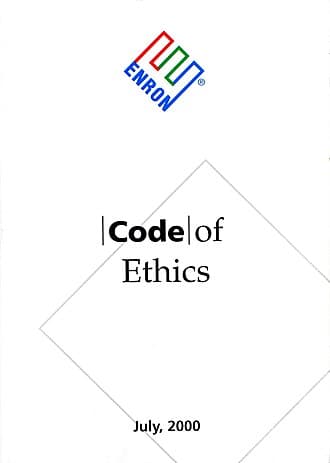
The board of directors twice voted to suspend Enron's own code of ethics to permit Fastow to run the SPEs that were enriching him personally while serving the company's need to hide debt. They did so because the CFO and CEO presented the arrangements as necessary for the business, and the board's information environment, shaped by the same culture of performance over substance, did not give them the tools to evaluate that claim independently. They were not passive. They were active participants in a system that had been designed to make honest assessment of what was actually happening nearly impossible from any position inside it.
What the Collapse Was
The end came quickly once it began. In October 2001, Enron reported a third-quarter loss of $618 million and disclosed the SEC investigation into the SPE arrangements. In November, the company restated five years of financial results, acknowledging that earnings had been overstated by $586 million. On December 2, 2001, Enron filed for Chapter 11 bankruptcy protection, at the time the largest corporate bankruptcy in American history. More than twenty thousand employees lost their jobs. Employee retirement accounts, heavily concentrated in Enron stock that the company had encouraged workers to hold, were effectively wiped out. The scandal accelerated the passage of the Sarbanes-Oxley Act of 2002, which imposed new requirements on corporate accounting and governance.
Ken Lay was convicted of fraud and conspiracy in 2006 and died before sentencing. Skilling was convicted on multiple counts and served twelve years in federal prison. Fastow pleaded guilty and served six years.
The minimum viable truth is this: Enron did not fail because a few individuals decided to commit fraud. It failed because it built an institution whose fundamental operating logic was that performance, presented with sufficient confidence and backed by sufficiently complex documentation, could substitute indefinitely for the substance it was performing. The accounting was not the fraud layered on top of the company. The accounting was the company's actual operating system, and when the system encountered reality, it had no response available, because it had spent fifteen years systematically eliminating the people and practices that would have prepared one.
References
- McLean, Bethany and Peter Elkind. The Smartest Guys in the Room: The Amazing Rise and Scandalous Fall of Enron. Portfolio, 2003. - Gibney, Alex (dir.). Enron: The Smartest Guys in the Room. Magnolia Pictures, 2005. - Powers, William C., Raymond S. Troubh, and Herbert S. Winokur Jr. Report of Investigation by the Special Investigative Committee of the Board of Directors of Enron Corp. February 1, 2002 (the "Powers Report"). - United States Senate Permanent Subcommittee on Investigations. The Role of the Board of Directors in Enron's Collapse. Committee on Governmental Affairs, July 8, 2002. - Eichenwald, Kurt. Conspiracy of Fools: A True Story. Broadway Books, 2005. - Healy, Paul M. and Krishna G. Palepu. "The Fall of Enron." Journal of Economic Perspectives, Vol. 17, No. 2, Spring 2003. - United States v. Skilling, 554 F.3d 529 (5th Cir. 2009). Affirmed in part, vacated in part, 561 U.S. 358 (2010). - Toffler, Barbara Ley and Jennifer Reingold. Final Accounting: Ambition, Greed, and the Fall of Arthur Andersen. Broadway Books, 2003.
---
Interpretive opinion based on the public record. Not a clinical assessment or diagnosis of any individual.