The Lewinsky Scandal
The most powerful man in the world and a 22-year-old intern. The scandal consumed the country. The power gradient was invisible to almost everyone at the time - including, for a while, Monica Lewinsky herself.
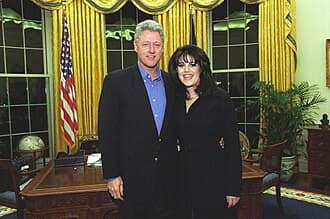
Power gradient made invisible by desire and by institutional interest
The least powerful party absorbs the most damage
Public shaming as political and social regulation
Asymmetric exposure - one party protected by institution, one party unprotected
The woman as the story - Clinton as the perpetual subject, Lewinsky as the object
The Gradient
He was 49. She was 22. He was the President of the United States. She was an intern. Every other variable in the analysis operates on top of this one.
The White House is not an ordinary institutional environment. It is the most hierarchically structured organization in American public life, in a building where the architecture itself communicates the concentration of power. An intern in that environment is not simply a junior employee. She is a person whose entire access, whose presence in the building, whose professional future is entirely contingent on the goodwill of the institution she serves. The President of that institution is not simply a supervisor. He is the institution.
The terrain question is not whether what happened was consensual in the technical sense. It is whether consent functions the same way at every point along a power gradient. The map suggests it does not, and that the consequences of that asymmetry fell almost entirely on the party with less power.
The Investigation as Amplification
Independent Counsel Kenneth Starr's investigation began as an inquiry into a real estate transaction from the early 1980s called Whitewater. By 1998 it had expanded, through a series of referrals and authorizations, into an investigation of a private sexual relationship between the President and an intern.
The specific prosecutorial approach Starr employed transformed the power dynamic in the worst possible direction for Lewinsky. She was threatened with prosecution for obstruction. She was held for hours by FBI agents. She was told to cooperate or face significant prison exposure. She was twenty-four years old at the time of the investigation. She was alone.
The Starr Report, submitted to Congress in September 1998, included explicit sexual detail that was unprecedented in the public release of a government document. The decision to include that detail was a choice. The effect was to ensure that Monica Lewinsky's most intimate experiences became part of the permanent public record in the most explicit terms available.
"The scandal was named after her. The consequences were borne by her. The institutional protection was available to him. This asymmetry is the terrain. Everything else is noise."
Clinton's Testimony and Its Language
Clinton's legal strategy produced some of the most precisely calibrated evasion in the documented record of public accountability. His August 1998 deposition included the statement: "It depends on what the meaning of the word 'is' is." His defense that oral sex did not constitute "sexual relations" under the definition provided to the deposition rested on a parsing of language that was technically defensible and substantively dishonest.
The language reveals the relationship to accountability. Clinton is among the most gifted political communicators of his generation. When he chose to parse rather than account, the choice was deliberate. The parsing was not confusion. It was the application of considerable intelligence to the project of avoiding a complete answer.
In his August 1998 national address, after the DNA evidence made denial impossible, he said: "I did have a relationship with Ms. Lewinsky that was not appropriate. In fact, it was wrong." He then spent most of the remaining statement criticizing Kenneth Starr's investigation. The accountability sentence lasted approximately eight words. The grievance lasted considerably longer.
What Happened to Each Party
Bill Clinton completed his second term. He left office with a 65% approval rating. He has since built a post-presidency career as a statesman, speaker, and global philanthropist.
Monica Lewinsky spent the years immediately after the scandal largely unable to work, unable to live privately, unable to construct an identity outside the one the scandal had assigned her. The dress. The beret. The intern. She has said she was the first person to be publicly destroyed by the internet - the mechanism of twenty-four-hour tabloid coverage and early online media operating on a single target with no platform available for response. The specific intensity of the experience she had is the prototype for what would later happen to millions of people at lesser intensity through social media.
The TED Talk and What It Named
In 2015, seventeen years after the investigation, Lewinsky delivered a TED talk titled "The Price of Shame." She said: "At twenty-two, I fell in love with my boss. At twenty-four, I learned the devastating consequences. Can I see a show of hands of everyone who did something at twenty-two that they later regretted? I was patient zero of losing a personal reputation on a global scale almost instantaneously."
The talk is a document of a wound that took twenty years to begin naming publicly. Its significance is not only personal. It is structural: it was the first time Lewinsky had narrated her own experience in her own terms, for an audience large enough to shift the cultural record. She was building, in public, what had been taken from her in public.
The MeToo Reassessment
The cultural reading of the scandal shifted substantially after 2017. The #MeToo movement provided a vocabulary for power dynamics that had not been widely available in 1998. Lewinsky wrote in Vanity Fair in 2018: "Now, at 44, I'm beginning, only beginning, to consider the implications of the power differentials that existed in my relationship with Bill Clinton."
The reassessment did not require treating Lewinsky as without agency. It required treating the power gradient as a variable with real effects, not a detail to be managed. The person in that relationship with less power was younger, less institutionally protected, and absorbed nearly all of the damage. That is what the gradient produces.
The Narrative Control Problem
For twenty years, the story was told without her as its author. She was object, not subject. Her subsequent public work - the TED talk, the Vanity Fair essays, the producer credit on Impeachment: American Crime Story - represents a sustained attempt to reclaim authorship of her own story.
The attempt to reclaim narrative is itself a terrain map of what it costs to have your story told without you.
References
- Lewinsky, Monica. "The Price of Shame." TED Talk, March 2015. - Lewinsky, Monica. "Emerging from 'The House of Gaslight' in the Age of #MeToo." Vanity Fair, February 2018. - Toobin, Jeffrey. A Vast Conspiracy: The Real Story of the Sex Scandal That Nearly Brought Down a President. Random House, 1999. - Starr, Kenneth. The Starr Report. U.S. Government Printing Office, 1998. - Clinton, Bill. Address to the Nation, August 17, 1998 (public record). - Impeachment: American Crime Story. Directed by Ryan Murphy. FX, 2021. - Frankel, Marvin E. and Alan M. Dershowitz, coverage in The New York Times and Los Angeles Times, 1998-1999.
---
Interpretive opinion based on the public record. Not a clinical assessment or diagnosis of any individual.