Woodstock 99
This was not a riot that happened at a festival. It was a psychological pressure cooker whose explosion was predictable from the moment the design was finalized.
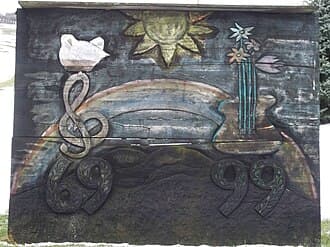
Nostalgia monetized without its conditions
Collective dehydration, financial exploitation, and structural neglect treated as someone else's problem
Failed container collapsing into mass disinhibition
Anonymous crowd as permission structure
Rage mistaken for liberation
The Container That Was Never Built
Woodstock 1969 did not produce peace and love because of the music. It produced those conditions because of density, weather, a genuinely free event, and a crowd that had not been treated as a revenue extraction opportunity. The promoters of Woodstock 99 studied the outcome and attempted to reproduce it without reproducing its causes.
A container that holds is built from structure, not from branding. The 1999 event was held on a former Air Force base in Rome, New York, in late July heat, with water sold at $4 a bottle, food at festival markup, and 200,000 people packed into a site with insufficient sanitation. The conditions were not incidental. They were the event.
The Psychology of the Crowd
Group psychology under stress follows a pattern that social scientists have documented since Gustave Le Bon: individual identity partially dissolves, the threshold for normally-inhibited behavior rises, and the crowd becomes a permission structure. What the crowd does together feels authorized by the fact that the crowd is doing it.
At Woodstock 99, that permission structure met a specific demographic: young men, largely white, raised on nu-metal and rap-metal genres whose explicit subject matter was aggression, resentment, and the right to take up space. This is not a condemnation of the music. It is a map reading of who was there, what they had been rehearsing emotionally for three days, and what the environment gave them permission to do.
"The Limp Bizkit set was not the cause of what followed. It was the moment the crowd's accumulated frustration found a form and a face. Fred Durst did not create the rage. He named it and pointed it outward."
The Limp Bizkit Set as Inflection Point
Fred Durst performed "Break Stuff" on the main stage Saturday night. By that point, the crowd had endured three days of heat, gouging, and logistical failure. The song is, by design, a permission slip for destruction: it articulates the fantasy of consequence-free violence as catharsis.
What is psychologically significant is not that the song was played. It is that the set functioned as a ritual container for rage that had been building without permission for 72 hours. When a crowd that size is given explicit permission, by a performer on a main stage, to direct its frustration outward, the crowd takes it. The fires that followed were not spontaneous. They were the completion of a process that the design had started.
The Shadow of Male Rage
The reported sexual assaults during the event are the most serious consequence and the most psychologically significant. They reveal what happens when the second layer of social inhibition is removed, not just the first.
The first layer removal produces property destruction. The second produces violence against people. Anonymous crowds, physical exhaustion, substance use, and an explicit atmosphere of permission form a specific kind of permission structure for men who carry unexpressed rage about something. The assault reports at Woodstock 99 were not a coincidence of timing. They were the logical end of a system that removed structure without asking what structure had been holding back.
Promoter Delusion as Psychological Pattern
Michael Lang and the other promoters believed, apparently sincerely, that the Woodstock brand was transferable across thirty years and entirely different conditions. This is a recognizable psychological structure: the conviction that a desired outcome can be produced by invoking its symbol, without reproducing its causes.
The promoters wanted the story of 1969 without its actual conditions. They wanted peace as aesthetic rather than peace as the product of a specific set of material relationships. The delusion was not cynical. It was the product of people who had confused their memory of an event with its mechanism. The most dangerous mistakes are made by people who believe deeply in what they are doing.
References
- Spiegel, Josh, dir. Woodstock 99: Peace, Love, and Rage. HBO Documentary Films, 2021. - Netflix Documentary. Trainwreck: Woodstock '99. Netflix, 2022. - Le Bon, Gustave. The Crowd: A Study of the Popular Mind. 1895. Reprint, Sparkling Books, 2009. - Reeves, Jimmy. "Woodstock 99 and the Failure of Nostalgia." Popular Music and Society, vol. 24, no. 2, 2000. - Sanneh, Kelefa. "Woodstock 99: The Violence Was in the Design." The New Yorker, August 2021.
---
Interpretive opinion based on the public record. Not a clinical assessment or diagnosis of any individual.