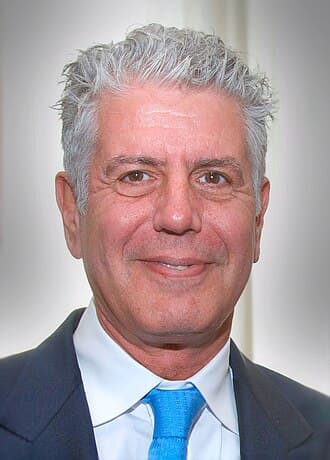
Anthony Bourdain
The seeker who could not be filled. Restlessness as both gift and fate, and what happens when the moving stops.
Restlessness as organizing vector
The unfillable gap / chronic non-satiation
The seeker who cannot be filled
Witnessing outward with difficulty witnessing inward
Intensity as presence-seeking
Origin Architecture
Bourdain was born in New York City in 1956 and grew up in Leonia, New Jersey, in a middle-class household. His father was a music executive; his mother a copy editor for the New York Times. He has described his childhood, in Kitchen Confidential and interviews, as comfortable and unstimulating in roughly equal measure. The deprivation is not material. It is a quality of interior experience - an early restlessness that found no adequate container.
He discovered France on a family vacation as a child, ate a perfect oyster on a boat in the harbor, and felt something click into place that he spent the rest of his life trying to recreate. He described the moment in his first book: "I had conquered my first local in the same spirit, I have to imagine, that went into discovering the New World - and with the same sense that I had found something I was not expecting to find." The oyster was not just a taste. It was a proof-of-concept: the world contained experiences that could reach all the way to whatever was hollow inside him. The project became finding more of them.
Kitchens and Heroin
He attended Vassar briefly, dropped out, and enrolled at the Culinary Institute of America. He began working restaurant kitchens in the late 1970s, cooking his way through dishwashing and prep and the midnight chaos of professional service. He also began using heroin, which he has described with unusual directness across multiple books and interviews.
The parallel between kitchens and heroin is not incidental. Both supplied the same structural need: intensity, the feeling of being absolutely present, the obliteration of the gap that opened in quiet moments. The kitchen at 2 a.m. on a Saturday, every table full, every ticket ringing - this is not a relaxed environment. It is a high-pressure situation that requires total presence and makes ordinary introspection impossible. Heroin accomplished the same erasure of interior distance through chemistry rather than labor.
Bourdain has described the heroin use as lasting through his twenties and into his early thirties. "I was a functioning addict for a long time," he told Terry Gross on Fresh Air in 2016. "Functioning in the sense that I showed up and did the work. Not functioning in the sense of having an actual life." He eventually stopped, through will rather than treatment, which is its own terrain statement: the same relentlessness that organized his ambition organized his recovery.
Kitchen Confidential and the Rupture
Bourdain spent his twenties and thirties cooking in New York restaurants, accumulating experience, publishing one failed novel, and writing about the industry. He submitted an essay to The New Yorker in 1999, which published "Don't Eat Before Reading This." Kitchen Confidential: Adventures in the Culinary Underbelly followed in 2000. He was forty-four.
The book was an overnight transformation. Within months of publication, he was famous. A Cook's Tour on the Food Network followed in 2002; No Reservations on the Travel Channel from 2005; Parts Unknown on CNN from 2013. By 2006 he was among the most recognizable figures in American food media. By 2013 he was among the most recognizable figures in American television.
The sudden fame did something specific to someone whose identity had been built around invisibility. For twenty years, Bourdain had been the person behind the pass, in the back of the house, doing work that the front of the house presented to diners who would never learn his name. The cook is definitionally anonymous. The professional kitchen valorizes exactness and output, not personality. You are what you produce, not who you are.
Kitchen Confidential inverted this. The person who had been invisible became the most visible thing. The identity architecture was not built for this reversal. He had to construct a public self, rapidly, and the public self he built - acerbic, restless, perpetually curious, the outsider who goes everywhere - was a compelling persona that was also, by many accounts, increasingly divergent from the person who went back to the hotel room at night.
Parts Unknown and the Visible Gap
His final show, Parts Unknown, ran from 2013 to 2018 on CNN and is widely considered his best work. The episodes that most clearly show the interior terrain are not the technically ambitious ones. They are the quieter ones: the episode in Iran, where he sat with families eating and said little, clearly moved by what he was encountering and unable to quite locate why. The episode in Hanoi with Barack Obama in 2016, at a plastic table eating bun cha for $6, where the ease of the interaction appeared to genuinely surprise him. The Japan episode, where he articulated something close to peace, and where his description of what he found in the culture's relationship to craft clearly landed against his own wound.
"I love the way the Japanese approach almost anything," he said in the Osaka episode. "The devotion to craft, the idea that you can spend your whole life perfecting something simple. I find that beautiful. I don't know if I'm capable of it, but I find it beautiful."
"He had seen more of the world than almost anyone alive. The restlessness was not resolving. This is the terrain signal. Movement was not the answer to the need. It was a way of living with the need without confronting it directly. The gap that the oyster in France had opened was the same gap, thirty years later, still open, still requiring the next destination to not-quite-close it."
Depression and the Interior Record
Bourdain has spoken and written about depression with the same directness he brought to the heroin years. He described the experience of arriving in a new and remarkable place and feeling nothing - the specific horror of being in a beautiful city, surrounded by interesting people and exceptional food, and finding the interior flatly unresponsive.
"There are times, I will confess, when I arrive somewhere extraordinary and I look around and I feel nothing," he said in a 2016 interview. "That scares me more than anything."
The depression was not a separate condition from the restlessness. It was the restlessness's shadow. When the movement could not generate the intensity it required, when the next destination did not deliver what the pattern promised, the gap that movement was designed to outrun became the only thing in the room.
His relationship with Asia Argent, which became public in 2017 following their meeting during the filming of the Parts Unknown Rome episode, appears from interviews and social media to have been one of the most important relationships of his later life. She was fiercely independent, worked during the relationship, and was not consistently geographically available. The relationship's dynamics, and the circumstances during the Parts Unknown filming trip to Strasbourg in June 2018, became the subject of public speculation after his death. The map notes only that the interior record in the final year, filtered through interviews and social media, shows a person whose wound was closer to the surface than the public persona typically permitted.
What the Moving Protected
Restlessness is a solution to a problem. The problem is not boredom. The problem is what becomes visible when movement stops: the quality of the interior in the absence of external input, the specific texture of whatever was hollow in Leonia and in the kitchens and in the countries that were supposed to fill it.
He died by suicide in Strasbourg, France, on June 8, 2018, at sixty-one. He was mid-production on a Parts Unknown episode. He was still moving.
The map that cannot be made now is the one that would sit with the stillness itself and ask what was there. He could witness the world with extraordinary precision and generosity. The witnessing inward was the harder work he did not have enough time to do.
References
- Bourdain, Anthony. Kitchen Confidential: Adventures in the Culinary Underbelly. Bloomsbury, 2000. - Bourdain, Anthony. Medium Raw: A Bloody Valentine to the World of Food and the People Who Cook. Ecco, 2010. - Anthony Bourdain: Parts Unknown. CNN, 2013-2018. - Bourdain, Anthony. Interview with Terry Gross. Fresh Air, NPR, May 2016. - Down, Laurence. "Anthony Bourdain: The Man Who Ate the World." The New Yorker, November 2016. - Roadrunner: A Film About Anthony Bourdain. Directed by Morgan Neville. Focus Features, 2021. - Bourdain, Anthony. A Cook's Tour: Global Adventures in Extreme Cuisines. Bloomsbury, 2001.
---
Interpretive opinion based on the public record. Not a clinical assessment or diagnosis of any individual.