Elizabeth Holmes
Elizabeth Holmes did not simply lie about Theranos. She believed, with apparent sincerity, a version of the story she was telling - and the distance between that belief and reality is the most psychologically interesting thing about her.
Exceptionalism as identity, not aspiration
Father's failure (Enron, government service, career dissolution) internalized as a mandate never to fall
Motivated self-deception: the lie repeated until it becomes subjective truth
Instrumental closeness; intimacy in service of the mission, never independent of it
Identity capture via idealized persona (the Jobs imitation as self-replacement, not performance)
The Permission Structure
Elizabeth Holmes did not invent motivated self-deception. Silicon Valley handed her a permission structure already in place. The canonical move in the valley is to declare a future into existence and then race to make the declaration true before anyone checks. This is what Peter Thiel called "secrets" and what Steve Jobs called a reality distortion field. The difference is that those futures were eventually real. Holmes adopted the methodology without the underlying capability, and the adoption was not cynical. She appears to have genuinely believed the methodology would work, that the technology would catch up to the promise, that the gap was a timing problem rather than a physics problem.
That belief is the most psychologically significant fact about her case.
The Father and the Fall
Christian Holmes IV worked for Enron before the company's collapse. He spent subsequent years in government service at agencies including USAID, without achieving the prominence his early career might have suggested. The family moved frequently. Holmes has described watching her father's trajectory with what she framed as determination to do better. The child of a man whose career dissolved in one of the most spectacular corporate failures in American history grew up with an acute understanding of what falling looked like, and a corresponding drive to become someone who could not fall.
This is not biography-as-excuse. It is the identification of a motive structure. The specific wound of watching a father's professional collapse tends to produce one of two orientations: resignation or compensatory drive. Holmes was unambiguously the second type, and her drive was calibrated not just for success but for the kind of success that could not be taken back. A company that revolutionized medicine. A name in the permanent record.
The Jobs Imitation
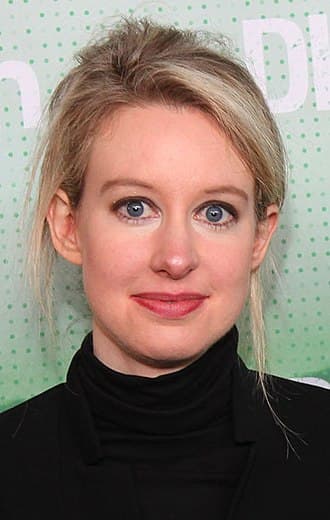
The black turtleneck was not a fashion choice. Neither was the artificially deepened voice, documented by multiple people who knew Holmes before Theranos, who say her natural register was higher. She studied Jobs's mannerisms, his framing, his public presentation of himself as a person for whom failure was temporarily adjacent but structurally impossible. She did not adopt these as tools. She replaced herself with them.
This is the distinction that makes Holmes clinically interesting rather than merely legally culpable. A con artist adopts a persona strategically and knows the distance between the mask and the face. Holmes appears to have closed that distance. The imitation became the self. When she spoke about Theranos in her characteristic baritone, describing technology that did not function, she was not performing conviction. She was expressing it.
The most dangerous form of deception is the kind the deceiver has already performed on herself.
What the Technology Could Not Do
Theranos's Edison device could not reliably perform the blood tests Holmes claimed it could perform. This was known internally. Tyler Shultz, Holmes's own employee and the grandson of her board member George Shultz, flagged the data problems internally before going to regulators. Former lab director Adam Rosendorff raised alarms. Holmes responded not with investigation but with the characteristic move of someone whose identity has fused with a claim: she defended the claim.
"We are going to change the world," she told employees, investors, and the public. She said this in venues ranging from TED talks to investor meetings where people committed hundreds of millions of dollars. She said it after she knew the device did not work. The question of whether she "knew" in the legal sense consumed years of litigation. The psychological question is subtler: what does it mean to know something that, if true, destroys the self you have constructed? For Holmes, it may have been experientially impossible to fully know it.
The Sentencing and the Self-Understanding
At her sentencing in November 2022, Holmes was given eleven years in federal prison. Her statement to the court was notable for what it revealed about her interior. She described being "devastated" by the outcome of Theranos. She spoke of her children, born after the charges, and what the sentence would mean for them. What she did not do was demonstrate, in any granular way, an understanding of what patients experienced when they received false diagnoses from tests that did not work. The grief was real. Its object was primarily herself and her story, not the people downstream of the technology's failure.
This is not sociopathy in the clinical sense. It is something more specific: the self-model of someone for whom the mission was so large that individual harm was genuinely difficult to hold in focus against it. She had absorbed the founder mythology completely, including the part that says history forgives visionaries their interim failures.
The Exceptional Child
Holmes showed up at Stanford at 18 with a history of presenting herself as exceptional and being received as such. She dropped out to pursue Theranos, citing Jobs as her model. The institution she left did not correct her. The investors who backed her did not correct her. The board members who included George Shultz, Henry Kissinger, and James Mattis did not correct her. Everyone who encountered her confidence largely reflected it back.
The psychology of someone who has been told they are exceptional since childhood, and who has never been in an environment that effectively contradicted that, is not equipped to process the information that the central project of their life does not work. Holmes was an extreme version of a type the valley has always produced. She was different only in that the gap between the claim and the reality happened to be in a domain where it could kill people.
References
- Carreyrou, John. Bad Blood: Secrets and Lies in a Silicon Valley Startup. Knopf, 2018. - Parloff, Roger. "This CEO Is Out For Blood." Fortune, June 12, 2014. - United States v. Holmes, No. 5:18-cr-00258-EJD (N.D. Cal. 2022). - Ramsey, Lydia. "Elizabeth Holmes's Former Lab Director Explains Why He Left Theranos." Business Insider, December 22, 2016. - Stempel, Jonathan. "Elizabeth Holmes sentenced to over 11 years in prison for Theranos fraud." Reuters, November 18, 2022.
---
Interpretive opinion based on the public record. Not a clinical assessment or diagnosis of any individual.