Kobe Bryant
He built an alter ego to survive the pressure and called it the Black Mamba. The question his life raises is whether the man and the construct ever met.
Mastery as the only tolerable identity
Conditional worth rooted in performance from childhood
Ego construction through persona as survival mechanism
Controlled distance except in the singular late relationship with Gianna
Accountability avoided through dissociation from the persona
The Mamba Is Not a Nickname
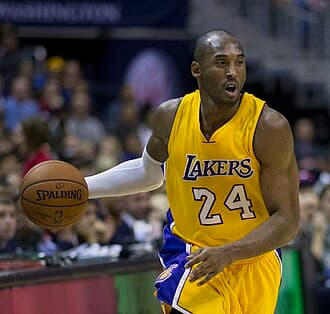
Kobe Bryant named his alter ego after the black mamba snake because it strikes with precision, without emotion, and without hesitation. He deployed this construct deliberately, describing it in interviews as a separate entity he could inhabit when the pressure required total obliteration of doubt. The Mamba was not a persona he wore on game days. It was, for most of his adult life, the self he preferred.
That preference is the terrain marker. It says: the person beneath the construct was not a comfortable place to live. Constructing an alternative identity is a sophisticated response to a self that feels insufficient, threatening, or unsafe. The question is what made the underlying self feel that way.
The Architecture of Conditional Worth
Kobe entered the NBA directly from high school at seventeen. His father Joe "Jellybean" Bryant had been a professional player whose career plateaued at the journeyman level. The son surpassed the father before he was old enough to rent a car. This inversion is not incidental.
Research on high-achieving children of former athletes consistently identifies a specific psychological burden: the child internalizes the parent's unlived ambition. The love is present, but it arrives conditional on performance. What Kobe described as his work ethic, insiders described as something closer to compulsion. He reportedly arrived at practice before staff, shot alone in the dark, contacted trainers at 3 a.m. The line between discipline and the inability to stop is worth examining.
Eagle, Colorado, 2003
In the summer of 2003, a nineteen-year-old hotel employee in Eagle, Colorado, accused Kobe Bryant of sexual assault. The criminal case was dropped after the accuser declined to testify. A civil settlement followed, terms undisclosed. Kobe issued a public statement acknowledging the encounter and acknowledging that she did not view it as consensual.
The psychological relevance is not guilt or innocence, which the legal process did not adjudicate. It is the response. Kobe compartmentalized. He returned to basketball. He won three more championships. He filed the event under the same internal architecture that filed everything: the Mamba does not carry it, so the man does not have to.
"A persona built to eliminate hesitation and doubt is also a persona built to eliminate the experience of consequence. The precision of the construct is its problem as much as its power."
The Father Who Was Not There
Kobe Bryant had three daughters. By most accounts, including those of people close to the family, he was not consistently present as a father in the early years. The work came first. The schedule came first. The construct required feeding.
Gianna changed something. His second daughter shared his obsession with basketball, and the footage and testimony of their relationship from her early teens onward shows something qualitatively different from what he appears to have offered his older daughters. He coached her. He sat with her. He showed up. Observers noted it looked like someone discovering fatherhood, not practicing it.
The repair was real. It was also late. There are exactly seventeen years between Natalia Bryant's birth and the crash on January 26, 2020.
The Helicopter
Kobe Bryant, Gianna Bryant, and seven others died when their helicopter flew into fog-covered hills above Calabasas at 9:47 a.m. on a Sunday. He was forty-one. She was thirteen.
The psychological question his death raises is not metaphysical. It is this: the final years of his life show a man beginning to dismantle the Mamba architecture. The memoir work, the Dear Basketball Oscar, the daughter he was finally present for. The evidence suggests someone in the early stages of discovering whether there was a self beneath the construction, and whether that self was someone he could live as.
He did not arrive at the answer. The work that remained was the work he had spent forty-one years preparing to avoid.
References
- Bryant, Kobe and Pablo S. Torre. The Mamba Mentality: How I Play. MCD, 2018. - Lazenby, Roland. Showboat: The Life of Kobe Bryant. Little, Brown, 2016. - Bryant, Kobe. Dear Basketball. Granity Studios, 2017. - Wojnarowski, Adrian. The Miracle of St. Anthony. Gotham Books, 2005. - Medina, Mark. Coverage in Los Angeles Daily News, 2003-2016. - Eagle County District Court case filings, 2003-2004 (public record). - ESPN 30 for 30: Kobe Doin' Work. Directed by Spike Lee, 2009.
---
Interpretive opinion based on the public record. Not a clinical assessment or diagnosis of any individual.