Muhammad Ali
Cassius Clay became Muhammad Ali, and then Muhammad Ali became something even the name cannot fully contain. He called himself the greatest before he had the record to prove it, and then he built the record to match the claim. This is not braggadocio. This is a specific psychological technology: the identity declared before it exists, so the person has something to grow into rather than something to live up to.
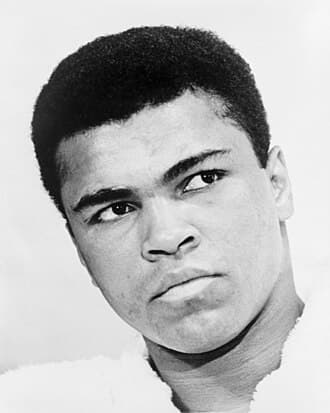
Identity as self-authorship - the deliberate, public construction of a self that does not depend on permission
The America that told a Black boy from Louisville what he was allowed to be, and the consequences of refusing that definition
Performance as conviction - the braggadocio was not separate from the belief, it was the mechanism that produced the belief
Magnetic at the center of any room, most himself in contest, fiercely loyal to the people who had been there before the greatness
The exile years as the cost of self-authorship taken to its ultimate expression - the boxing license, the title, the prime years
I Am the Greatest
Cassius Clay said he was the greatest before he beat Sonny Liston. He said it before anyone with standing agreed. He said it to cameras and reporters and opponents and to the air itself, relentlessly, in verse and in prose, before he had the championship that would make it a statement of record.
The standard reading of this is confidence, or showmanship, or the Louisville Lip performing for attention. The terrain reading is different. The declaration is a psychological technology. You announce the identity before it exists so that your behavior has something to organize around. The identity-to-come becomes a constraint on present action: a person who has publicly declared themselves the greatest cannot train carelessly, cannot fear openly, cannot lose with resignation. The declaration creates the person.
This is not common. Most people wait for external confirmation before claiming internal identity. Clay, later Ali, reversed the sequence deliberately and publicly. The world would decide later. He had already decided.
The Name
Cassius Clay became Muhammad Ali in February 1964, the day after he beat Liston. He announced his membership in the Nation of Islam. He rejected the name he had been given, describing it as a slave name, a designation assigned by the history of ownership rather than chosen by the person who carried it.
The name change was not primarily theological. It was an act of self-authorship made public. The person who had declared himself the greatest was now declaring that he was the one who got to name himself. Not the history that had produced the conditions his family was born into. Not the country that had assigned a legal identity. The man himself.
"The decision to rename yourself is the decision that the self is yours to define. For a Black man in 1964 America, this claim was not abstract. It was the direct refusal of a set of arrangements that had been telling Black people for three centuries what they were, what they were worth, and what they were allowed to become."
The Draft
In April 1967, Ali refused induction into the United States Army. He was stripped of his passport, his boxing license, and his heavyweight title. He was convicted of draft evasion and sentenced to five years in prison. He appealed. The Supreme Court overturned the conviction in 1971, by which point he had not boxed competitively for three and a half years.
He gave up the prime years of his boxing career for this. The years between twenty-five and twenty-eight, in a boxer's career, are not recoverable. He knew this. He was told this, by lawyers and advisors and people who wanted him to find a compromise. He did not find a compromise.
His explanation, offered in various forms in various interviews, contained the sentence that became the distillate of his position: "No Viet Cong ever called me nigger."
This is not an argument. It is a statement of alignment. His identity, the one he had authored for himself, could not be reconciled with fighting in a war on behalf of a country that had not reconciled itself with him. The self-declaration that had begun with "I am the greatest" arrived at its logical conclusion: he was the one who decided what he would and would not do with his body, his talent, and his years.
The draft refusal was the name change completed at cost. The name change said: I name myself. The draft refusal said: and I will pay for it.
The Exile
The three and a half years of forced inactivity are sometimes treated as a gap in the Ali timeline, a period of waiting before the real story resumed. The terrain reading treats the exile as among the most important periods of his psychological life.
He did not recant. He did not find a compromise. He lectured at universities. He spoke. He was present and visible and insistent. The exile did not produce the behavior the people who imposed it had intended to produce. It produced a man who discovered that his identity did not require the ring to survive.
The fights he missed cannot be recovered. What he gained is less legible but real: the knowledge that the identity he had declared could survive the loss of everything that seemed to make it possible.
The Fights After
When Ali returned in 1970, he was not the same fighter. The speed that had defined him was reduced. The jaw was more vulnerable. He adapted. He developed the rope-a-dope. He absorbed punishment and waited for the opening. He won the title back from George Foreman in Kinshasa. He beat Joe Frazier in Manila in what both men later described as close to a death experience.
He won these fights. He also absorbed damage that the medical evidence suggests was cumulative and serious. The Parkinson's diagnosis came in 1984. Ali has said in interviews that he has no regrets about the fights he took and the punishment he accepted. Whether this is conviction or limitation of retrospective access is not knowable from the outside.
The Body
The Parkinson's is the final chapter of the terrain reading, and it is the one that contains the most pain. A man whose entire project of self-authorship was built on the body, specifically on the body's speed and grace and power and beauty, spent the last thirty years of his life in a body that the disease progressively took apart.
He appeared at the 1996 Atlanta Olympics opening ceremony to light the torch, his hand visibly shaking. The stadium was silent in a way that stadium crowds are not usually silent. The world was watching the man who had called himself the greatest carry himself across the stage in a body that no longer did what it had once done.
"What it showed was that the identity had not been stored in the body. The body had been the vehicle. The identity was still there, in the man who carried himself across that stage with complete dignity in a body that was failing him, lit the torch, and did not look away."
References
- Remnick, David. King of the World: Muhammad Ali and the Rise of an American Hero. Random House, 1998. - Hauser, Thomas. Muhammad Ali: His Life and Times. Simon & Schuster, 1991. - Ali, Muhammad, with Richard Durham. The Greatest: My Own Story. Random House, 1975. - Marqusee, Mike. Redemption Song: Muhammad Ali and the Spirit of the Sixties. Verso, 1999. - Eig, Jonathan. Ali: A Life. Houghton Mifflin Harcourt, 2017. - When We Were Kings. Leon Gast, dir. 1996. - The Trials of Muhammad Ali. Bill Siegel, dir. 2013.
---
Interpretive opinion based on the public record. Not a clinical assessment or diagnosis of any individual.