Marlon Brando
Before Brando, American screen acting was largely an exteriorized craft. He made it interior, which meant he had to go somewhere most people do not willingly go. He had been trained for that descent since childhood.
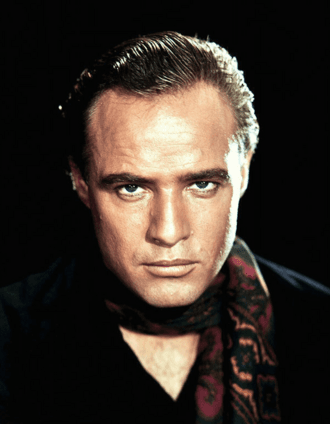
The interiority made visible, as survival skill and then as art
Alcoholic mother, cold and violent father, a childhood requiring emotional self-sufficiency
Radical refusal of systems that sought to define or possess him
Intensely charismatic in pursuit, withholding and absent once secured
The body as fortress after the world became intolerable
What He Changed
Before Marlon Brando, the dominant mode of American film acting was presentational. The actor faced the audience, projected clearly, and communicated through legible external gesture. Brando, trained in the Stanislavski-derived technique that Lee Strasberg and Stella Adler were developing at the Actors Studio in New York, did something different: he went inward and let the audience follow him there.
A Streetcar Named Desire on Broadway in 1947 and on film in 1951 was the rupture. Stanley Kowalski was not demonstrated. He was inhabited. The technique was new, but the capacity that made it possible was not. Brando had been practicing emotional access under pressure since before he knew what to call it.
The Parents
Marlon Brando Sr. was a cold and at times violent man who made his son feel perpetually inadequate. Brando described his father in interviews and in his memoir as someone who had nothing good to say to him, ever. Dodie Brando, his mother, was talented, warm, and an alcoholic. She was not reliably present. There were periods of hospitalization. Brando described her as the love of his life, and as someone he could never fully depend on.
A child in this configuration learns something specific: that the emotional interior is a place you go alone, that others cannot be counted on to meet you there, and that the skill of accessing genuine feeling under difficult conditions is not an artistic choice but a survival requirement. The Method was not a technique Brando learned. It was a formalization of what he had already been doing.
Stella Adler, who became his primary teacher in New York, reportedly recognized this immediately. She pushed him toward imagination rather than Strasberg's affective memory exercises, perhaps because a man with Brando's childhood had material that did not need to be excavated further. It needed to be shaped.
The Refusal
After The Godfather (1972) and Last Tango in Paris (1972), Brando was at the peak of his reputation and had largely stopped cooperating with the industry that had made him famous. He refused interviews. He arrived on set inadequately prepared. He had lines written on other actors' foreheads and on cue cards taped around the set because he had not bothered to memorize them.
This behavior is often described as eccentricity or arrogance. It is more accurately read as refusal. Hollywood had spent two decades attempting to package, manage, and commercially exploit the quality that made Brando extraordinary. His response, after a long war, was to withdraw the quality and offer only a simulation, and sometimes not even that.
"The actor who refuses to perform is making a claim: that the thing you want from me is not something I am willing to give you anymore, and that your commercial system has no mechanism that compels me."
The unprepared, overweight Brando on the set of Apocalypse Now in 1976 was not a man in decline. He was a man who had decided that the terms of the previous agreement were no longer acceptable.
Tetiaroa
In 1960, while filming Mutiny on the Bounty in Tahiti, Brando encountered the atoll of Tetiaroa. He eventually purchased it and began spending increasing amounts of time there, eventually building a small resort. He described it as the only place he felt genuinely at peace.
The retreat to Tetiaroa is the terrain marker for the second half of his life. The man who had been most alive in the most interior and exposed artistic practice of his generation chose to live as far as possible from the world that had required that exposure. The body enlarged. The world shrank. These are not unrelated developments. They are two aspects of the same withdrawal.
The Son and the Unraveling
In 1990, Brando's son Christian shot and killed Dag Drollet, the boyfriend of his sister Cheyenne, at the Mulholland Drive house. Cheyenne, who was pregnant with Drollet's child, later testified at trial and then recanted. Christian pleaded guilty to manslaughter and served five years. Cheyenne Brando died by suicide in Tahiti in 1995.
Brando's response to all of it, the courtroom appearances, the statements, the visible grief, was the most unguarded public presentation of his adult life. The man who had spent decades controlling what he gave the world gave the world his actual devastation. It was also the clearest demonstration of what his emotional architecture had always protected: underneath the refusal was a person who felt everything with full force and had learned, very early, that this was not safe to show.
He died in 2004. He was eighty. His estate included the rights to his name, his image, and the atoll at the end of the world where he had finally been able to stop performing.
References
- Brando, Marlon with Robert Lindsey. Songs My Mother Taught Me. Random House, 1994. - Manso, Peter. Brando: The Biography. Hyperion, 1994. - Grobel, Lawrence. Conversations with Brando. Hyperion, 1991. - Kazan, Elia. A Life. Knopf, 1988. - Schickel, Richard. Brando: A Life in Our Times. Atheneum, 1991. - Los Angeles Superior Court records, People v. Christian Brando, 1990 (public record). - Hearts of Darkness: A Filmmaker's Apocalypse. Directed by Fax Bahr and George Hickenlooper, 1991.
---
Interpretive opinion based on the public record. Not a clinical assessment or diagnosis of any individual.