Nikola Tesla
He could visualize a complete machine in three dimensions before he built it, feel the weight of its components, and run it mentally for weeks to test for wear. The gift that made him extraordinary also made ordinary life unbearable.
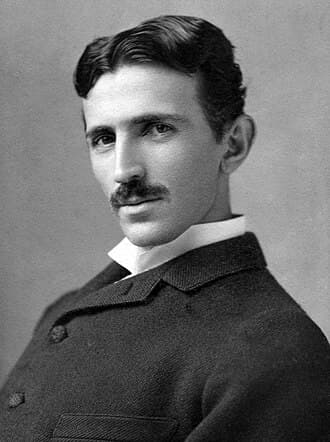
Total absorption into concept as refuge from embodied life
Genius unrecognized and then exploited by the world he was trying to illuminate
Work as the only relationship that did not betray him
Celibate and isolated, with deep attachment displaced onto animals
The betrayal by Edison as the organizing wound of the professional life
The Photographic Mind
Nikola Tesla was born in 1856 in Smiljan, in what is now Croatia. He claimed in his autobiography that he could visualize inventions in complete three-dimensional detail before building them, that he could run mental simulations, test components under stress, and identify failures, all without touching a physical object. He described this not as imagination but as perception.
The same neural architecture that produced this capacity made ordinary sensory experience a burden. He was repelled by pearls, could not touch another person's hair without distress, required that his meals be served in specific rituals, and worked in near-total isolation. These are not the eccentricities of genius. They are the accommodations of a person for whom the world as most people experience it was simply too much.
Edison and the Defining Betrayal
Tesla arrived in the United States in 1884 and went directly to work for Thomas Edison. Edison promised him fifty thousand dollars if he could improve Edison's DC electrical systems. Tesla did so. Edison told him the offer had been a joke. He paid Tesla a small raise instead.
This is the central wound in Tesla's professional biography, and it organized much of what followed. He left Edison's company and eventually developed alternating current in direct competition with Edison's direct current systems. The War of Currents, which Tesla and his backer George Westinghouse ultimately won on technical merit, was also a war about whether a genius could exist in the world without being consumed by the people who recognized his value.
Edison spent years running a disinformation campaign against alternating current, including public electrocutions of animals to demonstrate its danger. Tesla watched this and understood it precisely: the powerful do not acknowledge what they cannot control.
Pigeon 2903
In his later years, living in the Hotel New Yorker, Tesla developed an intense attachment to a white pigeon with light gray-tipped wings. He described his feelings for this bird in terms that he had never used about any human relationship, saying that he loved her as a man loves a woman, and that she was the joy of his life.
"What he described with the pigeon was not anthropomorphization. It was the one relationship in his adult life where the terms were entirely clear, the demand entirely manageable, and the attachment entirely safe from the betrayals that had defined every professional bond he formed."
Tesla never married. He described women who pursued careers as unnatural and said that celibacy had enhanced his scientific capacities. The more plausible reading is that intimate human connection, with its unpredictability and its capacity for exploitation, was a cost his nervous system could not absorb. The pigeon asked nothing he could not give.
The Marconi Wound
In 1901, Guglielmo Marconi successfully transmitted a radio signal across the Atlantic and received much of the credit for inventing radio. Tesla had filed the relevant patents earlier, and the United States Supreme Court ultimately ruled in 1943 that Tesla's patents had priority. The ruling came seven months after his death.
The pattern across Tesla's career is consistent: he develops, someone better connected to capital and publicity takes credit, the courts eventually vindicate him after it no longer matters. He was not temperamentally equipped to fight in the arenas where credit is actually assigned. Laboratories he could navigate. Financiers, publicists, and the politics of patent law were territories where his particular gifts produced no advantage.
Room 3327
Tesla died on January 7, 1943, in his room at the Hotel New Yorker. He had lived there for a decade, largely alone, largely impoverished. The FBI seized his papers immediately after his death, concerned about the theoretical weapons work he had claimed in his final years. Most of the papers were eventually returned and are archived at the Nikola Tesla Museum in Belgrade.
He was eighty-six. He had not held a laboratory position in years. The man who had envisioned wireless global communication, who had built the electrical infrastructure of the twentieth century, died in a hotel room surrounded by pigeons he had befriended on walks, with his scientific legacy still in active dispute.
The projects he pursued in his final decade, the death ray, the free energy transmitter, the global wireless system, were not the delusions of a broken mind. They were the logical extensions of a scientific vision that had always exceeded the funding and political will of the world he was working in. The gap between what he could see and what the world could support was the defining feature of his life from the beginning. At the end, it simply became total.
References
- Tesla, Nikola. My Inventions: The Autobiography of Nikola Tesla. Electrical Experimenter, 1919. - Seifer, Marc J. Wizard: The Life and Times of Nikola Tesla. Citadel Press, 1996. - Carlson, W. Bernard. Tesla: Inventor of the Electrical Age. Princeton University Press, 2013. - Jonnes, Jill. Empires of Light: Edison, Tesla, Westinghouse, and the Race to Electrify the World. Random House, 2003. - US Supreme Court. Marconi Wireless Telegraph Co. v. United States, 320 U.S. 1 (1943). - FBI FOIA release, Tesla papers, File 100-HQ-2203 (public record).
---
Interpretive opinion based on the public record. Not a clinical assessment or diagnosis of any individual.