American Psycho
Bret Easton Ellis set out to write a satire about a culture that had substituted identity for consumption, and ended up writing the most precise psychological portrait of a self constructed entirely from surfaces. Patrick Bateman is not a monster. He is a logical endpoint.
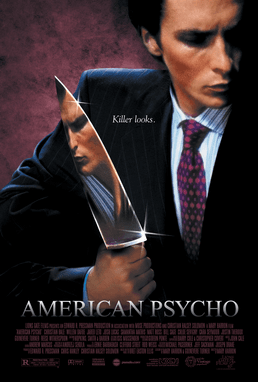
Identity as pure surface: a self assembled entirely from external signifiers with nothing underneath
The terror of indistinguishability: the horror of being interchangeable with your peers, which produces the need for increasingly extreme differentiation
Status anxiety as structural condition rather than incidental trait
Other people as mirrors or obstacles, never as separate subjects with their own interior lives
The unreliable narrator: the question of whether the violence is real or fantasy and why the answer does not change the psychology
The Surface as the Whole
Patrick Bateman knows the label of every suit he is wearing. He knows the thread count of his sheets, the precise restaurant where reservations are impossible to get, the correct response to every social situation in the specific register of early-1980s Manhattan finance culture. He knows all of this in exhaustive, almost clinical detail.
What Patrick Bateman does not know is who he is when the labels are removed.
This is the central psychological observation of American Psycho, and it is not a minor one. Bret Easton Ellis is describing a specific kind of self-construction that the culture he is depicting had made not only possible but mandatory: the self assembled entirely from external signals, from consumption and taste and status, in which the question of what is underneath the signals has no available answer.
The horror of American Psycho is not the violence. It is the emptiness that the violence is trying to fill.
The Business Card Scene
The most psychologically precise scene in Mary Harron's film, and in the novel, is the business card scene. Patrick and his colleagues compare business cards. The cards are nearly identical: same firm, same prestige, same weight of paper, same tasteful fonts. The differences are minimal. A slightly different shade of off-white. A slightly different typeface.
Patrick's response to a colleague's card is visceral panic. He sweats. The camera shows his face in a close-up of barely contained catastrophe. And then he produces his own card and waits for the response.
This scene is a complete portrait of the narcissistic wound in its pure form: the terror of being indistinguishable from your peers. If identity is made of external signals and the signals are all the same, there is no self. There is only the performance of a self, and the performance requires constant differentiation, constant confirmation that you are not the same as the other men in the room, even as everything about the culture you are embedded in requires you to be exactly the same.
The violence that follows in the novel and film can be read as the logical extension of this dynamic. When conventional differentiation fails, when the business card is not different enough, when the reservation is not exclusive enough, when the suit is not precisely correct enough, the differentiation must become more extreme. The violence is not separate from the status anxiety. It is the status anxiety taken to its conclusion.
Does It Matter Whether the Murders Are Real?
The novel is structured as an unreliable narration, and one of its central unresolved questions is whether the murders Patrick describes actually happen. There is evidence both ways. His attorney at the end of the novel tells him, regarding a specific murder, that it cannot have happened because the alleged victim was seen at a dinner in London. Patrick's response is not relief or acknowledgment. He is confused, and the confession he has left on the attorney's answering machine goes unreturned, as if it is too absurd to engage with.
Ellis has said in interviews that he does not know whether the murders are real, and that the ambiguity is intentional. The question the novel is actually asking is not whether the murders happen but what it means that Patrick needs to imagine them, whether or not he enacts them.
The unreliable narrator question redirects attention from the moral accounting of the violence to the psychological accounting of the fantasy. A man who needs to fantasize this kind of extreme differentiation tells us something about the wound that the fantasy is serving, regardless of whether the fantasy is enacted. The psychology is equally legible in either case.
This is the formal sophistication of the novel: it does not need to resolve the question of the violence to make its argument, because the argument is about the wound that generates the fantasy, not about the acts themselves.
The 80s Wall Street Context
Ellis wrote American Psycho in the late 1980s and published it in 1991, and the cultural specificity is not incidental. The decade he is describing produced a specific intensification of the dynamic he is mapping: a culture in which the accumulation and display of wealth became the primary identity formation mechanism for a certain class of young men.
Tom Wolfe had already identified the type in The Bonfire of the Vanities (1987), published four years earlier. Both books are describing the same cultural moment from different angles: the Masters of the Universe, the men for whom identity was entirely externalized in professional status and consumption.
What Ellis adds to the analysis is the interior view: what it feels like from inside when the exterior is the whole self. Wolfe's Sherman McCoy experiences humiliation and fear. Ellis's Patrick Bateman experiences something worse: nothing. The interior is not available to him. He describes emotions he does not seem to have access to. He performs appropriate responses in social situations without any evident connection to an actual emotional state.
Patrick Bateman is not a sociopath who has learned to mimic emotion. He is a person who was never given the tools to develop an interior life, because the culture he was raised in did not recognize interior life as valuable.
How the Book Was Misread
American Psycho was controversial on publication, and the controversy produced two misreadings that persist. The first was that the novel was a celebration of the violence it depicts, that Ellis was glorifying Patrick Bateman rather than dissecting him. This misreading required ignoring the satirical structure of the novel, the way the violence is rendered in the same affectless, consumer-catalog prose as the descriptions of suits and restaurants, which is the point rather than an oversight.
The second misreading was subtler: the adoption of Patrick Bateman as an aspirational figure by exactly the audience Ellis was satirizing. The Wall Street bro who identifies with Bateman as a power fantasy has read the costume and missed the wound. Ellis has spoken about this directly: "I was writing a satire about what was happening in New York in the 1980s. I was not writing a guide to it."
The business card scene lands differently for the two audiences. For the satirical reader, it is a diagnosis. For the aspirational reader, it is a tutorial. Both responses are informative about the reader.
What the Emptiness Points To
The deepest level of the novel is not about Wall Street or the 1980s or even about Patrick Bateman specifically. It is about the specific kind of suffering that results from having no access to an authentic interior life, from being a person whose self is entirely exterior, entirely performed, entirely dependent on external confirmation.
This is a recognizable psychological configuration, and it is not exclusive to investment bankers or to the 1980s. What Ellis found in that specific culture was an extreme version of a broader problem: what happens to a person who was never helped to develop a relationship to their own interior, who was raised in an environment where the interior did not matter and the exterior was everything.
Patrick Bateman is not a freak. He is a man who did exactly what his environment asked of him and arrived at exactly where that trajectory leads. The ending offers no resolution because the culture that produced him has not resolved. The analysis remains current.
References
- Ellis, Bret Easton. American Psycho. Vintage, 1991. - Harron, Mary, dir. American Psycho. Lions Gate Films, 2000. - Ellis, Bret Easton. Interview with Rolling Stone, 1994. On the intention of the satire. - Wolfe, Tom. The Bonfire of the Vanities. Farrar, Straus and Giroux, 1987. - Segal, Lynne. Slow Motion: Changing Masculinities, Changing Men. Virago, 1990. - Lasch, Christopher. The Culture of Narcissism: American Life in an Age of Diminishing Expectations. Norton, 1979. - Young, Elizabeth. "The beast in the jungle, the figure in the carpet: Bret Easton Ellis's American Psycho." Shopping in Space: Essays on American Blank Generation Fiction. Serpent's Tail, 1992.
---
Interpretive opinion based on the public record. Not a clinical assessment or diagnosis of any individual.