The Shining
The Overlook Hotel does not make Jack Torrance violent. It finds the violence already present and removes the last obstacles between Jack and what he has always been capable of. That distinction is what makes The Shining one of the most precise maps of domestic violence in the American canon.
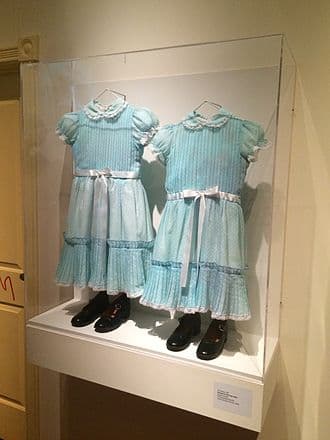
The wound as pre-existing condition: the environment amplifies what is already present rather than creating something new
Jack Torrance's alcoholism, self-loathing, and history of violence against his son, established before the film begins
Isolation as accelerant: the Overlook removes the social friction that had been keeping the wound partially contained
Grandiose fragility: Jack presents as a writer and intellectual while being unable to tolerate ordinary domestic reality
The child who knows: Danny's REDRUM as the knowledge that cannot be spoken directly arriving through an oblique channel
What the Hotel Actually Is
The most common misreading of The Shining treats the Overlook Hotel as the cause of what happens. The hotel is haunted, it drives Jack mad, it is responsible for the violence that follows. This reading makes a comfortable story: the external evil corrupts the innocent man.
Kubrick's film does not support this reading, and neither, ultimately, does King's novel, though King's version leans further into the supernatural and further into the idea of Jack as a man fighting his demons. Kubrick removes that framing almost entirely.
In Kubrick's version, the Overlook Hotel is an amplifier. It finds what is already there and gives it permission. The violence was always in Jack Torrance. The hotel is the environment that removes the last obstacles between Jack and what he has always been capable of.
This distinction matters psychologically because it describes something real about how certain kinds of violence operate. The abusive family member is not waiting for an external trigger to become who they are. They already are who they are. What changes is the context, the accountability, the presence of external friction that had been maintaining a partial inhibition.
The Wound Before the Film
The wound architecture in The Shining is established before the first frame. Jack Torrance has a history of alcoholism. He has already committed violence against his son Danny: a drunken rage in which he dislocated Danny's shoulder, an act Wendy describes to the hotel doctor early in the film. He has already lost a teaching job under circumstances that are not fully disclosed but suggest a volatile pattern.
Jack arrives at the Overlook not as an intact person being corrupted but as a person already organized around his wound, with the fragile apparatus of sobriety and professional function that constitutes his current containment. The Overlook does not introduce the violence. It finds the wound and addresses it directly.
The Overlook is the first environment Jack has encountered that speaks to him in the language of his wound rather than requiring him to contain it. The hotel does not ask him to be better than he is. It asks him to be exactly what he already is. For a person with Jack's wound structure, this is experienced as homecoming.
Jack's Wound Architecture
Jack Torrance is a recognizable type: the man who experiences ordinary domestic life as intolerable constraint. He is a writer who cannot write. He is a father who experiences his son's presence as an interruption. He is a husband who experiences Wendy's reasonable concern as persecution.
Jack Nicholson's performance makes this legible from the opening scenes. The affability is performed. Beneath it is a simmering contempt for everything around him: for the smallness of his circumstances, for the gap between who he believes himself to be and where he has actually arrived, for the family that is simultaneously the evidence of his failure and the audience for it.
Grandiose fragility is the technical term for this configuration. The grandiose self requires the world to reflect its own assessment of its specialness. When the world fails to do this, which ordinary life inevitably does, the response is either collapse or rage. Jack's wound produces rage.
The hotel feeds this directly. The ballroom, the Gold Room, the elegant decay of the Overlook all speak to the Jack who believes he belongs to a grander world than the one he has been given. The ghosts confirm his specialness. Lloyd the bartender gives him alcohol without judgment. Grady the former caretaker tells him what his wound most wants to hear: that his family is the obstacle between him and who he really is.
Danny and the Knowledge That Cannot Be Spoken
Danny Torrance's REDRUM is one of the most analyzed images in horror cinema, and the analysis usually focuses on its clever construction: MURDER spelled backward, visible in a mirror. But the psychological content of the image is what makes it durable.
Danny has a form of psychic perception, the shining, that serves in the film as a metaphor for something specific: a child's knowledge of what is happening in the family that cannot be acknowledged directly. Children in violent households know what is coming before it arrives. They read micro-expressions, they feel the quality of the silence, they track the specific way a door closes. This knowledge is real and accurate and cannot be spoken, because speaking it would require the adults to acknowledge what the adults are invested in denying.
REDRUM is MURDER arriving through an oblique channel because the direct channel is not available. Danny cannot say what he knows. He says it sideways, in a voice that is not quite his, in letters that require a mirror to read. The mechanism is the mechanism of the traumatized child communicating the unspeakable through whatever channel remains open.
Wendy Torrance Is the Most Interesting Character
Wendy Torrance is routinely dismissed, including by King himself, who has been publicly critical of Shelley Duvall's portrayal. This dismissal misreads what is psychologically most complex about the film.
Wendy is not passive. She is trapped. These are different conditions, and the difference is important.
Wendy has no resources. She is isolated in a building in the Colorado mountains with her child and her husband. She has no car capable of navigating the snow. She has no communication outside the radio. She has a son with a neurological condition she does not fully understand and a husband she has spent years managing around. She is not failing to act. She is operating in a situation in which all the ordinary exits have been systematically removed.
This is the architecture of domestic entrapment, and Kubrick renders it with precision. Wendy's arc is not a character flaw study. It is a study of a person with no resources facing a situation with total resources. Her survival at the end is earned, not accidental.
The Photograph and What It Means
The final image: a black-and-white photograph of the Overlook ballroom, dated July 4th, 1921. Jack Torrance is in it, smiling, at the center of the crowd.
The photograph is the film's most debated image. The most psychologically coherent reading is not supernatural but structural: the Overlook has always needed someone like Jack, and men like Jack have always found their way to places like the Overlook. The photograph is a record not of reincarnation but of repetition. The wound finds the environment that confirms it. The environment has been doing this for a long time. It will continue.
King's novel ends with the hotel destroyed, Jack's supernatural possession broken, a tragic but bounded conclusion. Kubrick's ending offers no such resolution. The photograph says: this is ongoing. The man smiling in 1921 was not the first. Jack is not the last.
References
- Kubrick, Stanley, dir. The Shining. Warner Bros., 1980. - King, Stephen. The Shining. Doubleday, 1977. - King, Stephen. On Writing: A Memoir of the Craft. Scribner, 2000. - Cocks, Geoffrey. The Wolf at the Door: Stanley Kubrick, History, and the Holocaust. Peter Lang, 2004. - Falsetto, Mario. Stanley Kubrick: A Narrative and Stylistic Analysis. Praeger, 2001. - Walker, Alexander, Sybil Taylor, and Ulrich Ruchti. Stanley Kubrick, Director: A Visual Analysis. Norton, 2000. - Herman, Judith. Trauma and Recovery. Basic Books, 1992.
---
Interpretive opinion based on the public record. Not a clinical assessment or diagnosis of any individual.