The Challenger Disaster
The engineers knew. They said so, in writing, the night before. What happened next is not a story about technical failure. It is a story about what institutions do to the truth when the truth is inconvenient - and what people do when the institution is louder than their own knowledge.
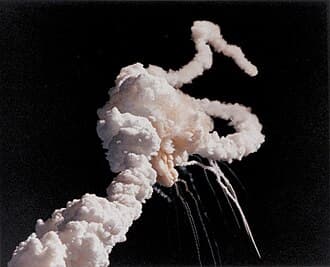
Institutional pressure silencing individual certainty
The cost of dissent inside systems that have scheduled their outcomes in advance
Deference replacing judgment - the moment when knowing and acting become separated
Hierarchical loyalty overriding professional obligation
Normalizing the anomaly - risk made routine until the routine fails catastrophically
What the Engineers Knew
On the evening of January 27, 1986, Roger Boisjoly and other engineers at Morton Thiokol gave NASA a formal recommendation: do not launch. The O-ring seals on the solid rocket boosters had known failure risks at low temperatures, and the overnight forecast for Cape Canaveral called for temperatures in the mid-twenties - far outside the tested range.
Boisjoly had been raising this concern for months. He had written a memo in July 1985 stating explicitly that if the O-ring issue was not addressed, the result could be "a catastrophe of the highest order - loss of human life."
The launch was scheduled for the morning of January 28th. There was a teacher on board. The president planned to call the shuttle from the State of the Union address that evening.
The engineers had the information. The institution had the schedule.
The Meeting
What happened in the teleconference between Thiokol management and NASA managers the night before the launch is the cartographic center of this event. Thiokol engineers recommended against launch. NASA managers pushed back. At a critical moment, Thiokol managers asked for a five-minute break - and in that break, told the engineers to take off their engineering hats and put on their management hats.
This instruction is the most psychologically precise sentence in the entire record. It names the mechanism explicitly: your professional judgment is a costume, and we need you to change costumes before you give us your answer.
"The engineers were not wrong. They were not overruled by better data. They were overruled by organizational pressure operating through the specific lever of role identity - the implied message that being a team player meant agreeing with the schedule, and that disagreement was a category error rather than a professional obligation."
Thiokol management gave the go-ahead. The launch proceeded.
Normalized Risk
The Rogers Commission, which investigated the disaster, identified a pattern that has since become one of the foundational case studies in organizational psychology: the normalization of deviance. The O-ring erosion had been observed and documented on previous flights. Because previous flights had not ended in catastrophe, the erosion was reclassified - gradually, without any formal decision - from warning sign to acceptable anomaly.
This is how risk becomes invisible inside institutions. It is not suppressed by malice. It is suppressed by repetition. The thing that should be a red flag becomes familiar, and familiar things stop registering as signals.
What Boisjoly Experienced After
Roger Boisjoly testified fully and honestly before the Rogers Commission. He named what had happened. He did not protect the institution.
He was subsequently sidelined by Thiokol, suffered severe post-traumatic stress, and was effectively unable to work as an engineer for years afterward. He spent the rest of his career giving lectures about ethics in engineering, often to standing-room audiences who found his story clarifying rather than discouraging.
The man who was right, and said so, and was ignored, and then said so again in public - and was punished for both - is the terrain marker that the disaster produces most reliably. Every institution has people like this. Very few institutions have built the conditions that would let them be heard.
The Psychological Map
Challenger is not primarily a story about NASA. It is a story about the interior experience of knowing something true and being unable to make it matter. It is a story about the specific psychological cost of deference - the thing that happens to a person who has professional knowledge, expresses it clearly, is overruled by social pressure dressed as organizational process, and then watches the consequence arrive.
Boisjoly described, in subsequent interviews, not being able to watch the launch coverage. He knew before the cameras showed it what was going to happen. The knowledge had been in the room the night before. The room had decided it was not the kind of knowledge that counted.
References
- Presidential Commission on the Space Shuttle Challenger Accident. Report to the President. U.S. Government Printing Office, June 1986. - Feynman, Richard P. "Personal Observations on the Reliability of the Shuttle." Appendix F to the Rogers Commission Report, 1986. - Vaughan, Diane. The Challenger Launch Decision: Risky Technology, Culture, and Deviance at NASA. University of Chicago Press, 1996. - Boisjoly, Roger. "Ethical Decisions: Morton Thiokol and the Space Shuttle Challenger Disaster." Lecture transcript, Ethics in Engineering, 1987. - McDonald, Allan J., with James R. Hansen. Truth, Lies, and O-Rings: Inside the Space Shuttle Challenger Disaster. University Press of Florida, 2009.
---
Interpretive opinion based on the public record. Not a clinical assessment or diagnosis of any individual.