Andrew Tate
One of the clearest cases of a wound architecture that got mistaken for a philosophy. The absent exceptional father, the hostile social environment, the body as proof: the entire structure is legible once you know where to look.
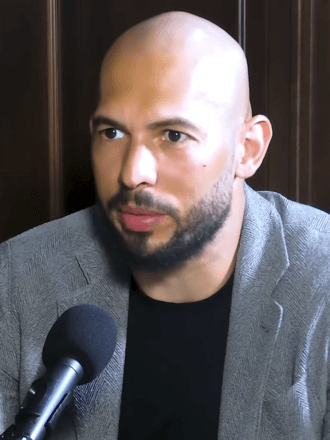
Masculinity as wound response
Absent idealized father / childhood bullying and powerlessness
Body as proof of dominance
Control vector - constructing environments of total dominance
Wound architecture mistaken for philosophy
The Father Who Was There and Then Gone
Emory Tate was a chess master of genuine distinction. Rated 2327 by the United States Chess Federation, he was considered one of the strongest African American chess players of his era, winning the Armed Forces Chess Championship four times. He was also not reliably present in his children's lives. He and Andrew's mother, Eileen Tate, separated when Andrew was young, and the family moved to Luton, England, where Andrew grew up with limited contact with his father.
The specific wound of an exceptional absent father is different from the wound of an ordinary absent father. With an ordinary absence you can construct a story about a man who lacked what was needed. With an extraordinary absence you are left with evidence that the person had what it took -- discipline, intelligence, the capacity for mastery -- and chose to direct it elsewhere. That evidence does not let you off the hook. It raises a different and more painful question.
Andrew Tate has spoken about his father with reverence. He has described learning chess and developing intellectual discipline from Emory's example. He has also described a childhood of material poverty and emotional instability in which his mother raised him and his siblings largely alone. The idealization of an absent extraordinary father and the reality of the absence coexist in his public statements without resolution. That coexistence is precisely the wound.
Luton and the Specific Psychology of Powerlessness
Luton is an industrial town north of London with a large South Asian immigrant population and a history of economic decline. Tate has described being bullied there as a child. He has said in multiple interviews that he was targeted, that he was physically threatened, and that the experience of being unable to defend himself was formative.
The terrain observation is not that bullying produces a particular outcome -- it does not, deterministically. The observation is about what it produces in combination with the other available material: an absent father whose domain was mastery, a childhood defined by powerlessness, and an interior architecture that has not yet developed the tools to metabolize the humiliation. In that combination, the path to a constructed self that cannot be victimized becomes appealing. Not incidentally appealing. Compulsively appealing.
In an interview he described the moment he decided to take martial arts seriously: >> "I realized that the only way to never feel that powerless again was to become someone that other people are afraid of." | Andrew Tate That is not a description of an athletic career. That is a wound speaking in plain language.
The Kickboxing Career and What It Built
Tate became a four-time ISKA World Champion kickboxer. This is documented, real athletic achievement requiring years of training, pain tolerance, and genuine competitive performance at an elite level. The body was transformed into proof.
What kickboxing required psychologically is as significant as what it produced. To train at that level requires the complete subordination of present comfort to future performance. It requires accepting physical pain as a condition of progress. It requires, above all, constructing an identity around a system that pays out in verifiable, objective terms. You win or you lose. The record is public. The proof is real.
For someone whose early wound was about powerlessness and the impossibility of objective proof of adequacy, this is not simply a career choice. It is an architecture. The training solves the Luton problem by making the answer visible, measurable, and undeniable. You cannot argue with a championship record.
"When the formative wound is about powerlessness, demonstrated power becomes the wound's preferred answer. The training, in this reading, is doing more than one thing at once."
The Webcam Studio and What the Business Model Reveals
Before his international media profile, Tate ran a webcam studio business in Romania in which women were employed to perform for paying customers online. He described the business model in a 2017 video that later became widely circulated: instructing the women to pretend to be in love with customers to increase revenue, describing methods for managing their behavior and maintaining their participation.
The terrain observation about this business model is not primarily legal or moral -- those are separate analyses. It is structural. He designed a system in which he had total control over the economic output of women who were financially dependent on his operation, in a jurisdiction whose legal environment made that structure sustainable. The wound architecture around control, combined with the specific psychology of women developed in Luton under material scarcity, produced a business model that externalized the interior structure. The company was a map of the wound.
Explicit Statements as Wound Architecture
Tate has said, in various interviews and courses, that men should not cry, that emotional expression is weakness, that the only currency that matters is respect earned through dominance, that women should be obedient to men who provide for them, and that vulnerability of any kind is an invitation for exploitation. He has packaged these positions as a philosophy, sold them to millions of young men, and described them as a corrective to a culture that has failed masculinity.
The terrain reading is different. Each of these positions is precisely what a person who had been hurt by vulnerability, powerlessness, and dependence would believe. Not because it is true, but because it solved the wound. If you believe that emotional expression is weakness, you do not have to feel what the absent extraordinary father's absence actually felt like. If you believe that dominance is the only currency, you can never be the boy in Luton again. The philosophy is the wound's answer to the wound.
He told Tucker Carlson in 2023: "The matrix tried to destroy me because I was the most important person on the internet. I was reaching young men with the truth." That framing -- chosen target of a coordinated system, bearer of suppressed truth, uniquely important -- is consistent with an interior architecture organized around an exceptional identity that has never been adequately confirmed.
The Romania Move and the Control Imperative
Tate moved to Romania in 2017. He has said in various interviews that he moved partly because Romanian law enforcement was less likely to investigate him and partly because the cultural environment was more aligned with his values regarding women and masculinity. He said explicitly in a 2017 interview that he moved to Romania partly because if he were accused of rape by a woman there, the police would be less likely to believe her.
Choosing a jurisdiction for its legal leniency is choosing to make the environment controllable. This is the same move as the webcam studio, the same move as the kickboxing career, the same move as the entire rhetorical apparatus of dominance philosophy. The wound was about an environment he could not control. The pattern across his adult life is to move into environments where control is maximized and the threat of accountability is minimized.
References
- Tate, Andrew. Various interviews on YouTube and podcast appearances, 2016-2023. - Emory Tate chess career records and USCF ratings, publicly documented. - Tate, Andrew. Kickboxing career record: ISKA World Full-Contact Kickboxing Champion documentation. - Ronson, Jon. "The Andrew Tate Problem." The Guardian, August 2022. - Lewis, Helen. "The Men Who Swallowed the Red Pill." The Atlantic, October 2022. - Tate, Andrew. Interview with Tucker Carlson. Tucker Carlson Network, 2023. - Beckett, Lois. "How Andrew Tate became a hero to young men." The Guardian, September 2022.
---
Interpretive opinion based on the public record. Not a clinical assessment or diagnosis of any individual.