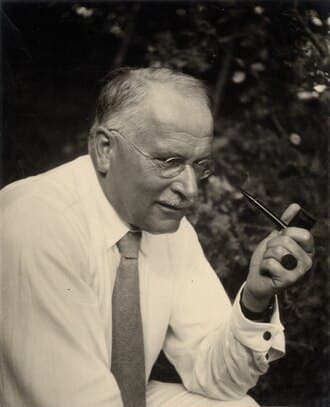
Carl Jung
He built the most comprehensive map of the human interior the twentieth century produced, entirely from the inside. The wound was the insufficient framework he inherited from a father who lost his faith. The method was a new framework large enough to hold the question the old one could not.
Wound-to-framework
Father who lost his faith / inherited doubt and insufficient container
Built comprehensive interior map from direct interior experience
Interior richness making ordinary sustained closeness harder
Bollingen: something that resists the framework entirely
The Father Who Lost His Faith
Johann Paul Jung was a Swiss Reformed pastor whose faith eroded under the weight of his own doubt. He preached while privately doubting, becoming increasingly depressed and distant as his son grew. He died when Carl was twenty-one, leaving his son with a structural inheritance: inherited frameworks may be insufficient, and authority figures may be most tormented by the unanswered questions beneath those frameworks.
The wound was not the death. It was watching, across a childhood, a man trying to hold a framework that could no longer hold him. Jung described his father in Memories, Dreams, Reflections as a man trapped between faith and doubt who could find no way through: "He had worked himself into a corner, and now he was shrinking from the things he had most ardently believed in." The son registered this and concluded, at some level, that the available frameworks were inadequate - and that the cost of pretending otherwise was the kind of slow interior collapse he had witnessed.
Two Personalities
Jung described throughout his life the experience of existing as two people simultaneously. In Memories, Dreams, Reflections, the autobiography he dictated in his eighties, he wrote: "From the start I had a sense of being a double person. One of me was a responsible pupil, diligent, decent... The other was a grown man, skeptical, worldly, removed from human concerns."
Personality No. 1 was the schoolboy, the son, the person who existed in the world of other people's expectations. Personality No. 2 was older, connected to something vast and historical - what he later identified as the collective unconscious, the inherited psychological material shared across human experience.
His description of Personality No. 2 is not metaphorical. He described it as a felt presence, an inner authority he consulted and deferred to from childhood. He also described, in the same memoir, a specific act from early boyhood: carving a small wooden figure, a manikin, and hiding it with a smooth stone in the attic of his family home. He visited the figure periodically, in secret. The act was, he later understood, a self-generated ritual - a child creating an anchor for the inner life that the outer world could not accommodate.
"I have often been asked where my ideas come from. I have to confess that I don't know. My ideas have invariably sprung to life from a conflict I have experienced, or from a need." - Carl Jung, Memories, Dreams, Reflections
The Parsonage and the Question
Growing up in a parsonage, surrounded by the apparatus of Christian faith, Jung experienced a childhood structured around answers to questions he found increasingly inadequate. The God of his father's church did not fit what he observed. His father preached. His father doubted. The gap between the public framework and the private experience was the formative lesson.
The question the parsonage produced was not "is Christianity true" but rather "what container is large enough to hold what I actually experience." The entirety of analytical psychology is an attempt to answer that question. The archetypes, the collective unconscious, the individuation process: these are not theories built from clinical observation. They are frameworks constructed to hold a specific kind of interior experience that inherited frameworks were unable to contain.
The Freud Rupture
Jung met Freud in Vienna in March 1907. By most accounts, including Jung's own, they spoke for thirteen hours on the first day. The connection was immediate and, for Jung, the quality of recognition he had been seeking: a mind capable of taking the interior seriously.
Freud appointed Jung his crown prince and designated him the first president of the International Psychoanalytic Association in 1910. The appointment served Freud's specific need: an heir who was not Jewish, who could carry psychoanalysis beyond what Freud feared would be dismissed as a narrowly Jewish enterprise.
The problem was the libido. Freud required agreement that sexuality was the foundational energy of psychological life - the non-negotiable premise from which everything else followed. Jung could not subordinate his interior experience to this fixed point. He had observed psychological material that seemed to exceed individual biography, that drew on mythological and collective themes that sexual theory could not accommodate. His 1912 work Transformations and Symbols of the Libido redefining libido as a broader psychic energy was the public announcement of the divergence. Freud read it as betrayal.
The break, completed in 1913, precipitated Jung's psychological crisis and, from within that crisis, the development of analytical psychology. What destroyed the relationship built the framework.
The Red Book
Between 1913 and approximately 1917, Jung filled a series of black notebooks with visions, unconscious dialogues, and records of active imagination sequences. He later transcribed and illustrated this material in a large red leather volume he called Liber Novus - the New Book. He kept it private for the remainder of his life. It was published in 2009, fifty years after his death, as The Red Book: Liber Novus.
The Red Book is the wound before the framework. It documents the interior experience that the methodology would later organize into comprehensible theory. It includes encounters with figures he called Philemon, Elijah, and Salome - personified aspects of the unconscious he engaged in extended dialogue. It is disorienting to read precisely because it does not translate these experiences into conceptual language. They are presented as events.
Jung wrote in the Red Book: "The years of which I have spoken to you, when I pursued the inner images, were the most important time of my life. Everything else is to be derived from this." He said this to Aniela Jaffe, who recorded his autobiography. He was not exaggerating.
Bollingen: The Tower Built by Hand
Starting in 1923, Jung constructed a stone tower on the shore of Lake Zurich at Bollingen with his own hands, adding rooms across four decades. No electricity, no modern conveniences. He cooked over an open fire, drew water from a well, chopped his own wood.
The tower is a terrain document distinct from everything else in his life. It is not a theory. It is a thing that resists translation into framework. He built it with his hands rather than his mind. He said it was where he felt most himself - "there I am in the real truth of my nature." The tower represents the portion of him that the framework, however comprehensive, could not contain. The man who built the most elaborate map of the interior also needed something that the map could not represent.
References
- Jung, C.G. Memories, Dreams, Reflections. Recorded and edited by Aniela Jaffe. Pantheon Books, 1962. - Jung, C.G. The Red Book: Liber Novus. Edited by Sonu Shamdasani. W.W. Norton, 2009. - Bair, Deirdre. Jung: A Biography. Little, Brown, 2003. - Shamdasani, Sonu. Jung and the Making of Modern Psychology: The Dream of a Science. Cambridge University Press, 2003. - Jung, C.G. Two Essays on Analytical Psychology. Collected Works, Vol. 7. Princeton University Press, 1953. - McGuire, William, ed. The Freud/Jung Letters. Princeton University Press, 1974. - Jung, C.G. Psychological Types. Collected Works, Vol. 6. Princeton University Press, 1921.
---
Interpretive opinion based on the public record. Not a clinical assessment or diagnosis of any individual.