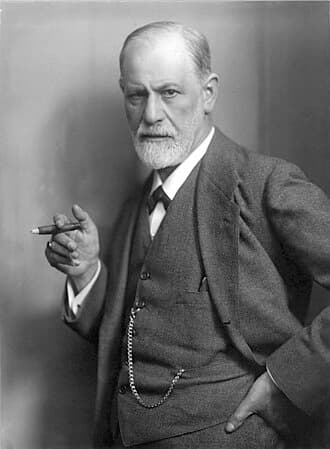
Sigmund Freud
The founder of psychoanalysis as terrain subject: the mother's favorite who needed recognition at scale, the father's son who watched submission and vowed surpassal, and the theory that universalized one man's specific wound as the human condition.
Recognition at scale
Conditional specialness / paternal submission / Jewish exclusion in Vienna
Wound universalized as human condition through theory
Authority-seeking through theoretical framework
Self-analysis bearing marks of the wound it examined
Amalia's Golden Sigi
Freud's mother, Amalia Nathansohn Freud, believed from the beginning that her firstborn son would be great. A fortune teller had reportedly told her at his birth that she had brought a great man into the world. She repeated this to him. She called him her golden Sigi. She gave him the best room in the family apartment, a private oil lamp for studying while siblings shared candles, and a piano removed from the house because its practice disturbed his concentration.
The psychological effect of this treatment is specific and has a specific cost. The child who receives reflected greatness before it is earned develops two things simultaneously: genuine confidence, and a hunger for the external recognition that can never quite prove the internal proposition. The promise was delivered too early and from too interested a source. The recognition has to be earned again from the outside, at scale, from people with no obligation to love you. That drive runs through Freud's entire career like a structural beam.
He was aware of some of this. He wrote to his friend Wilhelm Fliess in 1897: "I have found love of the mother and jealousy of the father in my own case too, and now believe it to be a general phenomenon of early childhood." That sentence is worth reading slowly. He found it in himself and immediately made it universal. The move from "in my own case" to "general phenomenon" is the core of what this map is tracking.
The Hat in the Mud
Freud's father Jakob was a wool merchant who had already had two sons by a previous marriage when he married the twenty years younger Amalia. He was a mild man, accommodating, not given to confrontation. Freud records in The Interpretation of Dreams the story that became central to his self-understanding: when Jakob was a young man, an antisemite knocked his new fur hat into the mud and told him to get off the pavement. Jakob picked up the hat and walked away.
Freud, hearing this story as a boy, found it intolerable. He compared his father unfavorably to Hannibal's father Hamilcar Barca, who made his son swear revenge on Rome. The son who had been promised greatness by his mother now faced a father whose response to humiliation was compliance. The contradiction was irreconcilable and productive. Freud would spend his life building something large enough, authoritative enough, and systematically unanswerable enough that the mud-and-hat response would never be necessary. His weapon would be theory, not retreat.
The Vienna Exclusion and What It Produced
Freud entered the University of Vienna in 1873, one year after Jews were granted full civil rights in Austria. The formal permission and the social reality were different things. He wrote in his autobiography that as a Jew at university he found himself "in the opposition" and was taught early "to be familiar with the fate of being in the opposition and of being put under the ban of the compact majority." Academic advancement was systematically slower for Jewish physicians. Hospital positions required navigating antisemitism. The professoriate arrived for Freud only in 1902, at age forty-six, after colleagues lobbied the minister of education on his behalf.
"He needed to create something authoritative in a world that denied him authority. The theory had to be large enough, systematic enough, and inarguable enough to force recognition that the social environment withheld."
This is not a claim that antisemitism explains psychoanalysis. It is a claim that the specific form psychoanalysis took -- universal, systematic, resistant to falsification from the outside, claiming to explain its own critics as resisters -- reflects the psychological needs of a man who had been excluded from every authoritative institution available to him. He built his own.
The Self-Analysis of 1896-1899
Jakob Freud died on October 23, 1896. Freud wrote to Fliess four days later: "The old man's death has affected me deeply. I valued him highly, understood him very well, and with his peculiar mixture of deep wisdom and fantastic light-heartedness he had a significant effect on my life." He also called it "the most important event, the most poignant loss, of a man's life."
What followed was a sustained, unprecedented self-analysis conducted by correspondence with Fliess between 1896 and 1899. Freud analyzed his own dreams, his own memories, his own aggression toward his father. This self-analysis produced the Oedipus complex, the interpretation of dreams, the theory of infantile sexuality, and the edifice of psychoanalysis as we know it. It produced all of this from one man examining one man's interior, in grief, in the middle of the night, alone. The resulting theory claimed to describe everyone.
The Oedipus Complex as Autobiography Universalized
Freud derived the Oedipus complex from his own self-analysis: the desire for the mother, the rivalry with the father, the threat of castration, the resolution through identification. He had a dominating, adoring mother, a submissive father he found inadequate, and a psyche shaped by that specific combination. He made this the universal structure of human psychological development.
His biographer Peter Gay notes that Freud's theoretical innovations consistently clustered around his own psychological conflicts. The concept of the death drive arrived in 1920, following the death of his daughter Sophie. His analysis of Leonardo da Vinci, now widely criticized as projection, said as much about Freud as about Leonardo. This is not a refutation of the theory. It is an observation that the theory was built from autobiography and the seams are visible.
The Pattern of Excommunication
Alfred Adler left the Vienna Psychoanalytic Society in 1911 after theoretical disagreement. Carl Jung broke in 1912 following disputes about the centrality of sexuality. Otto Rank, perhaps the most devoted disciple, was expelled from Freud's circle in 1926. Wilhelm Reich, Sandor Ferenczi, and others were pushed out or marginalized.
The pattern is consistent: a disciple develops a significant theoretical modification, Freud treats it as betrayal rather than development, the relationship ends. Freud wrote of Jung in 1912: "He seems to be objective and superior. I know of nothing that I could reproach him with, and yet there is something that he is holding back." He was right that something was being held back -- independent thought.
The wound that needed recognition at scale cannot tolerate modification of the framework that earned it. To change the theory is to unmake the achievement. The excommunications are the mother's promise and the father's hat meeting the challenges of intellectual inheritance.
Cocaine and Fleischl-Marxow
In 1884 Freud published a paper recommending cocaine as a treatment for morphine addiction and for general use as an analgesic and stimulant. He gave it to his friend Ernst von Fleischl-Marxow, who was dying painfully from a nerve infection and had become addicted to morphine. Fleischl-Marxow became addicted to cocaine instead, at far higher doses than Freud had recommended, and died in 1891. Freud continued using cocaine himself into the 1890s.
His investment in cocaine's therapeutic properties reflects a characteristic pattern: passionate adoption of a system that promised to solve intractable problems, followed by reckoning with its costs. The cocaine episode is the earliest documented version of a structure that recurs across his career -- the confident advocacy of a framework before its failure modes are visible.
References
- Freud, Sigmund. The Interpretation of Dreams. 1900. Translated by James Strachey. Basic Books, 1955. - Freud, Sigmund. The Psychopathology of Everyday Life. 1901. Translated by James Strachey. W.W. Norton, 1966. - Freud, Sigmund. An Autobiographical Study. 1925. Translated by James Strachey. W.W. Norton, 1963. - Gay, Peter. Freud: A Life for Our Time. W.W. Norton, 1988. - Jones, Ernest. The Life and Work of Sigmund Freud. 3 vols. Basic Books, 1953-1957. - Freud, Sigmund. Complete Psychological Works of Sigmund Freud. Standard Edition. Translated by James Strachey. Hogarth Press, 1953-1974. - Masson, Jeffrey Moussaieff, ed. The Complete Letters of Sigmund Freud to Wilhelm Fliess, 1887-1904. Harvard University Press, 1985. - McGuire, William, ed. The Freud/Jung Letters. Princeton University Press, 1974. - Bernfeld, Suzanne Cassirer. "Freud and Archeology." American Imago, 1951.
---
Interpretive opinion based on the public record. Not a clinical assessment or diagnosis of any individual.