Naomi Osaka
The cost of excellence performed for others. What happens when a quiet person is handed a very loud platform, and finally names the price.
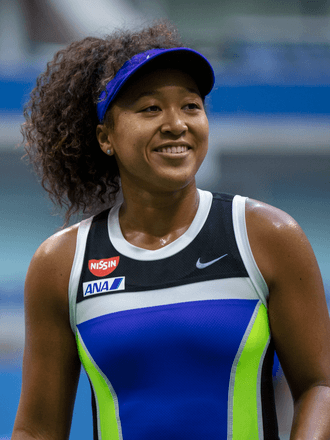
Quiet person handed a loud platform
Mismatch between nature and sport's requirements
Excellence performed for others
Identity without full belonging - neither fully Japanese nor American
Precise cost-naming as significant interior awareness
The Quiet Person
Osaka describes herself as introverted and shy. She grew up between Japan and the United States with a Haitian-American father, Leonard Francois, and Japanese mother, Tamaki Osaka, feeling she did not fully belong in either culture. She became famous in a sport requiring mandatory press performance, constant visibility, and public persona projection across two national identities.
The foundational terrain feature is the mismatch. She chose tennis, or was guided toward it from an early age when her father, inspired by the Williams sisters, moved the family from Japan to the United States to develop her game. Celebrity arrived as a consequence of excellence, before she had developed any relationship to it. This sequence matters. Fame that arrives as the byproduct of something you genuinely love is different from fame that arrives as something you pursued. It is less prepared for, and its costs are less visible until they are impossible to ignore.
The 2018 US Open
On September 8, 2018, at Arthur Ashe Stadium in New York, Osaka defeated Serena Williams 6-2, 6-4 in the US Open final. She was twenty years old. She became the first Japanese player, male or female, to win a Grand Slam singles title.
The match should have been the defining moment of her arrival. Instead, it was dominated by Williams's dispute with chair umpire Carlos Ramos, who penalized Williams for receiving coaching signals from the stands, then for racket abuse, then for verbal abuse. Williams called the code violations sexist and demanded an apology that was not forthcoming. The crowd, heavily favoring Williams, booed through the trophy ceremony.
Osaka stood on the court in a visor, crying. She apologized to the crowd. "I know that everyone was cheering for her, and I'm sorry it had to end like this," she said, holding her trophy.
That sentence is a terrain document. She had just won a Grand Slam final and she was apologizing for winning. The victory was legitimate and complete. The apology was real. Both things happened simultaneously because her interior architecture had been built to manage others' disappointment before her own experience.
"She received an enormous platform unprepared, under the most complicated circumstances imaginable - winning her first Grand Slam while the crowd booed the outcome, required to perform grace and gratitude for an audience that was grieving someone else's loss. She was twenty years old and she apologized for winning. That is not weakness. That is a person whose entire orientation toward visibility had been formed in the context of not wanting to take up too much space."
The Duality Question
Osaka holds both Japanese and American citizenship, though Japanese law requires athletes to choose one nationality by age twenty-two. She chose Japanese citizenship in order to compete for Japan at the Tokyo Olympics. The choice was practical and also symbolic: an alignment with a national identity that had not always aligned with her.
She has described the duality of her identity with care. In Japan, she has sometimes been received as not sufficiently Japanese - her father is Black, her look is different, her Japanese was not fluent in childhood. In the United States, she is sometimes framed primarily as a Black athlete, which absorbs the Japanese side of her identity. Neither framing is complete. Neither framing is hers.
"I feel like I've always been in the middle," she told The New Yorker in 2019. "I'm not the same as either side, and I think for a long time that felt lonely."
Becoming a symbol before settling into personhood creates specific terrain complexity. The symbol of Naomi Osaka has national, racial, and cultural dimensions that the particular person had not finished working through. The symbol required her to represent multiple communities simultaneously, as if the belonging question had been resolved when it had merely been deferred.
The 2021 French Open and the Naming
In May 2021, Osaka withdrew from the French Open after the first round, citing the mental health costs of mandatory post-match press conferences. She described the format as one that requires athletes to place themselves in situations of doubt and criticism immediately following competition, and said she had experienced depression since her 2018 US Open win.
The public and media response was divided, sometimes hostile. Critics argued she had an obligation to the press and to sponsors. Supporters argued she had identified a genuine structural problem in the sport's relationship to athlete mental health.
What the map notes is the precision of the cost-naming. She did not claim exhaustion or burnout in general terms. She identified a specific mechanism: mandatory public exposure after competition, for someone whose psychological structure was not built for compulsory visibility, caused genuine harm. She was not describing a preference. She was describing a wound and the specific instrument that re-opened it.
This kind of precision - the ability to identify not just that something hurts but exactly how it hurts and why - signals significant interior awareness. Most people cannot do this. She did it publicly, at twenty-three, under significant institutional pressure to remain silent.
"I never wanted to be a spokeswoman for mental health," she told Time in July 2021. "I just wanted to be honest about what was happening to me."
The Netflix Documentary and What It Showed
The 2021 Netflix documentary series Naomi Osaka followed her through the 2020 US Open and Australian Open. The footage is notable for what it shows rather than what it says: a young woman who is comfortable alone, deeply uncomfortable with celebrity, genuinely close to her small inner circle, and running a public performance of composure over a private experience of considerable anxiety.
The documentary shows her watching her own matches with her face in her hands. It shows the gap between the composed athlete on court and the person in the locker room. It shows someone who has not, as of 2020, reconciled herself to the visibility that her excellence has made unavoidable.
That reconciliation may be ongoing. She has spoken in recent years about working with therapists, about the relationship between her game and her mental health, and about the possibility that she can hold both - the excellence and the person it lives in - without one destroying the other.
The Trajectory Ahead
Osaka returned to the tour after the birth of her daughter in 2023. The return involved a gradual reintegration of the physical and, by her own account, a reassessment of what she wanted from the sport and for herself. The public performances of composure have become, if anything, more grounded - less like a mask maintained against pressure and more like a disposition she has actually arrived at.
The question the map holds going forward is whether the belonging question has been answered, or whether the symbol structure has simply expanded to include mother, returning champion, and mental health advocate as additional categories. A symbol that grows large enough eventually resembles a person. The map wants to know whether the person is still there underneath it.
References
- Naomi Osaka. Netflix documentary series, 2021. - Osaka, Naomi. Statement on withdrawal from the 2021 French Open. May 31, 2021. - Osaka, Naomi. "It's O.K. Not to Be O.K." Time, July 2021. - Bondy, Filip. "Naomi Osaka: Uneasy Lies the Head." The New York Times, August 2021. - Hirsch, James S. "Naomi Osaka's Complicated Identity." The New Yorker, September 2019. - 2018 US Open Women's Final. USTA official broadcast transcript, September 8, 2018. - Osaka, Naomi. Interview with Vogue Japan, 2020.
---
Interpretive opinion based on the public record. Not a clinical assessment or diagnosis of any individual.