Robin Williams
He gave the world more laughter than it knew how to hold, and died alone in a room. The comedy was not a performance of happiness but constructed armor over a specific early wound the world never saw, because it was always laughing.
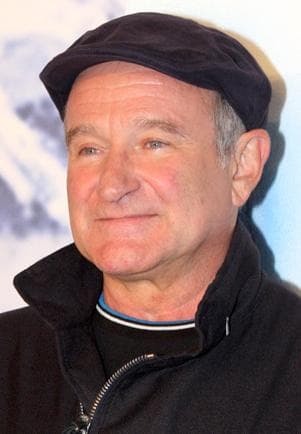
Manic generosity as wound management
Childhood aloneness in a large, emotionally distant household
Performance as connection substitute
Giving without receiving / comedy as the cost of admission
The interior the audience never touched
The House in Bloomfield Hills
Robin Williams grew up in a large house in Bloomfield Hills, Michigan, the son of a Ford Motor Company executive father who was frequently absent and a mother who was socially present but emotionally unavailable in the specific way that produces a certain kind of child. There were servants and square footage but not warmth in the rooms. He was, by his own description, fundamentally alone as a boy, his primary companion his own imagination and the voices he could produce from it.
The architecture this produces is a recognizable type: the child who learns to make adults laugh because laughter is the most reliable form of attention. Other children with similar terrain sometimes develop withdrawal, or intellectualism, or rage. Williams developed performance. The connection between what he felt and what the room felt became a mechanism he could operate, and he operated it with increasing virtuosity for the rest of his life. By the time he got to Juilliard, then to the San Francisco comedy scene, then to Mork and Mindy and beyond, the mechanism had become the identity. The wound and the gift had fused into something that looked, from the outside, like pure joy.
Comedy as Armor
The specific function of the comedy is what matters here. It was not simply what Williams was good at. It was the thing that stood between him and the childhood feeling: the particular texture of being alone in a large house, of not quite being seen by the people who were supposed to see you. When he was performing, he was never alone. The audience's laughter was, for the duration of the set or the scene or the interview, a form of contact that the house in Bloomfield Hills did not provide.
This explains something that always puzzled observers about him: the quality of desperation that lived inside the generosity. His comedy was not relaxed. It was urgent. He gave and gave and gave, in every room, at every dinner party, in every interview, as if the act of giving could not be stopped even when the situation called for stillness. Colleagues reported that being around him was exhausting and exhilarating in equal measure, that he could not quite turn it off, that the performer and the person had become so thoroughly merged that private Robin was almost inaccessible even to people close to him.
This is wound behavior, not character. The merger of performer and person was not something he chose. It was what happened to a boy who discovered that performance was the only door through which connection arrived.
The Marriages and the Longing
He was married three times. His capacity for tenderness was genuine and documented by people who knew him: he was devoted to his children, loyal to friends during illness, capable of profound empathy for strangers. What he could not do was allow himself to be witnessed in the places where the armor was not up. The specific skill that made him one of the greatest performers of the twentieth century was also the mechanism that kept intimacy at a certain distance.
His struggles with alcohol and cocaine in the 1970s and 1980s, his sobriety, his relapse in 2003 after the dissolution of his second marriage, his return to treatment, all trace the contour of someone for whom the interior quiet of genuine intimacy was not reliably available. The substances did what the performance did: managed the gap between the interior state and the state the wound required him to suppress. When the career contracted after years of commercial disappointments and his body began changing in ways he did not yet understand, the familiar management tools stopped working as reliably as they once had.
What the Diagnosis Explains and What It Does Not
In the autopsy following his death in August 2014, the medical examiner found Lewy body dementia, a disease in which abnormal protein deposits disrupt brain function, producing hallucinations, paranoia, severe mood dysregulation, and cognitive decline. His widow, Susan Schneider Williams, has been direct and public about the fact that he had no confirmed diagnosis before his death, that neither she nor his doctors fully understood what was happening in the final months, and that the disease produced experiences of profound terror that he could not articulate.
The Lewy body diagnosis is important for two reasons. First, it provides a physiological account of the specific deterioration in his final year: the fear, the confusion, the inability to trust his own perceptions. Second, and more importantly for this map, it does not replace the psychological terrain. The disease accelerated and catastrophized a fear of loss that was already present in the structure. The specific horror of Lewy body, for a man whose identity was built entirely on the quickness and generosity of his mind, on his ability to conjure any voice, fill any silence, become any character, was that it was attacking the very mechanism through which he had managed the original wound for fifty years. The armor was dissolving. What it had been protecting was now exposed, without the tools that had protected it.
He died in his bedroom in Paradise Cay, California. He was alone. This is the terrain completing itself with a terrible precision: the boy who was alone in the large house, who spent a lifetime learning to fill silence with laughter, died in silence, alone.
The Gift That Was Also the Wound
The world received an extraordinary amount from Robin Williams. The performances in Good Will Hunting, Dead Poets Society, The Fisher King, and Mrs. Doubtfire reached people in ways that were genuine and lasting. His stand-up was a category of its own. The generosity with which he gave his time and energy to strangers, to children in hospitals, to soldiers overseas, was not performance for an audience. It was the wound working in its most productive form: the boy who wanted to be seen had become the man who made sure everyone else felt seen.
But the gift and the wound were always the same thing. The giving was never separate from the need that produced it. This is not a diminishment of the giving. It is the minimum viable truth about where extraordinary generosity comes from, when it comes with that particular urgency: it comes from a place that is trying to repair something the giving cannot actually repair. He gave the world more laughter than it knew how to hold. He kept the account of what he received in exchange largely private, because the performance required it. And in the end the interior was where the disease waited, in the one room the comedy could not reach.
References
- Williams, Robin. Interview with Terry Gross. Fresh Air, NPR, January 2006. - Schneider Williams, Susan. "The Terrorist Inside My Husband's Brain." Neurology, September 2016. - Itzkoff, Dave. Robin. Henry Holt and Company, 2018. - Williams, Zachary, Zelda Williams, and Cody Williams. Public statements following Robin Williams' death, August 2014. - National Institute of Neurological Disorders and Stroke. "Lewy Body Dementia Information Page." NIH, 2023. - Zoglin, Richard. "Robin Williams: The Anatomy of a Great Clown." Time, August 2014. - Sragow, Michael. "Funny, Serious, Brilliant, Troubled." The Atlantic, September 2014.
---
Interpretive opinion based on the public record. Not a clinical assessment or diagnosis of any individual.