Napoleon & Josephine
The conqueror who could not conquer his own attachment, and the woman who turned contingency into power. What it means when military genius and emotional dependence live in the same person.
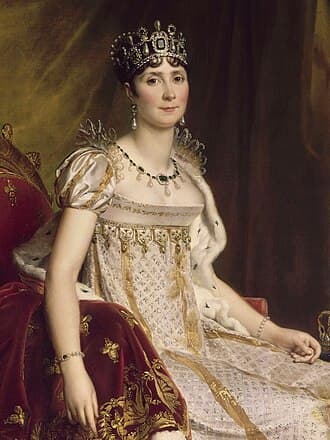
Obsessive attachment meets strategic affect
Outsider status, masculine overcompensation, merger hunger
Control achieved everywhere except the primary relationship
Dependency disguised as dominance
Strategic warmth deployed as survival
The Letters from the Field
Between 1796 and 1798, Napoleon Bonaparte wrote to Josephine de Beauharnais from the Italian campaign with a frequency and an emotional register that startled historians when the letters were first collected. He was conquering northern Italy. He was also, in nearly every spare hour, writing to his wife with a desperation that reads as completely at odds with his public persona.
"I wake filled with thoughts of you," he wrote in one of the early letters. "Your portrait and the remembrance of last night's intoxicating pleasures have left my senses in turmoil. Sweet, incomparable Josephine, what a strange effect you have on my heart."
The letters are not the letters of a man in control. They are the letters of someone for whom romantic attachment had become the primary site of vulnerability, and who could not stop making that vulnerability visible regardless of strategic cost. Napoleon's intelligence told him that the exposure was dangerous. His wound structure made the writing compulsive anyway.
Josephine's responses, by contrast, were infrequent, brief, and emotionally neutral. She was, by most accounts, not particularly in love with Napoleon at the marriage's outset. She had survived the Terror, lost her first husband Alexandre de Beauharnais to the guillotine, and arrived at her second marriage as a pragmatist. The arrangement had clear advantages. The emotional intensity was entirely on his side.
Who Josephine Was Before Napoleon
History has tended to frame Josephine primarily through her relationship to Napoleon, which means most accounts miss who she actually was. Born Marie Josepbe Rose Tascher de la Pagerie on Martinique in 1763, she arrived in France as a teenage bride to a man she had not chosen, survived his execution during the Terror while herself imprisoned in Les Carmes prison, and built a post-revolutionary social life with a combination of grace, intelligence, and considerable debt.
She was a survivor in the specific sense that the word carries when it refers to someone who has navigated real catastrophe rather than metaphorical difficulty. The Terror had shown her what political fortune could do. Her response was not to trust fortune but to cultivate relationships with enough people across enough factions that survival became more probable.
Her use of affect was strategic in the way that the affect of people who have survived genuine danger often is. She could project warmth, closeness, and intimacy without necessarily feeling them, not because she was cold by nature but because the conditions of her life had required that she decouple the performance of feeling from the experience of feeling. Napoleon, who operated from the opposite formation, a man whose feelings were impossible to detach from their expression, found this quality magnetic and maddening in approximately equal measure.
The Power Asymmetry That Kept Reversing
The surface structure of the relationship was clear: Napoleon held political and material power. He could and did give orders, spend money, arrange households, command campaigns, and eventually determine the fate of empires. Josephine was dependent on his favor.
But the psychological structure inverted this completely. Napoleon needed Josephine in a way that she did not need him, and both of them knew it. His jealousy during the Italian campaign was operatic: he wrote letters accusing her of infidelity (she was, in fact, conducting an affair with a young officer named Hippolyte Charles), demanded responses she did not provide, and oscillated between wounded reproach and renewed declaration.
When he returned from Egypt in 1799 to discover that the affair with Charles had been ongoing and was common knowledge, he initially moved to divorce her. What stopped him is revealing. Not strategy, not dynastic calculation, not image management. His brother Joseph pushed for the divorce; his brother Lucien pushed for it. Napoleon went to Josephine's room and reconciled. He could not execute the separation that his rational self had decided on.
“She has the most seductive manners and, what is rare in a Frenchwoman, is totally free from vanity. Her grace and kindness disarm everyone.”
Napoleon, describing Josephine to his secretary Bourrienne
The Divorce for Dynasty
The reconciliation of 1799 produced a more stable period, and by most accounts Napoleon and Josephine arrived at something closer to genuine mutual attachment as the years of the Empire progressed. The infidelities continued on both sides. The power asymmetry shifted as Napoleon's position grew more secure and Josephine's social capital became genuinely important to him rather than simply convenient.
But the structural problem that would end the marriage had been present from the beginning: Josephine's first marriage had produced two children, Hortense and Eugene, but she and Napoleon had not conceived together. Napoleon needed an heir. The Empire required succession. By 1809, the conclusion was unavoidable.
The divorce of December 1809 is one of the more psychologically complex scenes in European political history. Napoleon, who had restructured the continent, who had defeated the great powers of Europe, who had rewritten legal codes and remade institutions, wept during the formal announcement. Josephine wept. He arranged her post-divorce life with elaborate care: the Chateau de Malmaison, a generous income, continued use of the title Empress. The provision was not primarily strategic. It was the gesture of someone who was doing what he had decided was necessary while being constitutionally unable to pretend he wanted to.
He told his secretary Meneval that Josephine was "the most alluring and gracious of women" and that parting from her was the "greatest personal sacrifice he could have been required to make."
What She Built After
Josephine did not collapse after the divorce. This is itself significant. She retreated to Malmaison, where she had spent years cultivating one of the most remarkable gardens in France, collecting plants from around the world with a botanical passion that was entirely genuine rather than decorative. She entertained. She maintained connections. She died in May 1814, shortly after the first abdication, having outlasted the Empire that had been the condition of her extraordinary position.
The garden at Malmaison, including her collection of roses, is now understood as a genuine contribution to European horticulture. The rose species Rosa josephinae was named in her honor. This is not metaphor. It is a fact about what she built when she had the resources and the autonomy to build what she actually cared about, as opposed to what the role required.
“In order to govern one must believe in oneself. I do not believe in anything.”
Josephine, attributed, late in life
"Josephine" as Last Word
Napoleon died on Saint Helena on May 5, 1821, six years after Waterloo and seven years after Josephine's death. The accounts of his last hours report that among his final words were "France, the army, head of the army, Josephine."
The sequence has been disputed by historians. But the fact that it was reported, that this was the version that passed into the record, is itself a terrain signal. It is the story that made sense to the people who were present, given everything they had witnessed about who Napoleon was and what Josephine had meant to him.
A man who in life could not prioritize his attachment over dynastic necessity apparently, at the threshold of death, arranged his remaining words to put her last: not first, but last, which is the position of what you are not yet finished with. Whether the account is accurate or mythologized, it describes something true about the psychological structure of the relationship: he could not get past it. He had chosen the Empire over her, and the Empire had not outlasted her by long.