Nietzsche & Wagner
What it costs to build a philosophy around a person. The rupture that was philosophically necessary and personally devastating. The difference between admiring an idea and submitting to the man who carries it.
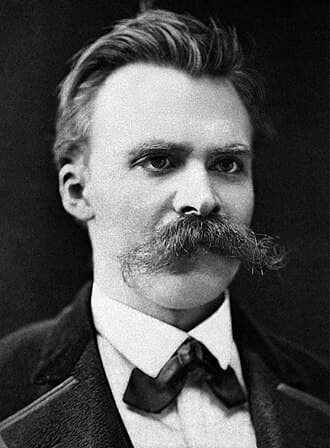
Philosophical discipleship that required disavowal to survive
Father-loss, the search for the commanding authority worth following
Idealization followed by rupture followed by philosophical replacement
Submission masquerading as intellectual friendship
The break as the condition of independent thought
The Young Philosopher and the Master
Friedrich Nietzsche first met Richard Wagner in Leipzig in November 1868, when Nietzsche was twenty-four years old and already an extraordinarily promising classical philologist. Wagner was fifty-five, already famous, already installed in the cultural imagination as Germany's greatest living composer. The meeting was arranged through Nietzsche's connection to Wagner's sister-in-law, and it produced, from Nietzsche's side, an immediate and overwhelming response.
He wrote to his friend Erwin Rohde the following day describing the encounter with the kind of dazzled intensity that young people produce when they have met someone who seems to embody everything they have been looking for. Wagner had played piano, discussed Schopenhauer (both men were deep readers of the philosopher), and engaged Nietzsche with what the young man experienced as full attention and genuine recognition.
The recognition was real, and it was also a performance. Wagner had a lifelong pattern of surrounding himself with brilliant younger men and women who would produce the energy, the adulation, and the organizational capacity that his grand projects required. He was not insincere in these relationships, but he was also not capable of the kind of equal friendship that Nietzsche, at twenty-four, may have imagined he was being offered.
Nietzsche began visiting Tribschen, Wagner's lakeside villa near Lucerne, in 1869. He would come to describe these years, in his later accounts, as "Tribschen, that far-off island of bliss."
The Tribschen Years and the Birth of Tragedy
The period from 1869 to 1872 was, by Nietzsche's later account, the happiest of his life. He visited Tribschen regularly, spending time with Wagner and Cosima von Bulow (who became Cosima Wagner in 1870 after her divorce). He was treated as part of the household. He ran errands, brought gifts, provided intellectual company, and was rewarded with the experience of being close to a man he considered a world-historical genius.
The relationship shaped his first major work. The Birth of Tragedy (1872) was ostensibly a study of Greek tragedy and its relationship to music, but it was also, in large sections, a celebration of Wagner's art as the reincarnation of Dionysian culture in the modern age. Nietzsche was twenty-seven when he wrote it. He had written a sustained philosophical work and turned its final movement into a promotional argument for his friend.
“Richard Wagner's art gives us this joyful hope -- a guarantee of a corresponding development and preparation of all artistic powers.”
Friedrich Nietzsche, *The Birth of Tragedy*, 1872
The book was not well received by classical philologists, who found its methodology too speculative. Nietzsche's mentor Friedrich Ritschl was unenthusiastic. The Wilamowitz-Mollendorff polemic against the book was devastating within the professional field. Wagner was delighted.
The divergence between these two responses contains the central tension of Nietzsche's early career. He was producing work that served Wagner's purposes and compromised his own professional standing. The submission was real, and it had real costs.
The Growing Unease
Nietzsche's private notebooks from the mid-1870s show a mind beginning to work its way out of a position it had occupied too completely. He continued to visit Wagner, continued to attend Bayreuth during the construction of the Festspielhaus. But the notes show increasing skepticism about what Wagner's project actually was.
The Bayreuth Festival of 1876 was a crisis point. Nietzsche attended, observed the enthusiastic crowds, the nationalist fervor, the way the event had become a social occasion for exactly the kind of German complacency he had come to find intolerable. He left early. He wrote in his notebook: "I did not find the Germany I was looking for."
He published Human, All Too Human in 1878, a collection of aphorisms in a style and a philosophical mode that were a nearly total repudiation of the Birth of Tragedy approach. The book was dedicated to Voltaire. There was no mention of Wagner. Cosima wrote in her diary that the publication was a betrayal. Wagner reportedly called the book "a bad book."
The break was not yet public or final. But it was, philosophically, already complete.
Parsifal and the Impossibility of Return
Wagner's final opera, Parsifal, premiered at Bayreuth in 1882. It is a work of Christian mysticism organized around the themes of redemption through renunciation and the healing of a wounded king. It was not the art that Nietzsche had described in The Birth of Tragedy. It was, in Nietzsche's reading, a capitulation to everything that Wagnerian art had once opposed: Christianity, resignation, the European culture of pity that Nietzsche was building an entire philosophy to counter.
Nietzsche received the piano score in January 1882 and wrote to his friend Peter Gast: "Has Wagner ever been so great? Has he ever been so profound?"
The sentence has a complicated irony. The profundity he was recognizing was also the thing he could not accept. Parsifal was Wagner's most ambitious work. It was also, in Nietzsche's account, his most complete self-betrayal: the composer who had once seemed to embody life-affirming art had produced a monument to life-negation.
“Wagner never thought more carefully, never felt more deeply, than in this work. But he has borrowed from Christianity, and he has borrowed from Schopenhauer, and what he has done is to set these borrowed materials to music with the genius that has always been his. The result is a masterpiece of decadence.”
Friedrich Nietzsche, notebooks, 1882
The Case of Wagner
The Case of Wagner, published in 1888, the year before Nietzsche's mental collapse, is one of the most unusual documents in the history of philosophy: a sustained, brilliant, personally wounded attack on a man who had been central to the author's intellectual and emotional life for nearly two decades.
Nietzsche called Wagner a sickness. He called him the supreme example of what he elsewhere called decadence: an art that exhausts rather than invigorates, that draws the audience toward surrender rather than affirmation. He described the Wagnerian audience as people who want to be overwhelmed, whose pleasure is the pleasure of the slave who prefers strong chains to the difficulty of freedom.
The argument is philosophically serious. But the rhetoric is also personal in a way that Nietzsche's strongest philosophical writing usually is not. The Case of Wagner is not simply a philosophical position paper. It is an exorcism.
The man who needed to be cast out was the man who had been, for years, the primary object of Nietzsche's admiration and the primary organizing force in his intellectual life. The ferocity of the attack is proportional to the depth of the attachment. You do not write with that energy about someone who never mattered to you.
What Replaced Wagner
The long project of Nietzsche's mature philosophy, from Human, All Too Human through Thus Spoke Zarathustra through the late works, can be read as the construction of an alternative to the thing he had found in Wagner and then had to repudiate.
What he had found in Wagner was a commanding presence, an authority worth submitting to, someone whose vision was large enough to organize a life around. Nietzsche's father had died when he was four years old. The search for a commanding authority who was also worthy of the respect he generated is a detectable thread throughout his biography.
The Ubermensch, the overman of Zarathustra, is in part a philosophical figure designed to replace the kind of authority that Wagner represented: not a living man with his own interests and appetites and capacity to disappoint, but a concept that demanded the best of the one who pursued it without being able to betray him.
“One repays a teacher badly if one remains a student only.”
Friedrich Nietzsche, *Thus Spoke Zarathustra*, 1883
The line is usually read as general wisdom. It is also, in context, a piece of autobiography. Nietzsche had been Wagner's student longer than was good for him. The philosophy that followed the break was the work of a man trying to become something other than a follower, trying to build a framework for human excellence that did not require him to subordinate his own intelligence to another person's vision.
The tragedy is that the break was both necessary and devastating. Nietzsche's most important work came after the rupture with Wagner. It also came accompanied by increasing isolation, deteriorating physical health, and the collapse of 1889 that ended his productive life at forty-four. What the Wagner attachment had provided, however problematically, was a sense of belonging. What replaced it, philosophically rich as it was, could not provide that.