The Truman Show
What the film is actually mapping is the psychology of a person raised inside a constructed reality who begins to sense the seams, and what it costs, after a lifetime inside the comfortable lie, to choose the terrifying and genuinely unknown door.
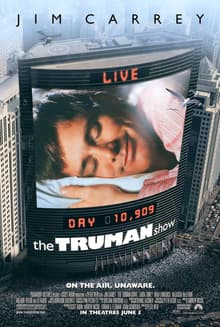
The constructed life as the only life you know
Being raised as content, love from Christof that is genuine and extractive simultaneously; every relationship in Truman's life is a performance he is not in on
The moment the architecture of your reality becomes visible, and the choice between the comfort of ignorance and the terror of authentic existence
All of Truman's relationships are performances, which is why Sylvia (the real one) is so disorienting, she related to him as a real person, the only one who ever did
Christof as the controlling father who genuinely loves his creation while being completely unwilling to release it, the archetype of love as possession
The Premise as Psychology
The Truman Show is not a film about television. It is a film about constructed reality and the psychological experience of living inside a narrative that was designed for someone else's consumption. The premise is precise: Truman Burbank has been raised from birth inside a massive studio dome, surrounded by actors, filmed continuously, his entire life broadcast to a global audience, and he does not know.
The horror of this is not primarily technological. It is relational. Every person Truman has ever loved was performing. His mother. His best friend. His wife. The emotional experiences of his childhood, the grief, the joy, the friendships formed, the losses mourned, were real to Truman and staged for everyone else. He was the only person in his own life who was not in on it.
This maps onto something psychologically recognizable even without the dome. People raised inside family systems with rigid narratives, systems where certain feelings are forbidden, certain truths are never named, where the function of each family member is to maintain the architecture rather than to live authentically inside it, grow up with the same basic condition as Truman: genuine experience generated inside a constructed container, with no access to the constructedness of the container.
The question the film is really asking is not "what if your life were a TV show?" It is: what happens to a person when the reality they were given turns out to have been a performance, and how do they live in the gap between what they were told and what was true?
Christof
Christof is the film's most psychologically complex figure, and the film is honest enough not to make him a simple villain. Ed Harris plays him with a quality of genuine belief: Christof does love Truman. He believes, with apparent sincerity, that the world inside the dome is a better world, that Seahaven is kinder, safer, more beautiful than the actual world, and that he is giving Truman a gift by keeping him inside it.
This is the precise structure of a particular kind of controlling love. The parent who cannot release the child into the world's uncertainty because the uncertainty is genuinely threatening, and who experiences their control as protection. The partner who manages every aspect of their beloved's life and genuinely cannot see the management as its own form of harm. Christof's love is real. His creation is real. His belief in what he has built is not cynical.
But the care and the cage are the same thing. This is the line the film insists on. You cannot love someone by making them the object of your project. You cannot protect someone by removing their capacity for self-determination. The sincerity of the intention does not change the nature of the act.
“I have given Truman the chance to live a normal life. The world, the place you live in, is the sick place.”
Christof, *The Truman Show*
Christof cannot release Truman because Truman is not primarily a person to him. He is a creation. The love is real, but it is the love of the artist for the work, and that love, however genuine, is incompatible with the work becoming independent.
Sylvia and the Rupture
Sylvia (Lauren) is the film's rupture point. She was an extra who broke character, who tried to tell Truman the truth before being pulled from the set and removed from his world. What she represents in the film is psychologically specific: the one authentic relationship. The one person who related to Truman as a real human being rather than as a character in a show.
This is why Truman's attachment to her is so persistent, so apparently irrational. He has not seen her in years. He has been told she moved to Fiji. He has been given a wife, a life, a social world full of people who are warm and consistent and present. And yet Sylvia remains. He constructs her face from magazine clippings. He cannot let her go.
The persistence makes psychological sense once you understand what she represented: evidence. Evidence that authentic contact was possible. That someone had seen him, not the character, not the product, but the actual person, and had cared about what they saw. That kind of experience does not fade in the face of competing relationships that are more available but less real.
The Waking
The process by which Truman begins to notice the seams is rendered with genuine fidelity to what it actually feels like when the architecture of your assumed reality starts to become visible. The light falling from the sky. The man in the elevator. The extras circling the same block. Each instance is small enough to explain away. Each one is explained away. The gaslighting is continuous and systemic: every anomaly is accounted for, re-narrated, absorbed back into the fiction.
This is the specific psychological experience the film is documenting. The person who notices something wrong with the story they have been given, and who is consistently told by everyone around them that there is nothing wrong, that their perception is the problem, not the reality. The disorientation of that experience is total. The self-doubt it produces is structural. You do not know whether you are seeing clearly or whether you are unwell.
Truman's determination in the face of this gaslighting, his insistence on trusting what he has observed over what he has been told, is the film's version of psychological courage. It is harder than it looks.
The Door
The final scene is the film's most honest moment. Truman's boat reaches the edge of the dome. He finds a door in the sky, a door to the actual world, to the world outside the set, to everything real that has been kept from him his entire life. Christof speaks to him directly for the first time, voice from the heavens, and offers him the comfort of the familiar: you are safe here; you are known here; out there is chaos and uncertainty and no one watching over you.
And Truman takes a bow and walks through.
The choice is not presented as easy. That's what makes it matter. The genuine unknown, not the constructed unknown of Seahaven's managed "adventures," but the actual unknown, is genuinely frightening. What the film argues is that the authentic life, with all its terror and shapelessness and absence of guarantee, is not just preferable to the beautiful lie. It is the only kind of life that is actually yours.
The audience inside the film cheers and then immediately reaches for the remote to find something else to watch. It is the film's darkest joke. The moment of genuine human liberation occupies exactly as long as entertainment requires.
---
Interpretive opinion based on the public record. Not a clinical assessment or diagnosis of any individual.