To Pimp a Butterfly
The album marshals the entire apparatus of musical genius to stage a public reckoning with a private wound: the psychic cost of making it out when so many didn't, and the particular loneliness of a success that reads, from the inside, as a form of abandonment.
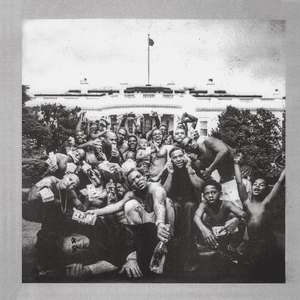
Survival guilt as creative fuel
Compton as origin and wound simultaneously; the friends lost, the violence witnessed, the success that arrived as distance from the place that made him; the cultural machine that wanted to own the redemption narrative
The oscillation between self-affirmation and self-destruction; the album as a document of a person trying to hold together while the weight of representation pulls them apart
Lucy, the album's personification of fame, money, and industry, as the seductive destroyer; the protagonist who understands the trap and enters it anyway
The conversation with Tupac at the album's end, Kendrick speaking to the dead, the ancestors, the ones who didn't make it out; grief structured as dialogue
The Problem the Album Addresses
Survival guilt is the psychological experience of those who live through what others did not, the soldiers who come home when their unit didn't, the cancer patient who enters remission when the friend diagnosed the same week has died, the person who escapes the neighborhood when the people they grew up with are still inside it. The guilt is not logical. It does not reflect actual culpability. It is the psyche's attempt to make sense of an outcome that feels morally asymmetrical: you made it, they didn't, and the distance between those two facts requires some accounting.
To Pimp a Butterfly is the most sustained and structurally sophisticated artistic treatment of survival guilt in contemporary music. It addresses the specific experience of making it out of Compton, of achieving a level of success that placed Kendrick Lamar in a category entirely unlike the people he grew up with, and of the psychological weight that success placed on him, not because the success was unwanted but because it was both real and isolating in ways the success narrative never names.
Making it out is not the end of the story. It is, for many people, the beginning of a different kind of difficulty, the difficulty of being somewhere else while belonging, still, to where you came from.
The album refuses the clean redemption arc. It insists on the mess: the depression, the distance, the guilt, the seduction of the very machinery that profits from Black pain and Black success alike.
Lucy
The album's central antagonist is not a person. It is an abstraction made vivid: Lucy, Lucifer, but more specifically the personification of fame, money, and the cultural industry that packages suffering as content and success as moral proof. Lucy appears throughout the album as a voice of flattery and false promise, offering Kendrick everything the world says he should want.
What makes Lucy psychologically precise is that she is not simply evil. She is seductive in the way that real temptation is seductive, because what she offers is genuinely attractive, and because the offer arrives at the moment when the alternative (the weight of responsibility, the guilt, the complexity) is at its most exhausting. The trap is not that it looks like a trap. The trap is that it looks like relief.
The cultural industry's relationship with Black success has a specific structure: it wants the narrative of transcendence without the weight of context. It wants Kendrick-from-Compton as a proof of possibility, not as a person with specific grief, specific politics, specific demands on the systems that shaped him. The machine wants to own the redemption story because redemption stories sell, and because owning the story means controlling what it says.
“I can feel your love / I don't really feel your love.”
Kendrick Lamar, *To Pimp a Butterfly*
Lucy is what happens when the industry gets what it wants: the artist becomes content, the pain becomes product, and the person disappears into the narrative that was built around them.
The Compton Problem
The geography of this album is not metaphorical. Compton is a specific place, a place of specific violence, specific beauty, specific community, specific loss. The album keeps returning to it because Kendrick cannot leave it, not really, regardless of how far the success takes him physically.
Place functions as wound in a particular way for people who make it out. The place made you. It formed the specific shape of your attention, your values, your humor, your fear. It is inseparable from who you are. And then you leave it, and the leaving is necessary, and the leaving is success, and the leaving is also a kind of amputation. You carry the place with you but you are no longer in it. The people who are still in it are living a reality you can observe but no longer fully inhabit.
The guilt of distance is specific: it is not that you chose to leave rather than stay and fix it. It is that you left and the leaving was not available to the people you left behind, and that your departure was, in some small structural sense, the sign that the system had worked. You were the exception the system uses to justify itself. That role is not something you chose, but it is what you have been assigned.
The Affirmation and Its Limits
"i" and "Alright" are the album's two most straightforwardly affirmative tracks, and the album surrounds them with everything that complicates the affirmation. This is the structural argument: self-love is real, self-love is necessary, self-love is also not simple when the self being loved is being destroyed by systems that affirmations alone cannot address.
"Alright" became an anthem, became, specifically, a protest anthem, chanted at demonstrations for Black lives. It carries that weight. The affirmation is real. It is also, in the context of the full album, a single note in a much more complex chord. The album does not argue against self-love. It argues that self-love under structural pressure requires something the phrase alone does not contain.
The therapeutic model that places self-affirmation at the center of healing is not wrong. It is incomplete. To Pimp a Butterfly is the musical argument for that incompleteness, an album that achieves genuine affirmation through the process of refusing to pretend the affirmation is sufficient.
The Conversation with Tupac
The album's final track, "Mortal Man," ends with a conversation between Kendrick and Tupac Shakur, a conversation constructed from a 1994 interview, spliced and shaped into dialogue with Kendrick's present. Tupac died in 1996. The conversation is impossible and the album does it anyway.
This is grief structured as dialogue. It is the attempt to reach across the gap between the living and the dead and maintain the connection that death interrupted, to speak to someone who cannot answer, using the record of what they said when they could. The conversation is not a gimmick. It is a psychological document: a man in 2015, carrying the weight of a generation's losses, trying to speak to the representative of the previous generation's losses, and finding in the older man's words something that speaks back.
What the conversation names is the continuity of the wound. Tupac's generation and Kendrick's generation are separated by two decades and connected by the same basic structure: Black genius pressed against the same systems, the same seductions, the same question of what survival means and what it costs. The conversation with the dead is a way of saying that the dead are not finished speaking, that the questions they were asking before they were taken remain open, and that the living carry the obligation to keep asking them.
---
Interpretive opinion based on the public record. Not a clinical assessment or diagnosis of any individual.