Amy Winehouse
The talent was not the problem. The talent was the most legible thing about her - what everyone could see and what the industry could monetize. The wound was underneath, and it was older than the music, and it ran in a pattern that the music described with almost clinical precision.
Extraordinary creative intelligence organized around an unresolved attachment wound - the father who arrived and departed as events
Intermittent paternal availability producing an adult organized around pursuing brilliant, unreliable people
Replication - each significant relationship recapitulating the structure of the original wound
Intense, all-or-nothing attachment to unavailable figures; simultaneous push toward and away from care
The coping mechanism named in the art, accurately, before it became fatal
The Talent Was Not the Problem
Amy Winehouse could do things with a voice that most singers cannot be taught to do. The phrasing was off the beat in ways that were structurally impossible to imitate without understanding what she was doing instinctively. The jazz influence was not learned as an affectation - it was absorbed from childhood listening to Dinah Washington and Sarah Vaughan and the girl groups she loved, and it came out as something entirely her own. The Back to Black album (2006) is one of the most precisely crafted pop records of its era: lyrically specific, emotionally exact, performed with a control that made the rawness seem effortless.
The talent is not the story. The talent is the vehicle by which the story became legible to millions of people who would not otherwise have had access to it. What Amy Winehouse documented in her music was the interior architecture of a person organized around a wound she had no way to leave behind. She described it accurately. She described it before she fully understood what was happening. The art was ahead of the consciousness, which is a mark of genuine creative intelligence and also, in her case, a form of terrible irony: she could name the thing in the lyrics before she could stop doing it in her life.
The specific quality of her lyrical intelligence is worth attending to carefully. She did not write in metaphors. She wrote in situations, in conversations, in the exact language people use when they are in the middle of something they cannot see clearly. "We only said goodbye with words" is not poetry in the elevated sense. It is the precise description of a specific kind of emotional withholding - the goodbye that never lands because the parties involved cannot access the register where the real departure happens. That kind of writing requires the writer to have been inside the experience, not adjacent to it.
The Father Wound
Mitch Winehouse was a London cab driver who was charismatic, emotionally present in bursts, and intermittently reliable throughout Amy's childhood. He had another family. His arrivals in Amy's life were events - charged with significance, generating the particular electricity that unpredictable availability produces in a child who is organized around waiting. His departures were felt as abandonments, even when they were simply the ordinary movements of a man whose attention was divided in ways he may not have fully understood himself.
The pattern this produces in a child is specific and well-documented in the attachment literature. The child cannot predict the parent's availability. The parent's presence becomes intensely significant because it is unpredictable - the intermittent reinforcement that produces the strongest and most durable attachment behavior. The child organizes her emotional life around the hope of the parent's return and around the task of managing her own distress in the parent's absence. She learns to be exquisitely sensitive to the emotional states of others. She learns to perform for the available parent in ways that might increase the probability of his continued presence. She learns that love is not given steadily - it arrives and recedes, and the skill required is managing yourself through the recession while keeping the welcome ready for the next arrival.
What Amy conspicuously never said, in any of the substantial interview record she left behind, was that her father had failed her in a structural or systemic way. She talked about him with warmth. She credited him with passing on her musical taste - the Tony Bennett records, the Frank Sinatra, the instinct for phrasing she inherited from his ear. She defended him in public when he began to monetize his proximity to her story, including his appearance on Celebrity Big Brother while she was in active crisis. The defense was not simply loyalty; it was the behavior of a person who has learned to protect the parent from accountability because the alternative - acknowledging the damage - is more threatening than the damage itself.
The conspicuous absence of any direct criticism of Mitch in the public record is itself diagnostic. The father wound in Amy's psychology was not characterized by overt hostility or estrangement. It was characterized by something more structurally insidious: idealization maintained in the face of evidence, protection extended to the person who had originally required the child's protection, the circular care that is the hallmark of the child who parented the parent.
Linguistic Fingerprint: How Amy Talked About Herself
Amy's interview style was direct, funny, and self-deprecating in a specific way. She used profanity fluently, which had the effect of making her seem more candid than she was. The profanity was a kind of intimacy signal - it suggested you were getting the unfiltered version. But underneath the apparent candor was a characteristic move: she talked about her private life with humor rather than with direct emotional disclosure.
The quote attributed to her - "I write songs because I'm fucked up in the head and it helps me" - is often cited as evidence of her self-awareness. It is self-aware, but it is also performing self-awareness in a way that forecloses the next question. If you say you're fucked up with enough humor and enough apparent acceptance, the person asking the questions has nowhere to go. The disclosure is real but it is also a door that looks open and leads nowhere.
More telling is her pattern of describing her relationships - particularly her relationship with Blake Fielder-Civil - in terms of intensity rather than cost. She described what she felt, not what the feeling was doing to her. She described the love without a separate narrative of the destruction. In the documentary footage and the interviews from 2007 and 2008, there is a specific compression in how she spoke about the period: she moved quickly through it, used present-tense language that collapsed time, and rarely paused to assess. The assessment was in the music. In speech, she described the experience without evaluating it.
Key Insight: The linguistic pattern - direct about the surface, opaque about the structure - is consistent with a psychology that has built its identity around the experience of intensity. People organized around attachment wounds do not usually describe those wounds as wounds. They describe the feelings that the wounds produce, with a fluency born from long familiarity, and the description itself functions as a way of staying inside the experience rather than stepping outside it.
Blake Fielder-Civil and the Replication
The relationship with Blake Fielder-Civil, whom Amy married in 2007 and divorced in 2009, is understood popularly as a bad influence story - a good woman brought down by the wrong man. The terrain reading is different, and it is more accurate to what is known about how early attachment patterns operate in adult relationships.
Blake was charismatic, unreliable, and intermittently present. He was brilliant in flashes and catastrophically unavailable in the periods between. He introduced heroin into Amy's life at the exact moment when she had achieved the kind of success that she had no internal framework for managing - the global attention, the Grammy Awards, the critical recognition, the industry apparatus that had decided she was the thing it needed. The success brought with it a magnitude of visibility that had no precedent in her life and no psychological container. The exposure was total. The infrastructure to manage it was absent.
Blake was the wrong person at the wrong time in a life that had been organized, by the original wound, around finding the wrong person at the wrong time. The accuracy of this replication is the thing worth attending to. It was not random. A person organized around intermittent attachment does not seek out reliable partners; reliability is not recognizable as love to a person whose template for love is structured around unpredictability. Reliability feels flat. The person who is present consistently, who does not generate the cycle of departure and return, does not trigger the attachment system in the way that the intermittently available person does. Blake triggered the system completely. The selection was not mistake. It was pattern recognition.
The replication pattern is the wound's most reliable tell. The adult finds, with what feels like uncanny luck, exactly the person whose emotional structure recapitulates the original injury. The accuracy of the selection is not coincidence. The psyche recognizes the familiar, and the familiar feels like home, even when home was the place where the damage happened. Amy did not fall into bad luck with Blake. She found him the way a homing mechanism finds its target.
The marriage happened in Miami in 2007, after a brief reunion following a separation. The urgency of the reconciliation - the speed of the marriage, the way it was described in contemporary reporting as Amy's initiative, her insistence - is consistent with the attachment pattern. The intermittently available person had been temporarily away. His return required securing. The security took the form of legal commitment, which is the formal structure available when the internal security system has not been built.
“He's the most brilliant person I've ever met. I know we're meant to be together.”
Amy Winehouse
The language is instructive. "Most brilliant" and "meant to be" in the same breath: the first is a quality that makes him compelling, the second is a framework that removes the relationship from the domain of choice. If it is meant to be, it is not a decision she is making; it is a destiny she is recognizing. This construction - framing the compulsive pursuit of an unhealthy attachment as recognition of inevitability rather than as a choice that could be made differently - is the psychological grammar of the replication pattern at full expression.
"Rehab" as a Psychological Document
The song is usually heard as defiance. The refrain - "no, no, no" - is read as the gesture of a person too proud or too far gone to accept help. The terrain reading is different, and it requires understanding what the song is actually describing.
Amy was twenty-two when she wrote it. The specific complaint she articulates - "they tried to make me go to rehab" - is not a celebration of drinking. It is a description of a specific confrontation between Amy and the people who managed and loved her, in which those people had decided the problem was the alcohol and the solution was treatment. The song is not arguing that they are wrong. It is articulating, with extraordinary precision, the interior logic of the person who cannot accept the treatment that is being offered.
The coping mechanism is not the drinking, though drinking is the surface. The coping mechanism is the entire emotional structure - the way of managing internal states that was built in response to the wound and that has been working, after a fashion, for years. To give it up is not to get better. It is to have nothing, because nothing else was ever built. The song captures this precisely: "I don't ever want to drink again / I just - I just need a friend." The second line is not a deflection. It is the actual diagnosis. The drinking is the substitute for the friend who would make the drinking unnecessary. The substitute is not available for replacement by an institution.
The "no, no, no" is not defiance. It is the sound of the wound protecting itself. The wound knows, at the functional level, that the coping mechanism is the only available architecture for survival. The wound does not know that the coping mechanism is also the architecture of destruction. This is not stupidity. It is the logic of a psychology that learned to survive in one environment and cannot translate that learning into a different one.
The song was written before the heroin, before the most visible period of deterioration. She was describing, prophetically, the structure of what was coming. The art was ahead of the life by several years. By the time the life caught up with what the art had described, there was no distance left between the document and the thing being documented.
The Constructed Persona and What It Concealed
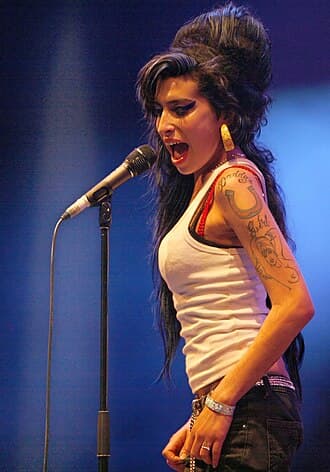
The beehive, the heavy eyeliner, the 1960s girl group aesthetic - Amy's visual identity was as constructed as any other performer's, but it was constructed from her own materials, from things she genuinely loved and had absorbed. Unlike performers whose persona is a replacement for the self, Amy's persona was an amplification of something real. The Ronettes reference was not an affectation; she had grown up with her grandmother's record collection. The aesthetic was a way of saying "this is where I come from" rather than "this is what the market wants."
This authenticity of surface made her both more present and more exposed than most performers of comparable fame. The gap between the performed self and the private self was narrow, which meant that when the private self was in crisis, the crisis showed. The 2007 and 2008 tabloid images - the photographs that circulated of her physical deterioration - were disturbing in a way that similar images of other celebrities were not, because with Amy, there was a visible person inside the pictures. She had not built enough persona-distance to make the crisis look like something happening to a product.
What Amy never showed publicly was the version of herself that was frightened. She showed the angry version, the funny version, the raw version. She showed vulnerability in ways that looked like strength - the directness, the refusal to perform wellness when she was not well. But the specific affect of fear - the quiet, still kind that does not perform and does not make jokes - that is not visible in the public record. The absence is notable. A person whose primary relational skill is reading the emotional states of others, who has learned to manage her own distress by performing it rather than sitting with it, does not easily access the register of quiet fear. It has no audience. It has no function in the relational repertoire.
The Industry and What It Failed to See
The Grammy performance via satellite from London in February 2008 - delivered by a person who was visibly not well, accepted by an audience that applauded the performance while the person giving it was in documented crisis - is a specific image of what the industry's relationship to Amy actually was. She won five awards that night. The industry celebrated the music while the person who made it was demonstrably falling apart. The celebration and the abandonment were simultaneous.
The industry apparatus that had built the commercial structure around Back to Black did not, for the most part, have the tools to engage with what was happening after the album's success. It had tools for managing talent. It did not have tools for managing a person whose talent was inseparable from a psychological structure that was becoming incompatible with continued output. The instrument and the person could not be separated, and the industry was only equipped to work with the instrument.
There is a specific cruelty in what the industry did with Amy's crisis: it made the crisis part of the product. The tabloid images, the cancelled concerts reported as news, the erratic performances that circulated as video clips - these were consumed with the same apparatus that consumed the music. The suffering was monetized alongside the art. She was documented dying, and the documentation was watched.
What the industry conspicuously never did - and this absence is as diagnostic as anything in the record - was create the conditions under which the person might have been treated as a person rather than as an asset. The conversations that happened were about output, about tours, about recording schedules. The conversation that would have needed to happen - about what the work was costing her and why she could not stop - did not happen, or happened too late, or happened without the power to produce any consequence.
The Hinge Moment: 2008
In early 2008, Amy was in a period of enforced relative sobriety - the performances that year, while erratic, included several that demonstrated the original power was intact. She was in St. Lucia for part of the year, removed from the London environment. There are accounts from people around her of a period of relative stability, of Amy functioning in ways that suggested the possibility of a different outcome.
The relapse, when it came, was triggered by the collapse of the relationship with Blake, who was incarcerated in the UK on assault charges related to a separate incident. The pattern was fully legible at this point to anyone watching it: the intermittently available person had been removed, the attachment system had nothing to cling to, the coping mechanism intensified to fill the space. The structure of what was happening was not mysterious. The intervention that might have addressed the structure - rather than the symptoms - was not available or was not deployed.
This is the hinge. Not the moment she started drinking, not the marriage to Blake, not the first use of heroin. The hinge is 2008: a period of reduced crisis, a demonstrated capacity for relative stability, a moment when the structural momentum could theoretically have shifted, and an absence of the sustained therapeutic and relational infrastructure that would have been required to hold the shift. The moment passed. What followed was the documented deterioration of the final three years.
The Final Years
The period between Back to Black (2006) and her death in July 2011 was marked by the public visibility of the deterioration: cancelled concerts, erratic performances, the tabloid documentation of her physical state. She attempted a European tour in June 2011 that was abandoned after the opening Belgrade performance, in which she appeared confused and visibly impaired on stage. The footage circulated immediately. The tour was cancelled within days. She returned to London.
She died of accidental alcohol poisoning on July 23, 2011. She was twenty-seven. The official finding was acute alcohol toxicity. Her blood alcohol level was more than five times the legal limit for driving in the United Kingdom. She had been sober for a period before the relapse - approximately three weeks, according to subsequent accounts. The relapse is consistent with everything known about the behavior of a coping mechanism that has not been replaced: it returns when the pressure that originally required it returns, or when the thing that temporarily substituted for it is removed.
She was twenty-seven, which placed her in the grim statistical company of Jimi Hendrix, Janis Joplin, Jim Morrison, Kurt Cobain, and Brian Jones. The "27 Club" is usually invoked as a coincidence or a mythology. The terrain reading is less romantic: the cluster of deaths at this age among performers of a certain type is likely an artifact of the accelerated damage produced by combining extraordinary creative output, early fame, unresolved psychological wounds, and the specific chemistry of alcohol and narcotics in a young body that has been under sustained metabolic stress. The coincidence is less cosmic than it appears. The conditions are replicated across cases.
What the Art Tells Us That She Could Not
The body of work Amy Winehouse left behind is, among other things, a precise self-portrait of the psychology described in this map. Frank (2003) documents the early relational patterns: the aggression, the wit, the refusal of sentimentality, the incapacity to sustain a relationship with someone who is straightforward and available. Back to Black (2006) documents the replication pattern in full expression: the departure, the grief, the understanding that the grief is about something older than the relationship being described, the inability to stop wanting what is destroying her.
"Love Is a Losing Game" is the most fully realized document in the catalogue. It is a song about knowing the structure of what you are in and being unable to leave it. "For you I was a flame / Love is a losing game." The sacrifice is named. The loss is named. The knowledge that the knowledge is not enough is named. She understood what was happening to her. She could express it with extraordinary precision. The expression did not change it.
The distance between knowing and changing is the central fact of Amy Winehouse's psychological portrait. She was not missing insight. She was missing the structural conditions - the sustained, unchosen, unconditional human connection - that would have made insight operable. Insight without a secure base to act from is documentation, not transformation. She documented with devastating accuracy. The transformation did not come.
“I write songs because I'm fucked up in the head and it helps me.”
Amy Winehouse
The wound came first; the music was its most precise and enduring record.
References
- Johnstone, Nick. Amy, Amy, Amy: The Amy Winehouse Story. Omnibus Press, 2008. - Winehouse, Mitch. Amy, My Daughter. HarperCollins, 2012. - Bowlby, John. Attachment and Loss, Vol. 1: Attachment. Basic Books, 1969. - Kapadia, Asif, dir. Amy (documentary film). A24, 2015. - Brown, Garth. "The Anatomy of a Lost Voice." The Guardian, August 2011. - Cavendish, Lucy. "What Happened to Amy Winehouse." The Telegraph, July 2011. - Main, Mary, and Judith Solomon. "Discovery of an insecure-disorganized/disoriented attachment pattern." In Affective Development in Infancy, edited by T.B. Brazelton and M.W. Yogman. Ablex, 1986. - Levy, Shawn. Amy Winehouse: The Biography. Overlook Press, 2011. - Doyle, Tom. "Amy Winehouse: The Q Interview." Q Magazine, March 2004.
---
Interpretive opinion based on the public record. Not a clinical assessment or diagnosis of any individual.