Eminem
Most artists put distance between themselves and their wound. Eminem pointed a microphone at it. The Kim Scott wound, the absent father, the mother who medicated and disappeared: all of it went into the catalog, named and detailed, screamed at full volume. The result is one of the most psychologically transparent bodies of work in popular music. The question is not what the art says. The question is what it cost him that the art was the only place he could say it.
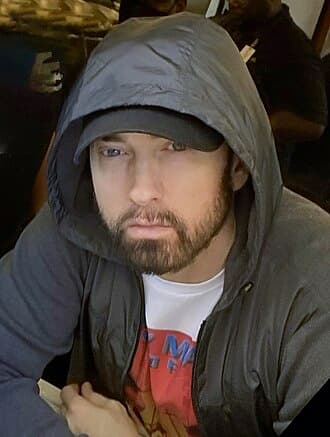
The wound as primary material - an artist for whom the creative process and the psychological process were never separate
Dual abandonment: the father who disappeared without explanation, the mother who was present but not a safe harbor
Rage as the available channel for pain that had no other outlet - and the exhaustion that arrives when rage is the only tool
The Kim Scott relationship as the central repetition: the person who was both the wound and the only witness to it
Slim Shady as shadow - the alter ego given permission to say what Marshall Mathers could not
The Catalog as Autobiography
Between 1996 and the present, Marshall Mathers has released one of the most detailed psychological self-portraits in the history of recorded music. This is not a metaphor. The abandonment by his father is in the catalog, named directly, addressed in the second person. The relationship with his mother is in the catalog, with her name, in legal disputes over what he said about her. The marriage to Kim Scott and the violence of that attachment is in the catalog, with her name, enacted in real time over a track that runs seven minutes long.
Most artists use transformation: the wound becomes something else, something with enough distance to be art. Eminem mostly did not. The wound stayed the wound. The art was where he took it to be witnessed by the largest audience he could find.
The scale of the audience is part of the psychology. A man who was abandoned needs to be seen. The largest stadium in the world still contains, somewhere in its function, the original need: to be seen by the specific people who did not look.
The Father
Marshall Bruce Mathers Jr. left when his son was eighteen months old. He did not maintain contact. He moved to California. He remarried and had other children. Eminem has addressed his father in interviews and on record for thirty years and the father has not responded publicly in any substantive way.
This is the architecture of the abandonment wound: it is unresolved because it is unresolvable. The person who caused it has not provided the acknowledgment, the explanation, or the repair that would allow the wound to close. The wound stays open because the door that would close it has never been opened from the other side.
"Abandonment by a parent, when the abandoning parent never returns to explain or repair, leaves a specific type of damage: the child builds theories about why they were left, and those theories are always about the child's own inadequacy. The absent parent's silence is not neutral. It is interpreted, over years, as verdict."
The father wound runs under the catalog in a way that is sometimes less visible than the mother or Kim material, but it is foundational. The need to be the greatest in the room, the need to be witnessed at scale, the need to prove the talent to an audience that cannot turn away: all of it points back to the original audience that did.
Slim Shady
Slim Shady arrived on The Slim Shady LP in 1999 as a character, a fictional alter ego who could say things Marshall Mathers could not say. Slim Shady committed fictional violence. He was deliberately offensive. He gave voice to material that the more controlled Marshall Mathers persona kept managed.
In Jungian terms, Slim Shady is shadow work in the most literal sense: the disowned material given a name, a persona, and a platform. What Slim Shady could say was what Marshall Mathers could not afford to know about himself directly. The cruelty, the nihilism, the contempt, the violence: not as a representation of who Eminem is, but as a container for what could not be acknowledged as his own.
The interesting psychological moment is when the Slim Shady container became insufficient. By the time of Recovery (2010), the alter ego had largely been retired. The man was too present in the material to maintain the fictional distance. The wound had gotten too large for the character to hold.
Kim Scott
Kim Scott is the most psychologically dense single subject in the Eminem catalog. They met as teenagers. They had a daughter together. They married, divorced, remarried, divorced again. The relationship involved documented violence. Kim was the subject of a track in which Eminem enacted, in graphic detail, murdering her. She sued him for defamation. She attempted suicide during the period of the Marshall Mathers LP.
The terrain reading of this relationship is not about blame allocation. It is about the pattern: Kim Scott was the person who was simultaneously the wound and the only witness to it. She knew Marshall before he was Eminem. She knew the apartment in Detroit and the poverty and the child and the failure before the success. She was present for the real material in a way that no one else who arrived later could be.
This is why the relationship could not end cleanly. People who have witnessed the wound have a hold that is distinct from and more powerful than love. The attachment was not to Kim Scott as a person who made him happy. The attachment was to Kim Scott as the person who knew. Getting free of her would have required getting free of the one person who had seen the pre-persona self.
Recovery and the Identity Crisis
The addiction years, roughly 2005 through 2008, are documented in the catalog and in interviews. The overdose on methadone was nearly fatal. Recovery from addiction required Eminem to stop using the substance that had been managing the wound.
What is less discussed is the psychological crisis that followed sobriety. The wound that the addiction had been medicating was still there. The rage that had been the primary available channel for processing the wound was, without the substance, much harder to access in the controlled way the catalog had required. The first sober albums received mixed reception.
The crisis was, in the terrain reading, an identity crisis as much as a substance crisis. If Eminem was not the man channeling his wound into rage into music at maximum volume, who was he? The addiction had solved the question by keeping the wound accessible. Sobriety required a different relationship with the material, and that relationship took years to find.
What the Catalog Costs
Three decades of public psychological processing is not free. Kim Scott's daughter Hailie has grown up with her parents' relationship as public material. Kim Scott has lived inside a public narrative of her as the source of the wound for most of her adult life. Eminem's mother has lived inside the Cleanin' Out My Closet account of her parenting for twenty years.
The art is extraordinary. The psychological transparency is, in some ways, admirable: a man who does not pretend that he is not damaged. But the cost is paid partly by the people who appear in the material without having chosen to be there.
This is the limitation of using other people as primary material without their consent. The therapeutic benefit to the artist is real. The benefit to the people named in the therapy is more complicated.
The Later Work
The later catalog, beginning roughly with The Marshall Mathers LP 2 (2013) and continuing through Music to Be Murdered By (2020), shows a man still in the same psychological territory but with different access to it. The rage is more performative, less raw. The wound is still there, but the artist has more distance from it than the early material allowed.
Whether this represents integration or just the natural cooling that comes with time and sobriety is not fully resolvable from the outside. What is legible is that the relationship between Marshall Mathers and his wound has changed. The wound is no longer the only thing in the room. There are other things in the room now, and the art reflects that.
References
- Eminem. The Slim Shady LP. Interscope, 1999. - Eminem. The Marshall Mathers LP. Interscope, 2000. - Eminem. Recovery. Interscope, 2010. - Eminem. The Marshall Mathers LP 2. Interscope, 2013. - Bozza, Anthony. Whatever You Say I Am: The Life and Times of Eminem. Crown, 2003. - Heller, Jason. "The Complicated Legacy of Eminem's Rage." The Atlantic, 2020. - Strauss, Neil. "The Eminem Interview." Rolling Stone, April 2004. - van der Kolk, Bessel. The Body Keeps the Score. Viking, 2014.
---
Interpretive opinion based on the public record. Not a clinical assessment or diagnosis of any individual.