The AIDS Crisis
The way stigma determines which suffering registers. How a medical catastrophe was shaped less by the virus than by who the virus was perceived to affect first. What an entire generation did with grief that the culture refused to witness.
Stigma as the mechanism that determined who was allowed to suffer visibly
Collective grief without cultural permission
Political mourning as the only available channel for grief
Community under siege constructing its own witness
Mainstream visibility arriving too late and at too high a cost
The Silence and What It Said
The first cases of what would become AIDS were reported in the Morbidity and Mortality Weekly Report of the Centers for Disease Control on June 5, 1981. Five young gay men in Los Angeles had developed Pneumocystis carinii pneumonia, an infection typically seen only in severely immunocompromised patients. All five had been in good health before the illness. All had other unusual infections. The report was clinical and brief.
By the end of 1981, 270 cases of severe immune deficiency had been reported and 121 people had died. The New York Times ran its first story on the epidemic on July 3, 1981: a brief piece on page A20, below the fold, describing a "rare cancer" seen in 41 gay men. The placement was not incidental.
Ronald Reagan, who became president in January 1981, did not publicly mention AIDS until September 1985, by which time more than 12,000 Americans had died of the disease. He did not give a major policy speech on the crisis until 1987, when cumulative deaths in the United States had passed 20,000. His press secretary Larry Speakes was recorded laughing when asked about AIDS at a 1982 briefing. The reporter asking the question used the word "gay" and Speakes said: "I don't have it, do you?" and the briefing room laughed.
The silence of the government was not passive. It was a position. The position communicated to the people dying and to the people watching them die that their suffering did not register, that it was not a national emergency, that the administration had made an assessment about whose lives counted and those lives had not made the cut.
“Our government has blood on its hands. And I'm here to rub it in.”
Protest sign at an early ACT UP demonstration, New York, 1987
Who Was Dying
The epidemic's early years in the United States were concentrated in communities that mainstream American culture had already organized around not seeing: gay men, intravenous drug users, Haitian immigrants. The clustering was not total; hemophiliacs and blood transfusion recipients were also affected from early on, and the epidemic was simultaneous in sub-Saharan Africa, where it followed heterosexual transmission patterns. But in the United States, the perception that AIDS was a disease of specific and stigmatized populations shaped the public and political response at every level.
The New York Post ran the headline "Gay Plague" in 1982. Jerry Falwell, the televangelist and founder of the Moral Majority, described AIDS as "the wrath of God upon homosexuals." Pat Buchanan wrote in his syndicated column that gay men had "declared war upon nature, and now nature is exacting an awful retribution."
This was not fringe opinion. It was the dominant public framing of the crisis in its first years. The framing had concrete effects: it slowed the federal funding response, it enabled the silence of institutions, and it told the people who were sick and the people who loved them that the culture considered their deaths a form of justice.
The psychological cost of dying while being told you deserved to die is a particular kind of suffering. The AIDS crisis produced it at scale, across a community that was already living with the knowledge that its existence was not fully recognized as legitimate.
ACT UP and the Invention of Political Mourning
The AIDS Coalition to Unleash Power was founded in New York in March 1987. Its founding meeting was called by the writer Larry Kramer at the Lesbian, Gay, Bisexual and Transgender Community Center in Greenwich Village. Kramer had been writing and speaking about the crisis since 1981 with a fury that many people found excessive and that turned out to be precisely calibrated to what the moment required.
ACT UP's most important innovation was the conversion of grief into a form of political action that was visible, confrontational, and impossible to ignore. The "die-ins," in which activists would fall silently in public spaces to represent the dead, were designed to force a non-participating public to visually register what was happening. The demonstrations at the FDA in 1988, at the National Institutes of Health in 1990, at the Republican National Convention, were organized around the argument that silence equaled death, a formulation that was also a billboard.
The organization also produced something more personally urgent: a community of mourning for people whose grief had nowhere else to go. The funerals of the AIDS years were attended, in many cases, by people whose families had not shown up, whose workplaces did not acknowledge their loss, whose grief existed in a social vacuum. ACT UP provided a context in which the grief was witnessed, named, and organized into action.
“We are not going to go away. We are not going to be quiet. Until there is treatment, until there is a cure, we will be here.”
Larry Kramer, ACT UP rally, 1988
The AIDS Memorial Quilt
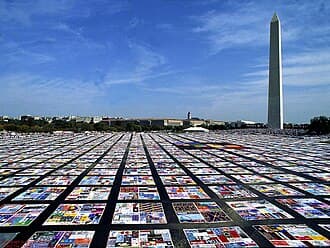
The AIDS Memorial Quilt was conceived by activist Cleve Jones in 1985 and first displayed on the National Mall in Washington on October 11, 1987, the day of the National March on Washington for Lesbian and Gay Rights. The first display contained 1,920 panels, each three feet by six feet, each created to memorialize one person who had died.
The scale grew. By 1992, the Quilt covered the entire National Mall. By the time of its last full display in 1996, it contained 40,000 panels representing approximately 70,000 people and weighed 54 tons. Each panel was made by someone who had loved the person it commemorated: partners, parents, siblings, friends.
The Quilt is one of the most significant collective memorials in American history, and its significance is inseparable from the conditions that produced it. It was created because the official culture had not created a memorial. It was created by people who needed to make the grief visible because the grief was being made invisible everywhere else. Its domestic materials, the fabrics and photographs and names sewn by hand, were a deliberate counter to the abstraction through which the crisis had been processed politically.
The Quilt was grief made into argument. The argument was: these were people. They had names. Someone loved them. That loving and that loss deserve the same witness that any other American loss deserves.
The Moment of Mainstream Visibility
Rock Hudson, the Hollywood actor and longtime gay man whose sexuality had been unknown to the general public, was diagnosed with AIDS in 1984. He disclosed his diagnosis publicly in July 1985 and died in October 1985. He was the first major American celebrity to die of AIDS, and his death produced a shift in public awareness that fifteen years of medical reporting and activist demonstration had not.
Ryan White was a thirteen-year-old hemophiliac in Kokomo, Indiana, who contracted AIDS through a contaminated blood transfusion and was barred from attending his middle school in 1985. His family's legal fight to return him to school received national coverage. White was articulate, white, young, and had contracted the disease through a means that separated him, in the public imagination, from the stigmatized communities most associated with AIDS. His story produced sympathy that the stories of gay men had not been permitted to produce.
The psychological mechanism visible in these two cases is consistent and important. Hudson and White functioned as what sociologists call "boundary cases": people whose AIDS diagnoses forced a recategorization because they could not be accommodated by the existing stigma framework. Their suffering was legible to mainstream audiences in a way that the suffering of gay men and intravenous drug users had been systematically prevented from being legible.
This legibility came too late for the people who died before it arrived. The fifteen years between the first cases and the development of effective antiretroviral therapy cost more than 300,000 American lives and millions worldwide. The question of how many of those deaths might have been prevented by an earlier, more urgent public health response, unencumbered by the politics of who deserved to be saved, does not have a clean answer. It has an obvious direction.
What Was Lost
The AIDS crisis eliminated an entire generation of gay men from American cultural life. The artists, writers, performers, activists, and ordinary people who died between 1981 and 1996 cannot be fully accounted for because many of them were young enough that their major contributions had not yet been made. What was lost includes not only the people but the work they would have done, the communities they would have built, the knowledge that died with them.
The cultural memory of the crisis within the communities most affected has qualities that are different from the general cultural memory. The LGBTQ community that emerged from the epidemic carries a specific kind of institutional trauma: the knowledge, absorbed across a decade and a half, that the government was capable of watching you die in large numbers without acting, that the press was capable of not printing your name, that the hospitals were capable of turning you away, that the families were capable of not claiming your body.
This knowledge does not expire when the immediate crisis ends. It becomes a structural feature of how the community understands its relationship to institutions and to official care. It shapes the response to subsequent health threats, the readiness to mobilize, the level of trust extended to public health authorities.
“When I die, it will not be from AIDS. It will from not being able to stand the grief.”
Anonymous, quoted in the NAMES Project Quilt archive