The Milgram Obedience Experiments
Sixty-five percent of ordinary people, when instructed by an authority figure, administered what they believed to be a 450-volt electric shock to a stranger who had stopped responding. They were not sadists. They were not broken. They were people inside a structure that had distributed the moral weight of the action until it felt bearable. This is the finding. It has never been comfortably explained away.
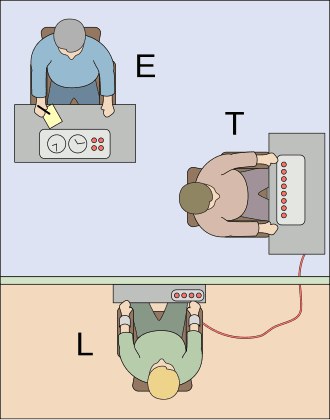
Obedience as the default state, not the exception - authority structures distribute moral responsibility in ways that allow ordinary people to do extraordinary harm
Not applicable as individual wound - but the experiment exposes a collective wound: the gap between who we believe we are and what we will do under structural pressure
The agentic state: the shift from autonomous moral actor to instrument of someone else's will, which happens faster and more completely than people expect
The experimenter as the moral weight-bearer, the participant as the executor, and the voice in the box as the invisible third party who absorbs the cost
The incremental escalation - no single step felt large enough to refuse, and by the time it was, the momentum of compliance was already in place
What Was Designed
In 1961, one year after the trial of Adolf Eichmann in Jerusalem, Stanley Milgram began a series of experiments at Yale University. Milgram had watched Hannah Arendt's coverage of the trial produce the concept of the banality of evil: the observation that Eichmann was not a monster but an administrator, a man who had organized mass murder with the same professional disposition he might have brought to any other logistical problem.
Milgram wanted to test a question: was there something specific to German culture that had produced the compliance of ordinary citizens in the Nazi project, or was the compliance the ordinary human response to authority that would appear in any population given the right structure?
He designed an experiment that would answer this question. He did not fully anticipate what the answer would be.
What Happened
Participants arrived at Yale to take part in what they were told was a study of memory and learning. They were introduced to another participant who was, in fact, a confederate of the experimenter. A rigged drawing assigned the real participant the role of "teacher" and the confederate the role of "learner."
The learner was taken to an adjacent room and strapped to a chair. The teacher sat in front of a shock generator with thirty switches labeled from 15 volts to 450 volts, with verbal labels ranging from "Slight Shock" to "Danger: Severe Shock" and, at the far end, simply "XXX."
The teacher read word pairs to the learner. When the learner made errors, the teacher was instructed to administer a shock, increasing the voltage with each mistake. At 75 volts, the learner (pre-recorded) began to grunt. At 120 volts, he complained that the shocks were painful. At 150, he demanded to be released. At 300, he refused to answer. Past 330, silence.
When participants hesitated or refused, the experimenter used a standardized script: "Please continue." "The experiment requires that you continue." "It is absolutely essential that you continue." "You have no other choice, you must go on."
Sixty-five percent of participants administered the maximum 450-volt shock.
None of the psychiatrists, psychologists, and ordinary people Milgram had consulted before the experiment predicted this result. The psychiatrists predicted that approximately one percent of participants would reach the maximum. The one percent estimate turned out to describe approximately the inverse of the actual outcome.
The Agentic State
Milgram's theoretical account of what he observed centers on what he called the agentic state: the psychological shift that occurs when a person moves from acting as an autonomous moral agent to acting as an instrument of an authority structure.
In the autonomous state, a person is the originating source of their actions and feels responsible for their consequences. In the agentic state, the person understands themselves as executing someone else's decision. The moral weight of the action is felt to have transferred to the authority who gave the instruction.
This transfer is not dishonest. It reflects a genuine psychological shift in how the person is experiencing their own actions. The participants who administered the shocks were not pretending that the experimenter was responsible. They genuinely experienced the experimenter as responsible, in a felt sense, in a way that made the action feel different from what it would have been had they chosen it independently.
"The agentic state is not a moral failure peculiar to weak or damaged people. It is the predictable result of being inside a legitimate authority structure that has normalized the action being requested. The structure distributes the moral weight across the relationship, and the distribution is real enough that it changes how the action is experienced by the person doing it."
The Voice in the Box
One of the conditions Milgram tested was varying the proximity of the learner to the teacher. When the learner was in the same room, compliance rates dropped. When the learner could be seen as well as heard, compliance dropped further. When the learner was out of sight and out of earshot, compliance reached its highest levels.
The voice in the box is the psychological technology that makes compliance possible. The learner, heard but not seen, is abstract in a way that the learner visible through a window is not. The 450-volt shock administered to a person in the next room is a different action, psychologically, from the same action administered to a person whose face you can see.
This is not a finding about cruelty. It is a finding about abstraction. The further the harm is from direct perceptual contact, the easier it is to administer. Industrial scale harm, bureaucratic harm, harm delivered through systems and chains of command and administrative processes: all of it uses the same mechanism. The voice in the box is the victim reduced to a level of abstraction that makes the action bearable.
The Incremental Escalation
The escalation from 15 to 450 volts did not feel like one decision. It felt like thirty decisions, each of which was only marginally different from the one before. By the time the participant reached the level of visible distress in the learner, they had already administered twenty shocks. The momentum of compliance was already substantial.
This is a structural feature of the design, and it is also a structural feature of how ordinary evil operates in non-laboratory conditions. No one decides to participate in something monstrous at full scale. They participate in something small and then something slightly larger and then something slightly larger still, and by the time the scale is monstrous, the prior decisions have already been made.
The participant who refuses at 150 volts has already administered ten shocks. The refusal requires not just refusing the next action but retroactively reassessing the previous ones. The sunk cost of prior compliance is a structural incentive to continue.
What It Means
The Milgram experiments do not mean that human beings are fundamentally cruel or fundamentally corruptible. They mean that human beings are fundamentally social, and that the social structures they operate within are capable of producing behavior that the same individuals, operating independently and autonomously, would not choose and would find horrifying.
This is a more disturbing finding than the cruelty interpretation, because it implicates everyone rather than only the damaged. The sixty-five percent who administered the maximum shock were not selected for cruelty. They were selected from the general population. The finding is about what the general population does when inside a structure that distributes moral responsibility in ways that make harm bearable.
The experiments were conducted once. The structure they modeled operates continuously.
The Replication History
The experiments have been partially replicated under modified ethical conditions that do not allow participants to believe they are actually harming someone. The replication rates, while lower than the original 65 percent (both because participants have cultural awareness of the Milgram result and because the design modifications change the psychological conditions), remain well above the one percent that pre-experiment predictions suggested.
The finding has not been explained away. It has been refined, debated, and contextualized. The core observation, that ordinary people in authority structures do things they would not independently choose, has not been successfully challenged.
References
- Milgram, Stanley. Obedience to Authority: An Experimental View. Harper & Row, 1974. - Milgram, Stanley. "Behavioral Study of Obedience." Journal of Abnormal and Social Psychology 67, no. 4 (1963): 371-378. - Arendt, Hannah. Eichmann in Jerusalem: A Report on the Banality of Evil. Viking Press, 1963. - Burger, Jerry M. "Replicating Milgram: Would People Still Obey Today?" American Psychologist 64, no. 1 (2009): 1-11. - Blass, Thomas. The Man Who Shocked the World: The Life and Legacy of Stanley Milgram. Basic Books, 2004. - Russell, Nestar. Understanding Willing Participants, Vol. 2: Milgram's Obedience Experiments and the Holocaust. Palgrave Macmillan, 2019. - Zimbardo, Philip. The Lucifer Effect: Understanding How Good People Turn Evil. Random House, 2007.
---
Interpretive opinion based on the public record. Not a clinical assessment or diagnosis of any individual.