September 11
The attacks ruptured America's foundational belief in its own invulnerability, and the response to that rupture, shaped by leaders who understood the psychology of collective fear, extended the wound rather than healed it, writing trauma into the architecture of daily life for generations.
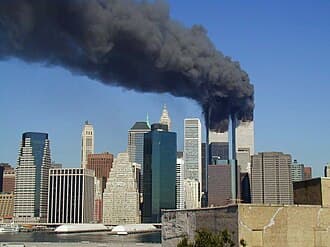
Civilizational trauma met with wound-management disguised as action
The rupture of American exceptionalism, the deep cultural belief that geography and power made the homeland untouchable; the experience of being vulnerable in your own living room
The collective trauma sequence: grief becoming rage, rage requiring action to restore the sense of control, action producing consequences that extended the original harm
The brief solidarity of shared grief, then its weaponization into division, the way collective pain, if not processed, becomes collective rage looking for an object
The surveillance state as trauma response institutionalized, the Patriot Act, TSA, mass surveillance as PTSD written into law and infrastructure; the wound made permanent in the architecture of daily life
Before
The specific character of the pre-9/11 American psyche is worth naming precisely, because the shock of September 11 was not just physical. It was the destruction of a foundational assumption.
America had not experienced a major attack on its continental territory since Pearl Harbor in 1941, and Pearl Harbor had attacked a military installation in a territory that was not yet a state. The two world wars had been fought elsewhere, in European and Pacific theaters, with American bodies but not American soil. The Cold War had produced genuine nuclear anxiety but it was the anxiety of possibility, not of event. In the decades between the Cold War's end and 2001, the predominant American self-image was of a nation uniquely protected by its geography, its power, and its goodwill, a place where things of this kind did not happen.
This was not simply arrogance, though there was arrogance in it. It was a structural feature of the national psychology: an assumption so deep and so rarely examined that it functioned less as a belief than as a fact. The ground was solid. The homeland was safe. The violence was something that happened to other places.
On the morning of September 11, 2001, that assumption was destroyed in real time, on television, while millions of people watched.
The Grief
The days immediately following the attacks produced something that Americans rarely display collectively: genuine, unguarded vulnerability. The country was frightened in a way it had no existing template for, and that fear temporarily dismantled some of the defenses that normally structure American public life.
The solidarity was real. The openness was real. There were moments in the days after September 11, in the way strangers spoke to each other, in the improvisatory memorials that appeared in public spaces, in the blood donation lines, in the quiet, that represented an authentic collective experience of grief, of shared fragility, of the kind of mutual recognition that usually requires catastrophe to produce.
Collective grief, before it is managed, contains a particular kind of possibility. It opens people to each other in ways that ordinary life forecloses. The question is always what happens to it next, whether it can be held in a form that leads to genuine integration, or whether it will be channeled into something else.
The grief was real and it did not last long in its open form. The political apparatus that shapes national emotional life was not built for grief. It was built for action.
The Turn
The conversion of collective grief into collective rage is a predictable psychological sequence, and it follows a predictable timeline. Grief is passive, it requires sitting with loss, tolerating helplessness, staying with what cannot be fixed. Rage is active. It provides the experience of agency. It restores the sense that something can be done, that the violated boundary can be enforced, that the intolerable vulnerability can be addressed by identifying and destroying its source.
The political leadership of the United States in 2001 understood, explicitly or intuitively, that the American public was in a state of acute psychological distress and that this state was politically shapeable. The language of the weeks after September 11, "wanted dead or alive," "axis of evil," the color-coded threat system, was not primarily strategic communication. It was affect management: it named the enemy, maintained the state of fear, and directed the rage that was looking for an object.
“Either you are with us, or you are with the terrorists.”
George W. Bush, September 20, 2001
The binary was psychologically functional. Trauma produces the need for clarity, for simple categories, for the reassurance that comes from knowing which side is which. The statement provided that reassurance while doing the work of preemptively delegitimizing any more complex response. To ask questions about the causes of the attack, the context, the longer history, this was not analysis. This was being with the terrorists.
The Wars as Wound Management
The psychological argument about the wars in Afghanistan and Iraq is not that they were irrational in every sense. It is that the primary driver of both was not strategic but psychological: the unbearable experience of helplessness, requiring action as its antidote.
The need to act when one is traumatized is more powerful than the need to be effective. It is more powerful than strategic calculation, more powerful than evidence, more powerful in many cases than the available information about what the action will actually produce. The action provides relief from the experience of being acted upon. It converts the victim into an agent. The relief is real regardless of whether the action achieves anything useful.
Afghanistan in 2001 contained a plausible strategic logic: the Taliban government had harbored al-Qaeda, the attack had been launched from Afghan territory, there was something there to respond to. The response still took the form it took, twenty years, hundreds of thousands dead, the same government in power at the end, because the need driving it was not primarily strategic. The need was for the relief of action, for the restoration of the sense that America could project force and therefore was not helpless.
Iraq had no connection to the September 11 attacks. The connection was manufactured and most of the people manufacturing it knew it was manufactured. What Iraq offered was a larger theater for the same psychological operation: a place where the force could be projected, where action could be taken, where the experience of helplessness could be converted into the experience of power. That the action produced chaos, enabled the expansion of the very forces it claimed to oppose, and resulted in the deaths of hundreds of thousands of civilians, these consequences did not register with adequate weight against the psychological function the action was serving.
What Remains
The permanent legacy of September 11 is written into infrastructure. The surveillance apparatus constructed in its wake, the Patriot Act, the NSA's mass surveillance programs revealed by Edward Snowden in 2013, the fusion centers, the no-fly lists, the watchlists, the transformation of airport security into a daily ritual of submission, did not disappear when the immediate shock faded. It became permanent, the way trauma responses tend to become permanent when they are institutionalized rather than processed.
This is what collective PTSD looks like at scale: the hypervigilance becomes the new normal; the emergency measures become standing policy; the security theater becomes the price of ordinary movement through the world. Americans take off their shoes in airports in 2026 because of a failed attempt in 2001. The TSA agents who pat down children and elderly passengers are, in a structural sense, the institutionalized expression of a nation that has never fully metabolized what happened on a Tuesday morning twenty-five years ago.
The attacks killed approximately three thousand people. The response to the attacks, the wars, directly and indirectly, killed hundreds of thousands, possibly over a million, depending on methodology. This asymmetry is the measure of the wound's depth. A healthy trauma response produces proportionate action aimed at genuine protection. What September 11 produced was something else: an amplification, conducted over decades, of the original harm. Which is, in the end, what untreated trauma does. It reproduces itself.
---
Interpretive opinion based on the public record. Not a clinical assessment or diagnosis of any individual.