Chernobyl
What Chernobyl revealed was not primarily a story about nuclear power but about what happens when an entire system is organized around the suppression of bad news, and the reactor that exploded was in many ways the least important thing that failed that night.
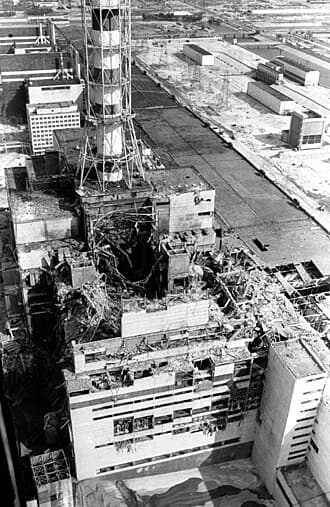
Institutional denial as existential hazard: the system could not process its own failures
Decades of information suppression created an apparatus incapable of responding to truth
The reporting architecture inverted: bad news traveled up the hierarchy as good news
Loyalty to institutional narrative over observable reality, from operator to Politburo
The invisible harm: radiation stripped the disaster of all legible warning signs
The System That Couldn't Hear No
In the Soviet system, bad news did not travel well. This was not incidental to Soviet culture. It was architectural. The ideological framework required that socialism be working, which meant that reports of failure were not merely inconvenient, they were ideologically impossible, which meant that the people responsible for generating those reports learned, over decades, to generate different ones.
The operators at Reactor Number Four at Chernobyl Nuclear Power Plant on the night of April 25 to 26, 1986, were not unusually negligent or unusually brave or unusually anything. They were people operating inside a system that had specific structural properties. One of those properties was that the RBMK reactor design had known safety flaws, including a dangerous positive void coefficient that made it unstable at low power. The information about this flaw had not been distributed to operators, in part because distributing it would have required acknowledging it.
The reactor that exploded was the physical endpoint of decades of informational suppression. The explosion was not primarily a technical failure. It was a communication failure that had been building for the entire life of the Soviet nuclear program.
What the Engineers Knew and Couldn't Say
The safety test being conducted that night was itself the product of deferred work. The test had been delayed and rescheduled multiple times over years, because the political pressure of the moment always took precedence over the engineering requirement. When it was finally conducted, it was run under conditions that the engineers involved found deeply uncomfortable, with a reactor in an unstable configuration and under pressure to complete the test before morning.
Anatoliy Dyatlov, the deputy chief engineer supervising the test, is often cast in retrospective accounts as the villain. His insistence on proceeding despite the operators' concerns, his dismissal of readings he did not want to hear, his famous refusal to accept the initial reports of the explosion, all point toward a man who had internalized the system's requirements for success so completely that he could not recognize catastrophe when it arrived.
But Dyatlov was himself an artifact of the system. The pressure on him to complete the test successfully was real and structural. His own professional survival depended on delivering the result the system needed. He was not uniquely defective. He was the point where the system's requirements and the physical world's requirements finally collided.
“We observed all the instructions. We did everything by the book. It should not have happened.”
Anatoliy Dyatlov, testimony at the trial of Chernobyl operators, 1987
The statement is both self-serving and, in a specific sense, accurate. The instructions were themselves a product of the system that could not acknowledge the reactor's real behavior.
The 36-Hour Delay and Its Logic
The explosion occurred at 1:23 AM on April 26. The evacuation of Pripyat, the city of 49,000 people built specifically to house Chernobyl workers, did not begin until 2:00 PM on April 27: thirty-six hours later.
The delay is often presented as inexplicable or as evidence of Soviet callousness. It was neither. It was the entirely logical output of a system where acknowledgment of disaster required authorizations that moved up a hierarchy where each level was motivated to minimize what it was passing upward. Each level of reporting that night and the following morning received information, softened it, sent up a reduced version, and waited for instructions that would be delayed because the picture arriving at the decision-making level did not convey the urgency that warranted fast decisions.
Moscow received, initially, a report of an accident. Not of an open reactor core releasing radiation at levels that were melting the dosimeters of the firefighters who had been sent in without adequate information to fight what they were told was a roof fire.
The firefighters who died in the weeks following the explosion were not uninformed by accident. They were uninformed because the information system had failed to carry the truth upward, and had failed in this way by design.
Gorbachev and the Acceleration of Glasnost
Mikhail Gorbachev's later writings and interviews identify Chernobyl as a turning point in his thinking about what kind of reform the Soviet system actually required. He had been pursuing glasnost, the policy of openness, before the explosion, but he has said that the event demonstrated with physical force what information suppression actually costs.
"Chernobyl shed light on many of the sicknesses of our system as a whole. Everything that had built up over the years converged in this drama: the concealing or hushing up of accidents and other bad news, irresponsibility and carelessness, slipshod work, and wholesale drunkenness."
The argument that Chernobyl accelerated the end of the Soviet Union is not simply a metaphor. It was a material demonstration that the information architecture of the Soviet system was incompatible with the safe operation of complex technological systems. A society that cannot carry bad news from the bottom to the top cannot make good decisions about the conditions at the bottom.
The Liquidators
Between 1986 and 1990, an estimated 600,000 workers participated in the cleanup and containment operations at Chernobyl. They were called liquidators. They received varying levels of radiation exposure and varying levels of information about what they were being exposed to. Many were not told the true nature of the hazard. Many were given dosimeters that were calibrated to produce readings below the official exposure limits, regardless of actual exposure, so that they could be kept on-site.
The long-term health effects on the liquidators are still contested in the scientific literature, in part because the Soviet and then Ukrainian and Belarusian governments had structural reasons to minimize documented harm. The people who went into the zone, who cleared the roof of the reactor by hand because the remote-controlled robots sent to do the job failed in the radiation, who built the sarcophagus over the open reactor core: they are among the most direct physical embodiment of what it means to be expendable to a system that cannot acknowledge the danger it is placing you in.
The Exclusion Zone as Monument
The 2,600-square-kilometer Chernobyl Exclusion Zone is the permanent physical archive of the event. Pripyat, with its fairground and its apartment blocks and its school with the scattered books, remains as it was, a monument not to the explosion but to the evacuation: the moment when the suppression finally failed and the physical reality was acknowledged.
The HBO miniseries Chernobyl, released in 2019, became a cultural phenomenon partly for reasons that had nothing to do with nuclear physics. It depicted, with precision and without consolation, the specific experience of people who know the truth and cannot make it matter inside a system that has organized itself against receiving it. The resonance of that depiction in 2019 was not accidental.
What Chernobyl Is For
Chernobyl is a case study in the cost of institutional denial at scale. Every organization, family, and system has some version of the mechanism that failed at Reactor Number Four: the process by which inconvenient information is softened, delayed, reframed, and finally suppressed as it moves toward the people who have the authority to act on it.
The specific horror of Chernobyl is that the harm was invisible. There were no flames after the initial explosion. There was no smell. The firefighters who received lethal doses of radiation in the first hours reported feeling fine. The invisibility of the harm was a physical analog for the invisibility of the information: the danger was real and present and not available to normal perception, just as the truth about the reactor was real and present and not available through normal institutional channels.
The reactor exploded because the system couldn't hear the truth. The question that Chernobyl has been asking ever since is: what does your system do with the things it doesn't want to know?
References
- Gorbachev, Mikhail. Memoirs. Doubleday, 1995. - Higginbotham, Adam. Midnight in Chernobyl: The Untold Story of the World's Greatest Nuclear Disaster. Simon & Schuster, 2019. - International Atomic Energy Agency. The Chernobyl Accident: Updating of INSAG-1. IAEA Safety Series No. 75-INSAG-7. IAEA, 1992. - Kopytko, Nataliya. "The Liquidators: Medical Consequences of the Chernobyl Nuclear Power Plant Catastrophe." Social Science and Medicine (2019). - Plokhy, Serhii. Chernobyl: The History of a Nuclear Catastrophe. Basic Books, 2018. - Shcherbak, Yurii. Chernobyl: A Documentary Story. Translated by Ian Press. St. Martin's Press, 1989.
---
Interpretive opinion based on the public record. Not a clinical assessment or diagnosis of any individual.