The Moon Landing
What collective aspiration looks like when it achieves form. The conditions under which humans are capable of the extraordinary. And what it reveals that those conditions were organized primarily by fear.
Fear as the engine of transcendence
Cold War terror transmuted into collective project
400,000 workers, three men get the myth
National collective mobilized by existential competition
Peak achievement followed by ordinary life and its difficulty
The Fear That Built It
On May 25, 1961, John F. Kennedy addressed a joint session of Congress and announced that the United States would put a man on the moon before the end of the decade. The speech is remembered as an expression of American ambition. It is more accurately understood as an expression of American fear.
Four weeks earlier, the Soviet Union had put Yuri Gagarin in orbit. The Americans had followed with Alan Shepard's suborbital flight, but the comparison was unfavorable. The space race was, in 1961, a race the Soviets appeared to be winning. Kennedy's moon declaration was not a vision born of confidence. It was a strategic response to the possibility that the Soviet Union would establish dominance in a domain that was beginning to be understood as central to both military and psychological superiority in the Cold War.
“We choose to go to the moon in this decade and do the other things, not because they are easy, but because they are hard.”
John F. Kennedy, Rice University, September 1962
The rhetoric of the Rice University speech, which elaborated the original congressional declaration, is built around challenge, effort, and the demonstration of capability. What it does not say, but what was present in every decision that shaped the Apollo program, is the terror underneath: the terror of falling behind, of ceding technological dominance, of being second in a competition that had existential stakes.
The moon landing is the most extraordinary example in human history of what terror, properly organized and sufficiently funded, can produce. This is not a diminishment of the achievement. It is an observation about the conditions that made it possible, and a question about what those conditions reveal.
The 400,000
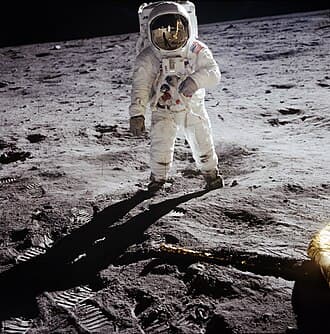
Neil Armstrong, Buzz Aldrin, and Michael Collins made the journey to the moon. They received the credit. They gave the speeches, attended the parades, met the heads of state, wrote the memoirs. They are the figures in the photographs.
The Apollo program required the work of approximately 400,000 people: engineers, technicians, mathematicians, seamstresses who sewed the spacesuits by hand, software programmers (many of them women, including Margaret Hamilton, whose team wrote the flight software), physicists, project managers, welders, and the astronaut corps itself. The organization required to coordinate that labor, to maintain the technical coherence of a project involving thousands of interdependent components across hundreds of contractors and government agencies, was itself an extraordinary achievement.
Most of those 400,000 people are not remembered. This is not unusual: the mythology of collective achievement regularly concentrates around a small number of visible figures while the labor that made the achievement possible recedes from view. But the specific shape of the Apollo mythology, its concentration around three men in a capsule, obscures something important about what the moon landing actually was.
“I remember the people who gave up holidays, vacations, and time with their families. I remember the women who stayed late to run the calculations again. The ones whose names you will not know.”
Gene Kranz, Mission Control Flight Director, *Failure Is Not an Option*, 2000
The moon landing was not the achievement of three men. It was the achievement of a particular kind of collective organization, produced under particular historical conditions, made possible by a particular scale of public investment. Understanding it as the story of three brave men is emotionally simpler and intellectually incomplete.
Leaving the Earth
The psychological literature on the astronaut experience is not large, but it contains something important. Multiple astronauts have described a transformation in perception that occurs when the Earth is seen from sufficient distance: the fragility of the planet, the arbitrariness of national boundaries, the smallness of human concerns against the scale of space. Edgar Mitchell, the Apollo 14 astronaut, described an experience of sudden interconnectedness on the return journey from the moon that he subsequently spent decades trying to understand and articulate.
This experience, often called the "overview effect," is not uniformly reported. Not every astronaut describes a transformative shift in perspective. But the phenomenon is common enough across multiple testimonies that it warrants attention as a genuine psychological effect of a specific physical experience: the experience of leaving the planet and looking back.
What this reveals about human psychology is interesting. The shift in perspective that space produces, the sudden recognition of Earth as fragile and small and shared, is a shift that is very difficult to produce through ordinary experience. People who have spent their entire lives on the planet, embedded in its politics and its conflicts and its seemingly insuperable local problems, generally do not spontaneously arrive at the overview perspective. It requires physical removal from the context to see the context clearly.
Armstrong's famous words, "One small step for man, one giant leap for mankind," reach toward this perspective. He had intended to say "one small step for a man," placing the individual in explicit contrast with the collective. The "a" was either lost in transmission or not spoken in the moment. The version the world received elides the distinction, which is both grammatically odd and, in retrospect, almost right: what the moon landing revealed is how difficult it is to hold individual and collective in the same frame.
The Return to Ordinary Life
What happened to the astronauts after Apollo is one of the more psychologically revealing sequels in public life. Several of them experienced significant difficulty in the years following their missions.
Buzz Aldrin was open, in his memoir Return to Earth (1973) and in subsequent interviews, about his depression and alcoholism following Apollo 11. He described the experience of returning to ordinary life after the most extraordinary event in human history as something for which there was no preparation and no precedent. "What do you do after you've been to the moon?" is not a rhetorical question. It is a genuine psychological problem.
Edgar Mitchell pursued spiritual research and founded the Institute of Noetic Sciences. Mike Collins described himself as relatively well-adjusted in comparison to some of his colleagues, but his memoir Carrying the Fire (1974) is notable for its emotional honesty about the isolation and strangeness of the experience.
Neil Armstrong retreated almost entirely from public life after Apollo 11. He gave relatively few interviews. He accepted relatively few engagements. He taught engineering at the University of Cincinnati for eight years, then withdrew from that too. He died in 2012, having given surprisingly little direct account of what the moon had been like.
The pattern across multiple astronauts suggests something that the celebratory mythology of the moon landing does not accommodate: that peak experience at this scale can make the subsequent life feel insufficient. The problem is not simply adjustment to celebrity. It is the more fundamental problem of having had the most significant experience of your life at thirty-eight or forty, and then having to construct meaning for the remaining decades in its aftermath.