The Oklahoma City Bombing
The moment America discovered that the threat could come from inside. The cognitive reorganization required when the enemy is not foreign but domestic, not alien but a decorated veteran who looks like everyone's neighbor.
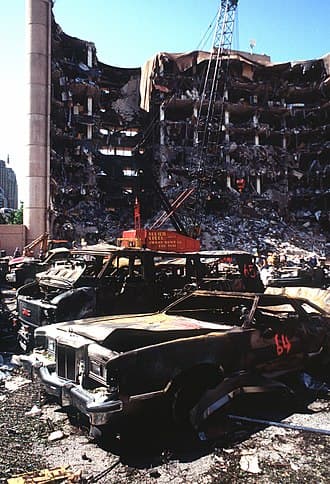
Domestic terror rupturing the foreign-threat framework
National innocence confronting homegrown radicalization
Grievance architecture built from real events twisted into mass murder
Anti-government community recognizing itself in the perpetrator
The question of why that the trial and execution could not answer
9:02 a.m.
At 9:02 in the morning of April 19, 1995, a truck bomb containing approximately 4,800 pounds of ammonium nitrate fertilizer and nitromethane exploded outside the Alfred P. Murrah Federal Building in Oklahoma City, Oklahoma. The north face of the building was destroyed. The blast was felt 55 miles away. 168 people died, including 19 children who were in the America's Kids day care center on the second floor. More than 680 people were injured. 324 buildings in the surrounding area were damaged or destroyed.
For several hours after the explosion, the media framing was organized around foreign terrorism. Middle Eastern terrorist groups were named in early reports. Federal officials spoke cautiously but the context was clear: the bombing of the World Trade Center in 1993, attributed to Islamic extremists, was the recent precedent, and that precedent shaped the interpretive frame.
Timothy McVeigh was arrested 90 minutes after the blast, not because of any investigation of the bombing but because an Oklahoma state trooper stopped him for driving without a license plate and found a concealed weapon. He was a white man from upstate New York, twenty-six years old, a decorated Army veteran who had served in the Gulf War and received a Bronze Star. He did not fit the frame.
The cognitive disruption when McVeigh was identified as the primary perpetrator was genuine and profound. The threat framework that most Americans carried was not built to accommodate a homegrown threat of this nature, organized by a decorated military veteran whose grievances were rooted in specific American events.
McVeigh's Psychology and the Grievance Architecture
McVeigh had grown up in rural New York, the son of an auto worker whose marriage had failed. He was by multiple accounts a serious student of American history and political philosophy of a particular kind: the anti-government tradition that runs from the Founding era through the militia movement, emphasizing individual liberty, government tyranny, and the right of armed resistance to federal overreach.
He enlisted in the Army in 1988 and distinguished himself. His performance at Fort Riley, at Grafenwohr in Germany, and in the Gulf War was by all accounts excellent. He received the Combat Infantryman Badge, the Bronze Star, and multiple commendations. He attempted to qualify for the Special Forces and failed the selection process, an experience that his biographers have identified as a turning point.
What he came back from the Army carrying was a combination of military training and skill, a developed political ideology, and a sense of grievance that found two specific events as its organizing framework.
The Ruby Ridge standoff in August 1992, in which federal agents killed the wife and son of anti-government separatist Randy Weaver, was the first. The Waco siege in 1993, which ended on April 19 with a fire that killed 76 members of the Branch Davidian religious community including their leader David Koresh, was the second. McVeigh visited Waco during the siege. He told journalists after his arrest that Waco was the event that made him conclude that the federal government was at war with its own citizens.
“I understand how [McVeigh] got to where he got to. The government was at war with its own people. That was not an illusion.”
Gore Vidal, who corresponded with McVeigh before his execution, 2001
The Vidal statement is not an endorsement of the bombing. It is an observation about the difference between the grievances, which had real foundations in events the government acknowledged had gone wrong, and the response, which was the murder of 168 people who had nothing to do with Ruby Ridge or Waco. McVeigh made the category error of treating random federal employees and their children as legitimate targets for retaliation against specific government decisions. The error was categorical and absolute. The grievances were not entirely fabricated.
The Murrah Building, the Daycare, and the Photograph
The Alfred P. Murrah Federal Building housed offices of multiple federal agencies: the DEA, ATF, Secret Service, Social Security Administration, and the offices of several federal judges. In McVeigh's targeting logic, these agencies represented the federal government's coercive apparatus.
The America's Kids day care center on the second floor housed 21 children on the morning of April 19. Fifteen of them were killed in the explosion. The oldest was five years old.
No targeting logic that includes a daycare center as acceptable collateral can be seriously defended as a coherent response to government overreach. McVeigh's own subsequent statements about the children, in which he described them as "collateral damage" using the military terminology he had learned in the Gulf War, revealed the degree to which his framework had become abstracted from the human reality of what he was doing.
The photograph that became the defining image of the bombing was taken by Charles Porter IV, a bank worker who happened to have a camera. It shows firefighter Chris Fields carrying one-year-old Baylee Almon, her left shoe missing, her body limp. The image won the Pulitzer Prize. It was the image that made the abstract destruction concrete for people who were not in Oklahoma City.
The photograph's power operates through the specific reversal it contains. The firefighter in the image, the person in uniform carrying the child, is not the threat. The threat came from someone who looked like the firefighter: trained, competent, wearing the same surface indicators of trustworthiness. That reversal was the cognitive disruption that the bombing produced at a national scale, and the photograph made it impossible to look away from.
The Trial, the Execution, and the Unresolved Question
McVeigh was convicted on 11 counts of murder and conspiracy in June 1997 and sentenced to death. He was executed by lethal injection at the United States Penitentiary in Terre Haute, Indiana on June 11, 2001, three months before the September 11 attacks. He declined to make a last statement; he had previously expressed no remorse and had described the children's deaths as collateral damage.
His co-conspirator Terry Nichols was convicted of conspiracy and involuntary manslaughter and sentenced to life in prison. A third figure, Michael Fortier, cooperated with the prosecution and received a reduced sentence.
The question the legal proceedings could not resolve was the one that the psychology of the event most demands: how does someone arrive at this? The movement from military service to anti-government radicalization to mass murder is not a path with a single obvious pressure point. It involves the accumulation of grievances, the adoption of an ideology that makes mass violence conceivable, the decision to act, and the suppression of whatever within the person would otherwise prevent the action.
“I bombed the Murrah Building to protest the continued siege of all law-abiding gun owners and all law-abiding citizens of this country who are being harassed, robbed, and murdered by a fascist government.”
Timothy McVeigh, in a statement written before the bombing
The statement's internal logic is coherent given its premises. The premises required the acceptance of a framework in which federal employees were not people going to work but representatives of a fascist occupation. The framework required sustained cultivation. It did not arrive overnight.
How It Was Handled Differently
The comparison between the response to Oklahoma City and the response to September 11 is instructive in ways that neither the defenders of the first response nor the defenders of the second have fully processed.
McVeigh was arrested, tried in civilian federal court, convicted, and executed in six years. The constitutional process was applied. The investigation, prosecution, and punishment proceeded within the existing legal framework. No new detention authorities were created. No new surveillance powers were authorized. The domestic political rights of American citizens were not significantly curtailed.
The September 11 attacks, carried out by foreign nationals, produced the opposite: the USA PATRIOT Act, the creation of the Department of Homeland Security, the authorization for military force in Afghanistan and eventually Iraq, the detention of individuals without charge at Guantanamo Bay, the authorization of enhanced interrogation techniques. The institutional response was vastly larger and more lasting.
The difference in response correlates with the difference in who committed the act. McVeigh was an American citizen committing domestic terrorism. The 9/11 attackers were foreign nationals. The response to each was shaped, in part, by what kind of threat each was perceived to be.
What the difference reveals is something about which threats the society feels it can process through existing institutions and which threats it responds to by expanding institutional power. The Oklahoma City bombing was terrible. The response to it did not permanently alter the legal framework under which Americans lived. The 9/11 attacks were also terrible, and the response to them did. Understanding that difference requires acknowledging that the category into which a threat is placed, domestic versus foreign, known versus alien, shapes the institutional response at least as much as the scale of the violence.