Napoleon Bonaparte
Napoleon was not a small man who compensated his way to empire. He was an outsider who conquered the inside, then discovered that the inside had always been the least interesting thing about him.
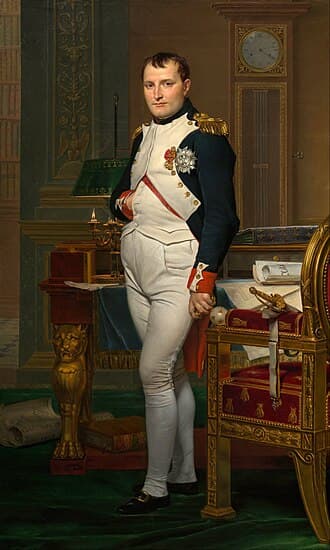
The perpetual outsider who became the inside, and could not stop
Corsican otherness: born French by accident of timing, never accepted as genuinely French
Compensation drive transformed into world-historical ambition; the wound as engine
Obsessive attachment (Josephine) coexisting with transactional clarity in all other relationships
Exile as the terrain event that stripped the compensatory structure bare, leaving only the original wound
The Myth and the Man
The Napoleon complex is the most famous piece of folk psychology in the Western canon: the short man who conquers empires because he cannot accept his own smallness. There is one significant problem with this formulation. Napoleon was not short. Contemporary French records place him at around 5 feet 6 inches, which was average or slightly above average for his era. The myth of his stature originated substantially in British wartime propaganda, which used a visual shorthand established by the caricaturist James Gillray. The English confused French inches and English inches in translating a measurement, and a legend was born.
What the myth reveals is not Napoleon's psychology but ours. We need exceptional achievement to have a pathological explanation, especially when the achiever is foreign and threatening. The real question about Napoleon's psychology is more interesting than compensatory height.
The Corsican Wound
Napoleon Bonaparte was born on August 15, 1769, in Ajaccio, Corsica, approximately fourteen months after France purchased the island from the Republic of Genoa. He was, by an accident of history, French. He did not sound French, did not come from French noble stock, and did not arrive at the mainland military academies with the ease of someone whose belonging had never been questioned.
At the Brienne military academy, where he was sent at age nine, Napoleon was mocked for his accent and his origins. He responded by becoming exceptionally good at the one domain where Corsican identity was irrelevant: mathematics and artillery. He learned early what outsiders always learn: the credential can override the origin, but only if the credential is overwhelming. He did not try to become more French. He became more dangerous.
This is the template from which his entire career was constructed. Every subsequent conquest, every title accumulated, every institution reformed can be read as an elaboration of the same fundamental move: if you cannot be accepted inside, you can become the inside.
Letizia and the Formation
His mother, Letizia Ramolino Bonaparte, was by all accounts a formidable figure: stern, practical, undemonstrative, and deeply competent. She managed a large family under difficult circumstances and did not trade in sentimentality. Napoleon described her with consistent respect and without visible warmth. "What a woman," he reportedly said of her. "What firmness. What strength of character."
The psychological formation that produces a man who can march an army across a continent and back, who can absorb catastrophic defeats and continue functioning, who can be exiled and immediately plan a return -- this is not formed in comfort. Letizia gave Napoleon the thing that is both the most useful and the most dangerous gift a parent can give: the absolute absence of softness. He never expected mercy from the world, because he had learned not to expect it at home.
Josephine
"I wake filled with thoughts of you. Your portrait and the intoxicating evening which we spent yesterday have left my senses in turmoil," Napoleon wrote to Josephine de Beauharnais in 1796, while commanding the Italian campaign. The letters continued in this register throughout the early years of their marriage. They are remarkable documents, not because they are romantic, but because they are helpless. The man who was rewriting the map of Europe could not manage equanimity about whether his wife loved him.
Josephine did not love him in the way he loved her. She was unfaithful. He discovered this during the Egyptian campaign and wrote to his brother that the discovery had destroyed his capacity for sentiment. He was wrong. He divorced her in 1809 for dynastic reasons -- she had not produced an heir -- and it is documented that he wept at the decision. He never stopped referencing her. Josephine was the one domain where his compensatory machinery did not work, where he could not out-achieve his own vulnerability.
The man who placed the crown on his own head could not make his wife stay.
The Self-Crowning
On December 2, 1804, at Notre Dame Cathedral in Paris, Pope Pius VII traveled to France to consecrate Napoleon's coronation as Emperor of the French. At the critical moment, Napoleon took the crown from the Pope's hands and placed it on his own head. He then crowned Josephine himself.
The gesture has been interpreted as arrogance, as anti-clericalism, as political theater. It was all of these. But as a psychological act it is transparent: Napoleon would not receive his legitimacy from a prior authority. He was the source of the legitimacy. The outsider from Corsica who had been mocked at Brienne for his origins placed himself above the most powerful institutional figure in Western Christianity and announced, in a gesture, that his authority derived from himself.
The Corsican boy who had never been accepted as French had made himself Emperor of France, and he alone would say so.
The Terrain Event: Exile
Napoleon survived Elba, his first exile, because Elba was not real exile. It was close enough to France that escape was practical and the return was possible. The Hundred Days ended at Waterloo in June 1815, and this time the coalition sent him to Saint Helena: a volcanic island in the South Atlantic, 1,200 miles from the nearest continent.
Saint Helena killed him more thoroughly than any battle. He arrived in 1815 and died in 1821 of what most modern historians believe was stomach cancer, possibly accelerated by the conditions of his captivity. He spent the years on the island dictating his memoirs, constructing the Napoleonic legend, working to control how history would read him. The exile did not break him in the sense of defeating his will. It broke him in the more fundamental sense of removing the activity through which he constituted himself. Without an outside to conquer, without a France to be more French than, without the perpetual motion that had organized his identity since Brienne, there was only the wound.
He was 51 when he died on Saint Helena. He had been Emperor, in various forms, for eleven years.
References
- Roberts, Andrew. Napoleon: A Life. Viking, 2014. - Schom, Alan. Napoleon Bonaparte. HarperCollins, 1997. - Cronin, Vincent. Napoleon Bonaparte: An Intimate Biography. William Morrow, 1972. - Asprey, Robert B. The Rise of Napoleon Bonaparte. Basic Books, 2000. - Napoleon Bonaparte. Letters to Josephine, 1796-1809. Various collections, including the Correspondance de Napoleon Ier, published 1858-1870.
---
Interpretive opinion based on the public record. Not a clinical assessment or diagnosis of any individual.