Joker (2019)
Todd Phillips's Joker asks the audience to inhabit the wound of a person who becomes dangerous, and the controversy it generated revealed more about the audience's discomfort with that request than about the film itself. Arthur Fleck is not a portrait of evil. He is a portrait of abandonment.
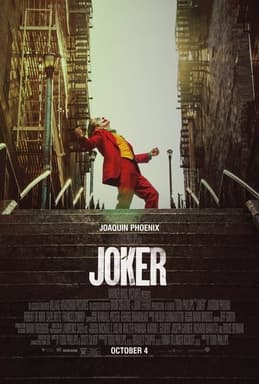
Violence as the endpoint of abandonment, not of evil: what the specific conditions of institutional neglect, social isolation, and untreated illness produce
Abusive childhood, institutional abandonment, undiagnosed and untreated mental illness, complete absence of genuine human connection
The wrong register: pseudobulbar affect as the wound expressing itself in an unreadable form, laughing where crying is meant
Fantasized connection substituting for actual connection: Arthur's relationships are primarily imagined
The unreliable narrator: the film's reality is constructed through Arthur's perception, which the film explicitly compromises
The Controversy as Symptom
Joker opened at the Venice Film Festival in August 2019 and won the Golden Lion, the festival's top prize. It opened in wide release in October 2019 to some of the most divided critical reception of the decade: enthusiastic audiences and deeply skeptical critics, with the critical resistance clustering around concerns that the film was dangerous, that it might inspire real-world violence, that its apparent sympathy for Arthur Fleck was irresponsible.
The audience gap is the first thing worth mapping. Films that critics find dangerous and audiences find true are worth examining, because the gap often reveals something about what the film is doing that makes critics uncomfortable and what it is doing that makes audiences feel seen.
What Joker does that provokes the critical discomfort is ask the audience to inhabit, in genuine and sustained detail, the interior experience of a person who becomes dangerous. Not to excuse that person. Not to endorse the violence. But to follow the logic of the wound from its origins to its endpoint, without the narrative distance that makes such an exercise feel safe.
The controversy is about permission: whether it is permissible to understand a person who becomes violent well enough to trace how they got there. The film says yes. Some critics said no. The disagreement is not primarily aesthetic.
Arthur Fleck's Wound Architecture
The film establishes Arthur Fleck's wound with specificity and care. He has a neurological condition, pseudobulbar affect, that causes involuntary laughing at socially inappropriate moments. He has a mother who was mentally ill and who, as the film reveals, may have subjected him to abuse and neglect in early childhood. He has been cycling through the institutional mental health system without adequate treatment. He has no genuine human connection: his apparent relationship with his neighbor is revealed to be a fantasy he has constructed entirely in his own mind.
This is not a character with one wound. This is a character with compounding wounds, each of which would be difficult to manage in isolation and which together constitute a nearly total abandonment.
What the film tracks is not the creation of a monster. It is the exhaustion of the last resources of a person who was never adequately resourced. Arthur does not snap because he is inherently evil. He arrives at violence through a sequence of losses, each of which removes something that had been maintaining a partial stability.
The specific sequence matters: the loss of his medication and therapy when the city cuts the social services budget; the loss of his job; the public humiliation on the subway; the discovery of his mother's history; the television mockery by Murray Franklin, the man Arthur had constructed as a fantasy father figure. Each event is a system failure, and the violence is what remains when all the systems have failed.
Pseudobulbar Affect as Metaphor
Pseudobubar affect is a real neurological condition characterized by involuntary and uncontrollable episodes of laughing or crying that do not correspond to the person's actual emotional state. It can occur following traumatic brain injury, stroke, or certain neurological conditions.
The film uses it with dual purpose: as a documented medical reality that grounds Arthur's experience in something clinically legible, and as the film's central metaphor.
The metaphor is this: Arthur laughs when he means to cry. Or more precisely, the damage expresses itself in the wrong register, in a form that is unreadable to the people around him, that causes others to interpret his internal state as the opposite of what it is. He is in pain and it emerges as laughter. He is humiliated and it looks like amusement.
This is not just a neurological portrait. It is a map of a specific kind of wound: the wound that cannot communicate itself in a legible form, that arrives in the wrong register, that is therefore misread and responded to as if it were something other than what it is. The condition is literal in Arthur's case. It is metaphorical in ways that land for anyone whose pain has been consistently misread.
The Conditions That Produce Violence
The critical anxiety about Joker was partly that it seemed to explain, and therefore potentially to justify, violence. This confuses two things that are worth keeping separate: explanation and endorsement.
The film is doing the work of explanation, which is the work of mapping the conditions under which a specific kind of outcome becomes likely. Those conditions are: childhood trauma and abuse, neurological difference, systematic institutional neglect, social isolation, public humiliation, the absence of any genuine human relationship, and the presence of a culture that romanticizes certain kinds of violent response.
None of these conditions, individually or together, makes violence inevitable. The film is not arguing determinism. It is arguing that these conditions constitute a specific kind of vulnerability, and that when they compound without intervention, the probability of a catastrophic outcome increases.
The film's argument is an argument for intervention at the level of the conditions. The violence Arthur commits is the consequence of the failure of every system that should have made contact before the endpoint arrived. That is not a justification. It is an indictment of the systems.
The Unreliable Narrator
The film explicitly compromises Arthur's reliability as a narrator. The relationship with Sophie, which occupies significant screen time, is revealed to be entirely fabricated. Arthur has been having an imagined relationship with a woman who barely knows him. She does not recognize him when he appears at her door.
This revelation reframes what we have been watching. If Arthur's experience of the Sophie relationship is not real, what else is not real? The film does not answer this question cleanly. It leaves open the possibility that significant portions of what we have been shown are Arthur's construction rather than documented events.
The formal function of this ambiguity is the same as in American Psycho: it redirects attention from the moral accounting of specific acts to the psychological accounting of the wound that generates the narrative. Whether or not specific events happened as depicted, the wound is equally legible. The unreliable narrator is a device for keeping the focus on the psychology rather than the plot.
What Joaquin Phoenix Brought
Joaquin Phoenix prepared for the role with a documented level of physical and psychological commitment. He lost approximately 52 pounds for the role, developing a movement vocabulary for Arthur that was specific to someone in that degree of physical depletion. The walk, the dancing, the quality of the laughter were developed in collaboration with the director over an extended period.
Phoenix said in interviews that what he was working toward was specificity: not a general portrait of mental illness but a specific person with a specific history. "What I found most interesting is this idea of how little we understand mental illness," he told the Toronto International Film Festival. "We have such a simplistic way of how we see these people."
The result is a performance that makes Arthur's interior legible in ways that the script alone could not accomplish. The audience does not merely observe Arthur. They track him, they are in his experience, they feel the moment-by-moment quality of a mind that is barely holding on. This is what made the performance simultaneously the most praised and the most controversial element of the film.
References
- Phillips, Todd, dir. Joker. Warner Bros. Pictures, 2019. - Phoenix, Joaquin. Press conference remarks, Toronto International Film Festival, 2019. - Mendelson, Scott. "Review: Joker." Forbes, October 2019. - Turan, Kenneth. "Joker review." Los Angeles Times, October 2019. - McNally, Kim. "Pseudobulbar Affect: What It Is and How It Differs from Other Conditions." Cleveland Clinic Health Essentials, 2020. - Herman, Judith. Trauma and Recovery: The Aftermath of Violence. Basic Books, 1992. - Fonagy, Peter, et al. Affect Regulation, Mentalization, and the Development of the Self. Other Press, 2002.
---
Interpretive opinion based on the public record. Not a clinical assessment or diagnosis of any individual.