Taxi Driver (Martin Scorsese, 1976)
Travis Bickle is not a monster. He is a map of what happens when extreme social isolation meets a psychology that cannot tolerate the absence of meaning - and what that combination produces when it encounters a specific landscape and finds a role to inhabit.
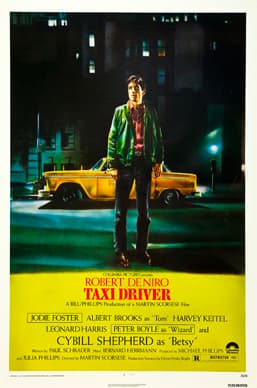
Social isolation so complete that the mind's own productions become the only available reality
Post-Vietnam displacement - a man formed for a context that no longer exists, returned to a world that has no place for him
Savior fantasy as the only available structure for meaning in the absence of any other social role
Incapable of genuine contact - every attempted relationship filtered through the lens of the fantasy he needs to sustain
The ending that resolves nothing - the psychology intact beneath the brief social recognition
The Architecture of Isolation
Paul Schrader wrote the script for Taxi Driver in 1972 during what he has described as a period of personal crisis - alone in Los Angeles, not seeing people for weeks at a time, conducting a running interior monologue with no external check on where it was going. He has said he identified with Travis Bickle. That identification is the source of the film's psychological accuracy.
Travis Bickle (Robert De Niro) drives a cab at night because he cannot sleep. He cannot sleep because his mind will not quiet. This is established in the opening minutes and it is the film's foundational psychological fact: Travis is a man whose interior is too loud for rest, and the only available response to that loudness is to keep moving.
He does not have friends. He does not have relationships. He has no community. He eats alone in a diner. He goes to pornographic films alone. He tries to talk to the Secret Service agents outside a campaign rally as if making conversation is something he knows how to do, and the conversation does not work because he does not know how. He writes journal entries addressed to no one that read like the transcript of a mind with no external regulation available to it.
Isolation of this depth is not merely loneliness. It is a feedback loop. The mind uses external contact - other people, their responses, their resistance, their difference from us - to calibrate its own productions. When external contact is absent, the mind's productions go unchecked. The fantasies become more vivid. The interpretations of events become more fixed. The internal narrative accumulates without correction. Travis's voiceover is the sound of a mind that has been in this loop for long enough that he no longer notices it.
The Political Landscape
Schrader's script was written in the aftermath of Vietnam and in the middle of Watergate. Scorsese shot it in 1975 New York - the city at its most visibly degraded, the streets of Hell's Kitchen and Times Square serving as location and as symbol simultaneously. The garbage strikes, the peep shows, the general texture of a city that had visibly failed to cohere.
Travis is a veteran. The film does not dwell on this. It does not need to. The veteran detail does two things: it explains a specific kind of violence capability that Travis carries without drama, and it locates his psychology in a historical wound that the film treats as background radiation rather than foregrounded explanation. Travis is a man who was shaped for a context - military service in a specific kind of war - that no longer exists, and who returned to a civilian world that had no place for what the war had made him. The disillusionment is not personal idiosyncrasy. It is the disillusionment of a generation, internalized.
"Travis Bickle is not an aberration. He is the landscape internalized. The post-Vietnam, post-Watergate cultural moment - the specific American experience of institutions revealed as hollow, of sacrifice demanded and then dishonored - finds its psychological expression in a man alone in a cab, narrating the filth he cannot stop seeing, waiting for a rain that will clean what nothing else has."
The Savior Delusion
Travis's attachment to Iris (Jodie Foster) - the twelve-year-old prostitute he becomes fixated on rescuing - is not primarily sexual. The film gestures toward that interpretation and then declines it. Travis takes Iris to breakfast. He tries to talk her into leaving. He is earnest and confused and incapable of understanding her perspective because understanding her perspective would require him to relinquish the fantasy that he is her rescuer.
The savior fantasy is the only available role that gives Travis's existence structure and meaning. He cannot save himself - he cannot even name what is wrong with himself, cannot understand why he cannot sleep or connect or find a place in the world. But he can imagine saving Iris. The fantasy of rescuing a child from exploitation allows him to construct a narrative in which he is not the problem. He is the solution. He needs her need the way the codependent needs the crisis - because it is the only available framework for self-definition.
The relationship with Betsy (Cybill Shepherd) - the campaign worker he pursues and loses with startling speed - is the film's early terrain marker for Travis's relational incapacity. He successfully asks her to coffee. He then takes her to a pornographic film on their first date, with no apparent awareness that this is not what most people do, because the pornographic films are where Travis goes and the world he inhabits has no clear boundary from the rest of his world. She leaves. He writes her letters. He calls her on the phone and is angry. He cannot understand what went wrong, because understanding would require a theory of other people's interiority that he does not have.
The Real Rain
The film's most famous line is in Travis's voiceover: "All the animals come out at night - whores, skunk pussies, buggers, queens, fairies, dopers, junkies, sick, venal. Someday a real rain will come and wash all this scum away." The desire for apocalyptic cleansing - a rain that would purify the landscape - is the terrain marker for a psychology that cannot tolerate complexity and ambiguity and has organized itself around the fantasy of a final solution to an internal problem that is being projected outward.
The violence at the film's climax - Travis's assault on the brothel where Iris is working - is framed in the film, and subsequently in the press coverage within the film's world, as heroic. He is briefly a celebrity. The tabloid front pages say he saved the girl. This is the film's cruelest formal joke. The violence did not come from heroism. It came from the same psychology that produced every other element of Travis's behavior - the isolation, the savior fantasy, the inability to find a place in the world by any ordinary means. The result happened to benefit someone. The origin was not benevolent. It was the expression of a psychology at its limit.
The final shot is Travis driving at night, the same streets, the same neon, his eyes in the rearview mirror - and then the quick flinch as something startles him. The film ends there. The psychology is intact. The rain did not come. The conditions that produced Travis Bickle are unchanged, and Travis Bickle is unchanged within them.
“Travis Bickle is a time bomb.”
Paul Schrader, screenwriter
The Mirror Problem
Schrader has said that when he wrote the script he was Travis. Scorsese has said something similar. De Niro's performance - the improvised "You talkin' to me?" scene in front of the bathroom mirror - is the film's most iconic image and also its most precise psychological portrait: a man rehearsing confrontation with a reflection because the reflection is the only available interlocutor. Travis talks to himself because he cannot talk to anyone else. The mirror does not talk back. This is not a problem Travis recognizes as a problem.
The film is not a horror story about a violent man. It is a psychological map of what produces a certain kind of violent event - the specific combination of isolation, displacement, the absence of meaning, and the presence of a ready-made framework (the savior narrative) for converting internal pressure into external action. It was not made as a warning. It was made as a portrait. The fact that it functions as a warning is a consequence of how accurate the portrait is.
References
- Schrader, Paul. Taxi Driver (screenplay). 1976. Published in Schrader on Schrader, ed. Kevin Jackson. Faber and Faber, 1990. - Scorsese, Martin. Commentary track. Taxi Driver: 40th Anniversary Edition. Sony Pictures, 2016. - Kolker, Robert. A Cinema of Loneliness: Penn, Stone, Kubrick, Scorsese, Spielberg, Altman. 4th ed. Oxford University Press, 2011. - Thompson, David, and Ian Christie, eds. Scorsese on Scorsese. Faber and Faber, 1989. - Hoberman, J. "Travis Bickle's New York." The Village Voice, 1996. - Pierson, John. Spike, Mike, Slackers and Dykes: A Guided Tour Across a Decade of American Independent Cinema. Miramax Books, 1995. - Canby, Vincent. Review of Taxi Driver. The New York Times, February 8, 1976.
---
Interpretive opinion based on the public record. Not a clinical assessment or diagnosis of any individual.